

(Français)
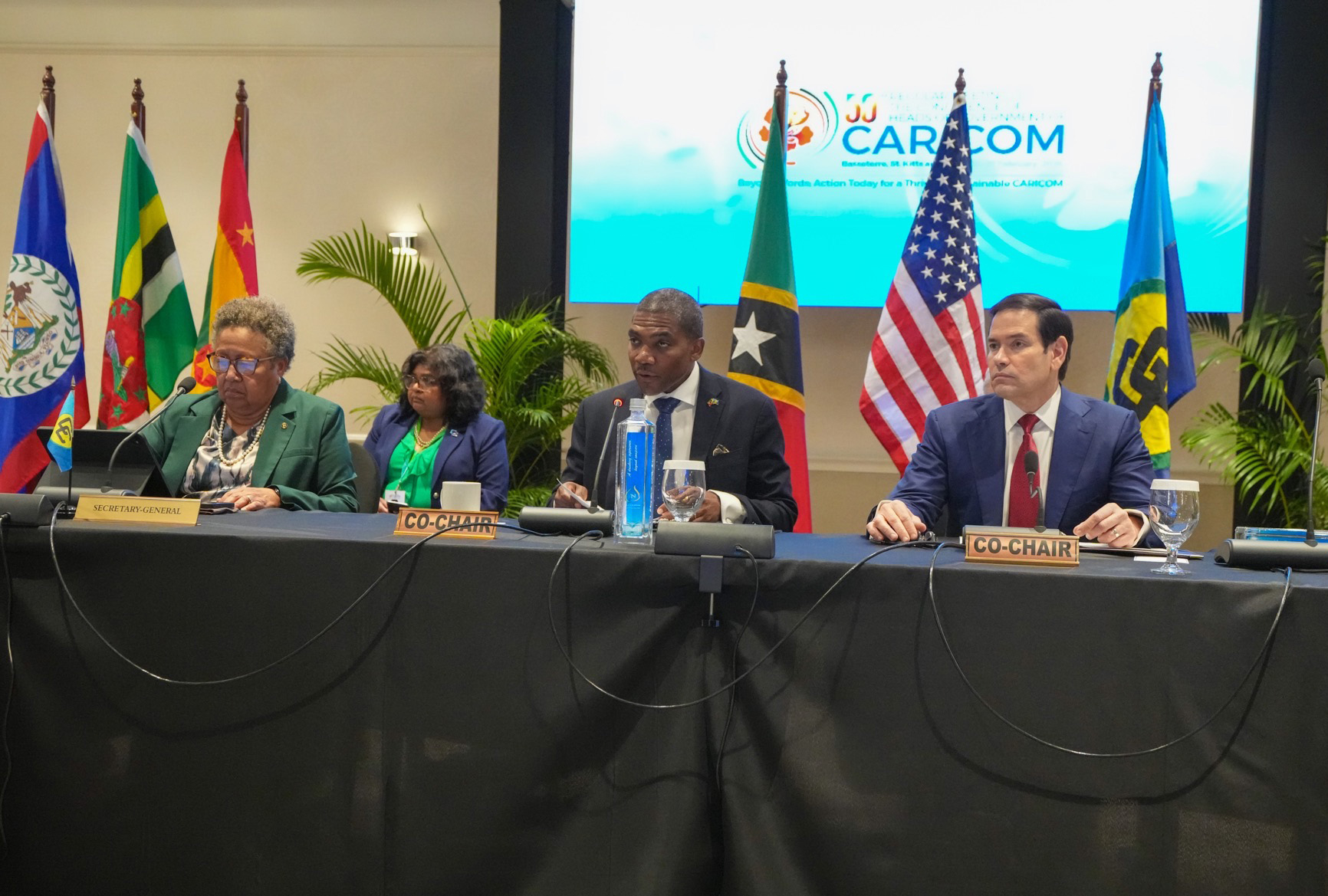
At its 34th Regular Meeting held in Trinidad and Tobago in July 2013, the 15 member states of the Caribbean Community (CARICOM) voted unanimously to launch a movement to demand, according to its June 2026 “Manifesto,” “reparations from the United Kingdom, Europe, and all enslaving nations (our emphasis), for their role in over 400 years of native genocide, chattel African enslavement, and violent extractive colonialism.” The “Manifesto” even cites Capitalism and Slavery, the classic book by Trinidad and Tobago’s former Prime Minister, Dr. Eric Williams.
CARICOM also opposed the U.S., Canada, and France-backed coup d’état in 2004 against elected Haitian President Jean-Bertrand Aristide, and for years, called for the Caribbean to be a “Zone of Peace,” and praised and defended the Cuban Medical Brigades, which brought first-class healthcare to many Caribbean nations.
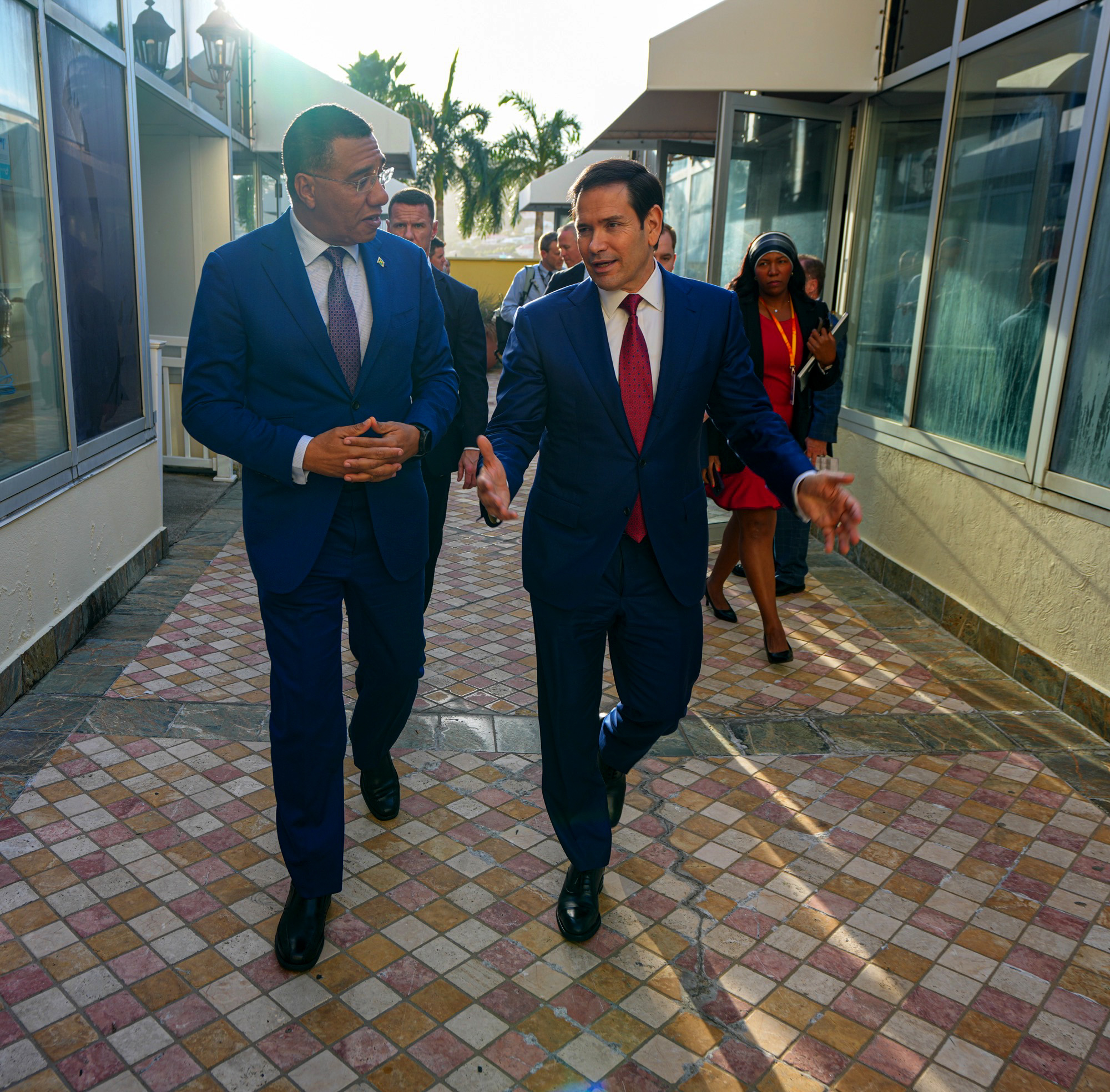
But today, as Washington launches a new offensive to smash any nation challenging U.S. hegemony in the Western Hemisphere, CARICOM is not just offering no resistance. It is rapidly retreating from its incipient anti-imperialist positions, adopting Washington’s directives for their domestic policies, and increasingly playing the role of the U.S. empire’s handmaiden.
CARICOM supplanted and subsumed by the “Shield of the Americas”
U.S. Defense Secretary Pete Hegseth (or as he calls himself “Secretary of War”) recently told reporters that “anywhere you traffic drugs or you threaten the American people or our partners, you are a target just like ISIS or Al Qaeda.” (His comments may seem contradictory, as Washington last year helped install a former Al Qaeda and ISIS lieutenant as president in Syria.)
Threatening violence against any perceived threats to U.S. interests in its “backyard,” Hegseth’s statement came three days after the U.S. Southern Command (SouthCom) announced that it was replacing its Operation Southern Spear with the “Joint Task Force-Western Hemisphere” (JTF-WHEM).
Operation Southern Spear (which blew up at least 67 small boats, killing some 221 people, in the Caribbean and East Pacific) was based on Trump’s National Security Strategy, which states that the U.S. government wants “a Hemisphere whose governments cooperate with us against narco-terrorists, cartels, and other transnational criminal organizations; we want a Hemisphere that remains free of hostile foreign incursion or ownership of key assets, and that supports critical supply chains; and we want to ensure our continued access to key strategic locations.”
The manufactured threat of “narco-terrorism” has been the justification for imperialist attacks on sovereign nations in Latin America and the Caribbean, primarily Venezuela and Cuba. “Hostile foreign incursion or ownership of key assets” refers to investments by China and, to a lesser degree, Russia, in the Western Hemisphere. “Key strategic locations” are those countries whose governments in May 2026 have joined the Washington-concocted “Shield of the Americas” coalition, as well as those which SOUTHCOM has targeted as somehow contributing to “terrorism” in the region.
In addition to the U.S., the Shield of the Americas coalition includes Argentina, Bolivia, Costa Rica, Dominican Republic, Ecuador, El Salvador, Honduras, Panama, Paraguay, Chile, Colombia, Guatemala, and Peru. One is not surprised by this a mix of neoliberal and fascist Latin American governments, many of which came to power through U.S. election engineering. But the coalition also includes one-third of the CARICOM member nations: the Bahamas, Belize, Guyana, Jamaica, and Trinidad and Tobago.
The Shield of the Americas functions as the political front for U.S. imperialist objectives in the Western Hemisphere.
The U.S. offensive comes ashore
New York Times reporter Maria Abi-Habib interpreted SouthCom’s announcement of JTF-WHEM as a move from “boat strikes from international waters to sovereign inland territories across the region.”
This interpretation was challenged by Drop Site News’ Camila Lourdes Galarza, who pointed out that this “isn’t Southern Spear’s first expansion into land ops. In March, the Pentagon bombed a dairy farm while Ecuadorian troops waterboarded the farmworkers. Ecuador has been the proving ground for the Donroe [Doctrine,] and the media silence has severely compromised all analysis of the region.”
Indeed, Galarza could also have pointed to Haiti, where Erik Prince’s new Blackwater outfit, called Vectus Global, has conducted a deadly Kamikaze drone war that has repeatedly massacred civilians. It was made clear in recent U.S. Congressional hearings that Vectus Global is a “tremendous partner” of the Pentagon’s Southern Spear operations in Haiti.
According to recent reports, Vectus Global mercenaries, along with the Canadian, U.S., and French trained Haitian National Police (PNH) and their allied paramilitary brigades, have killed the vast majority of innocent Haitians in 2025 and 2026.
In addition, the illegitimate, U.S.-installed government of de facto Prime Minister Alix Didier Fils-Aimé in Haiti has allowed the U.S. military forces to begin deploying on Haitian soil as part of Operation Southern Spear, first through taking control of Haiti’s main airport in Port-au-Prince, followed by the arrival in May of U.S. soldiers in the northeast town of Ouanaminthe.
Nonetheless, JTF-WHEM will inevitably lead to a sharp escalation in imperialist violence in the region.
The catch-all excuse of “Narco-Terrorism”
A key component of the propaganda campaign to justify Operation Southern Spear and the JTF-WHEM was the merger of the “War on Drugs” with the “War on Terror,” resulting in an imaginary new enemy called “Narco-Terrorists.”
The first “key strategic location” attacked was Venezuela, where the Jan. 3 kidnapping of President Nicolas Maduro and the subsequent government take-over has reduced the revolutionary Bolivarian Republic to what Venezuelan activist William Camacaro describes as a “quasi neo-colonial country of the United States.”
The campaign against Maduro began with the Trump administration’s claim – later withdrawn – that he was the leader of a “narco-terrorist” organization, Trende de Agua. The Trump administration has also justified its vicious fuel blockade on Cuba over the government’s non-existent role as a “state sponsor of terrorism.”
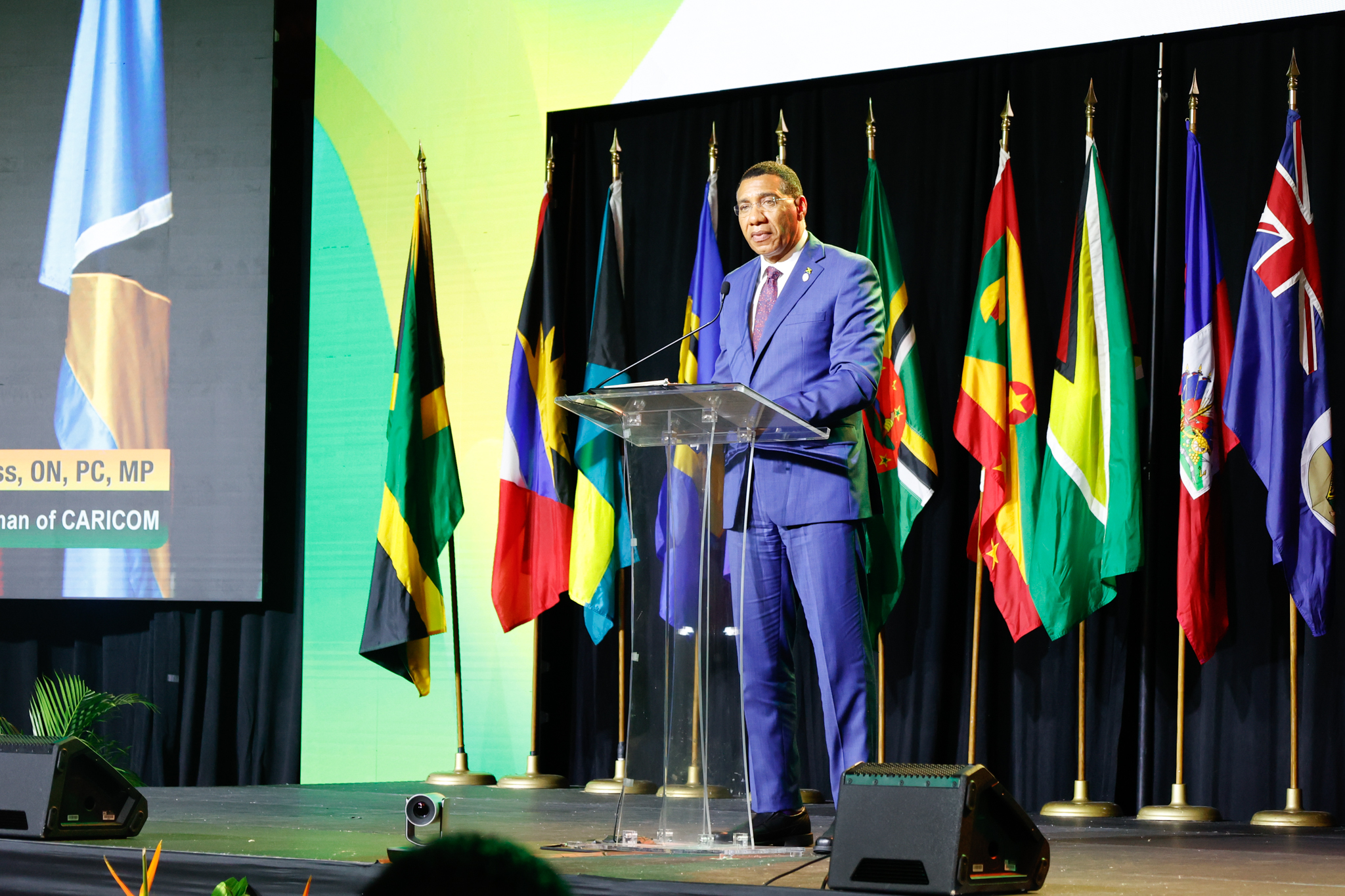
CARICOM leaders have played a key diplomatic role in deploying this new strategy in the Caribbean. In doing so, these leaders have threatened their own national sovereignty and undermined the organization’s stated goal for the Caribbean to remain a “Zone of Peace.” The governments of Jamaica, Trinidad and Tobago, and Barbados have led these efforts, turning the Caribbean into a “Zone of War.”
CARICOM conversion into U.S. imperialist proxy
CARICOM used to voice its opposition, however timid, to U.S. imperialist actions and policies in their region.
Following the U.S., French, and Canadian-backed coup against Aristide in 2004, CARICOM demanded an investigation and refused to recognize the illegitimate de facto government that Washington installed. For a brief moment, Haitian sovereignty seemed to be valued by CARICOM’s leaders.
CARICOM leaders have played a key diplomatic role in deploying this new strategy in the Caribbean. In doing so, these leaders have threatened their own national sovereignty and undermined the organization’s stated goal for the Caribbean to remain a “Zone of Peace.”
Twenty years later, CARICOM has facilitated U.S. imperialism in Haiti by supporting efforts to install the illegitimate Transitional Presidential Council (CPT) in April 2024. Cobbled together without Haitian representation and behind closed doors by CARICOM under the guidance of U.S. Secretary of State Anthony Blinken, the CPT was made up of representatives of various political parties and coalitions which serve the interests of Haiti’s bourgeoisie and Washington.
CARICOM also provided declarations of support and personnel for the Multinational Security Support Mission (MSS), which deployed the same year. The MSS, staffed largely by police from Kenya and some Caribbean countries, served as Washington’s military occupation force in Haiti.
Tasked with combating “gangs,” in reality, the MSS was to protect the CPT against an armed insurrection and a population which rejected it.
In 2024, Dr. Jemima Pierre argued that the U.S. needed to maintain its control of Haiti for its strategic importance and “the further militarization of the Caribbean and Latin American region in preparation for its confrontation with China”.
Two years later, as humanity hurdles toward another World War, Dr. Pierre’s prediction appears to be unfolding. Many CARICOM leaders are undermining their national sovereignty by signing security agreements with Washington, which aims to stop China’s Belt and Road initiative in the region.
Regional deals to counter China
China has made great inroads in the Caribbean, inking deals with important players like the Dominican Republic, Trinidad and Tobago (T&T), and Jamaica.
Three years ago, under the Biden administration, Jamaican Prime Minister Dr. Andrew Holness participated in two key meetings that promised new investments from the U.S. if Holness toed the line on U.S. objectives in the Caribbean.
CARICOM leaders have threatened their own national sovereignty and undermined the organization’s stated goal for the Caribbean to remain a “Zone of Peace.”
On Dec. 5, 2023, Holness met with then National Security Advisor Jake Sullivan to discuss, among other matters, “combating transnational criminal organization and the trafficking of illicit drugs and firearms” (more on this later). One week later, on Dec. 13, 2023, Holness also met with the U.S. International Development Finance Corporation (DFC) CEO Scott Nathan, to “deepen” the two countries’ economic relationship.
About one year later, Jamaica’s Finance Minister Dr. Nigel Clarke celebrated “10 major infrastructure projects valued at US$2 billion” resulting from MOU’s signed with the DFC. This was Clarke’s final agreement as Minister before taking on the position of Deputy Managing Director of the International Monetary Fund (IMF).
DFC Chief Policy Officer Caroline Vik met with Jamaican government officials in July 2026 promising billions more in investments. While no details have been announced, DFC related projects will inevitably lead to neoliberal policies, mobilizing private investment designed to compete with China’s Belt and Road initiative.
But for now, both Jamaica and T&T remain part of China’s Belt and Road initiative.
CARICOM leaders declare local gangs to be “terrorist” organizations
After coming to power in January 2025, the Trump administration began to identify “terrorists” everywhere.
In late February 2025, CARICOM’s member nations agreed to introduce legislation in their respective countries that would classify local gangs as terrorist organizations.
A year and a half later, however, not one CARICOM leader has followed through. In fact, CARICOM’s Montego Bay Declaration published in early July 2025 did not explicitly classify gangs as terrorists, stating simply that each member nation reaffirmed their commitment to “a comprehensive review of the criminal justice system.”
This lag in passing legislation is not a result of bureaucratic gridlock, second thoughts, or shifting priorities. CARICOM’s declaration reflected its acceptance of the U.S. government’s plan to militarize the Caribbean and Latin America. In any event, the body’s acquiescence to Washington’s politically-motivated reclassification of local gangs as “terrorist” groups has allowed the U.S. military to begin militarizing the Caribbean and to occupy nations in the Caribbean and neighboring Latin America.
This tacit agreement has completely undermined CARICOM’s stated desire to remain a “zone of peace,” which CARICOM leaders (with the exception of T&T) had reaffirmed only three months before agreeing to reclassify local gangs as “terrorist” groups.
Specific leaders within CARICOM played significant roles in this process. First among them is Jamaica’s Holness, following a fire-bombing of several homes in Spanish Town in April 2023. After acknowledging that the attackers were members of a local community, Holness told journalists that the fire-bombing was committed by “terrorists,” and they should be treated as such.
It was former T&T Prime Minister Keith Rowley, however, who led the effort at CARICOM to have local gangs reclassified as “terrorists.”
During the first Trump administration, Washington targeted T&T as the nation, per capita, which “has the greatest number of foreign fighters from the western hemisphere in ISIS.” That policy carried over into the Biden administration when the State Department hit the twin-island nation of 1.3 million with a level 4 travel advisory in 2021.
The travel advisory specifically mentioned the threat of gang violence and “terrorism,” going as far as to list specific regions of T&T where the perceived threat was highest. These regions also happened to be governed by elected members of Rowley’s ruling party.
Rowley rejected the notion that terrorism was a threat domestically. However, the opposition party, the UNC, used the travel advisory to attack his government, stating: “It is only a matter of time before the PNM [People’s National Movement, Rowley’s party] turns the whole of Trinidad and Tobago” into a “crime hell-hole.”
By 2024, Rowley relented to the U.S. pressure and became an advocate for the notion that gang violence was a form of “domestic terrorism” rather than criminality. At a press conference, Rowley explained that because the violent acts committed by local gangs “endanger people indiscriminately, that is what makes them an act of terror.”
In late 2024, Rowley became CARICOM’s leader in its “quasi-cabinet” on Crime and Security, whose goal was to develop a consensus among CARICOM states that local gang violence ought to be reclassified as “terrorism.”
Rowley was immediately backed by Holness. At the same press conference, he told reporters that he “only need to point to the situation in Haiti” and other CARICOM countries “with gangs that are arming themselves deliberately, stockpiling weapons, seeking to capture communities, and to corrupt public officials. That should not be considered ordinary criminality. That is a threat to the state and Caribbean nations must face that squarely and call it what it is, these are acts of terror.”
Labeling gangs as “terrorist” groups allows leaders to ignore criminality’s roots
Holness denies the roots of gangs, explaining to journalists at a separate event that he sees the violence perpetrated by gangs in Jamaica as “organized violence in our community” committed by “ gang members whose sole existence is to create mayhem and chaos, and that…is the definition of terrorism.”
Criminal gangs have been present in Jamaica for many decades. Jamaica also suffers from one of the highest murder by firearm rates in the world. While research has shown that gangs are caused by socioeconomic indicators such as poverty and unemployment, a recent increase in gang-related violence has also been fueled by an influx of illegal firearms.
Holness’ plan to label gangs “terrorist groups” and escalate violence in poor neighborhoods to kill gang leaders will not address the root problems.
Labeling all gangs and armed groups as “terrorists” also denies the complexity of their relationship to the communities in which they are based. Undeniably, some of these gangs are criminals who harm their communities’ residents. But it is also clear that some of the leaders who have been labeled as “gang leaders” in Caribbean countries serve the role of community leaders.
For example, Akido “Sunday” Williams, who lives T&T’s Port of Spain, discourages youths from engaging in violence. Yet he is one of many community leaders whom the police have labeled as a gang leader.
The same goes for some leaders within the Viv Ansanm (Live Together) armed group coalition in Haiti. Leaders, like Jimmy “Barbecue” Cherizier have emerged from community defense brigades and support their local community in many ways.
Outsiders should have no illusions about what labeling local gangs and armed groups as “terrorists” means: those so branded are targeted for assassination, while the local communities in which they live are terrorized by police. And increasingly, the police forces are supported by the U.S. military, arguably the planet’s greatest terrorist organization.
Caricom’s decision to embrace reclassification of gangs as “terrorist groups” plays into Washington’s imperialist goals
In Haiti, Erik Prince’s Vectus Global mercenaries, the PNH, and their paramilitary brigades have massacred hundreds of innocent shanty town residents while claiming to target armed group leaders, of whom they have yet to kill even one. If they did, the instability caused by a successful assassination would inevitably lead to an escalation in violence.
This is exactly what occurred when Othneil “Thickman” Lobban was killed by police last year in Jamaica. An immediate curfew had to be imposed because of a spike in violence. More importantly, the murder of a gang leader simply continued the cycle of violence, as a new leader is quickly selected. A recent report from the Jamaican Observer lists several gang leaders who were killed over the past 20 years, only to be replaced by another from a “revolving door” of other leaders.
Meanwhile, both of the major gangs in Spanish Town, Jamaica are believed to have ties to the two main political parties, a feature of gangs that is routinely ignored in these policy discussions.
The focus on assassinating leaders of criminal gangs and armed groups also sidesteps the most significant factor that fuels gang violence aside from socio-economic factors – the flood of firearms into the Caribbean.
While Holness points to Haiti as a major source of trafficked firearms – although the evidence to support this belief is scant – CARICOM leaders understand that these firearms originate in the United-States.
A December 2025 report by CARICOM and the Implementation Agency for Crime and Security (IMPACS) found that: “Maritime consignments from the United States are a primary vector for illicit trafficking, with procurement clustered in small southern areas, primarily in Florida.”
Other studies have shown that firearms are also being smuggled out of Georgia, New York, and Maryland.
Indeed, in an April 2023 press release, CARICOM leaders declared that the “increase in the illegal exportation of guns from the United States of America” was a “direct threat to our democracy.” CARICOM directly blamed the illegal importation of firearms for “the disproportionate share of our national budgets that we are compelled to allocate to measures to address crime, violence and national security as well as mental health and other health-related challenges.”
Clearly, CARICOM leaders understand the cause of the persistent rise in gun-related crimes. Yet these same leaders have been reticent to call out the Trump’s reluctance to pour resources into preventing the flow of guns into the Caribbean.
Instead, the Trump administration fired the first U.S. Coordinator for Caribbean Firearms Prosecutions in October 2025. This prosecutor’s responsibilities have since been handed down to staff in the various U.S. embassies in the Caribbean.
The flood of guns into the Caribbean has actually helped create the conditions that have, at least in part, prompted leaders to comply with Washington’s imperialist policies.
Meanwhile, CARICOM leaders who have been the most compliant with the Trump administration’s aggressive policies in the Caribbean have seen the U.S. increase investments in their countries.
Mia Mottley tries to have it both ways
Barbados’ Prime-Minister Mia Mottley has played a significant role in furthering Washington’s aims in the Caribbean.
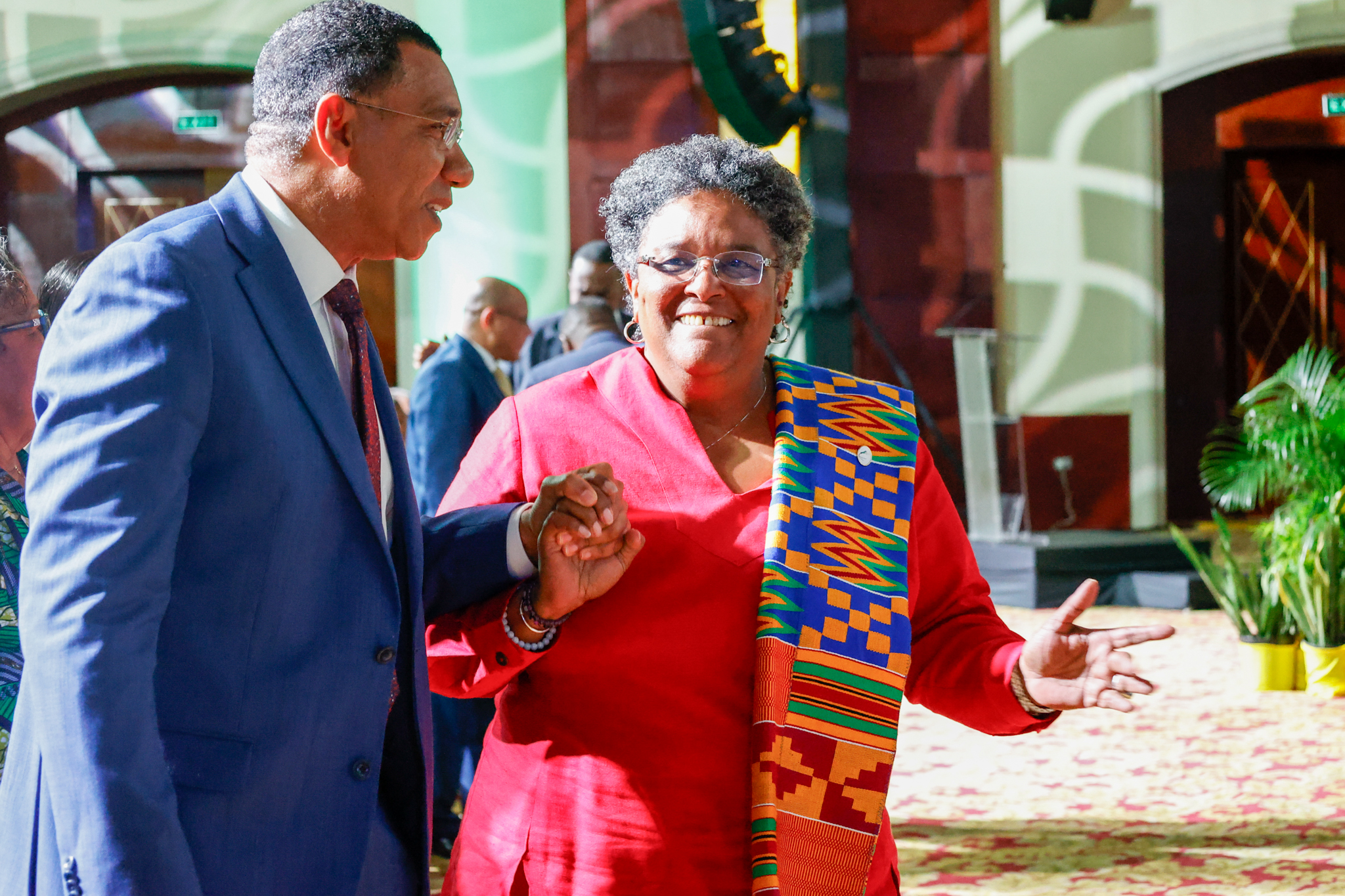
Mottley is a vocal proponent of maintaining the Caribbean as a “Zone of Peace.” Several of the policies she has endorsed, however, have had the opposite effect.
While Barbados has not signed to the Joint Security Declaration presented at the inaugural meeting of the “Shield of the Americas,” she has endorsed the notion that local gangs ought to be reclassified as “terrorist” groups.
Speaking at the same press conference where Rowley declared local gangs ought to be considered “terrorist,” Mottley explained that “this is not something we wanted to do, but it is imperative now.”
Mottley also did not hesitate to point to Haiti as a justification for supporting U.S. policy in the Caribbean. Mottley played a significant role in supporting the creation of the unconstitutional, UN-blessed but U.S.-led and -funded MSS.
New Trinidadian PM champions U.S. Imperialism in the Caribbean
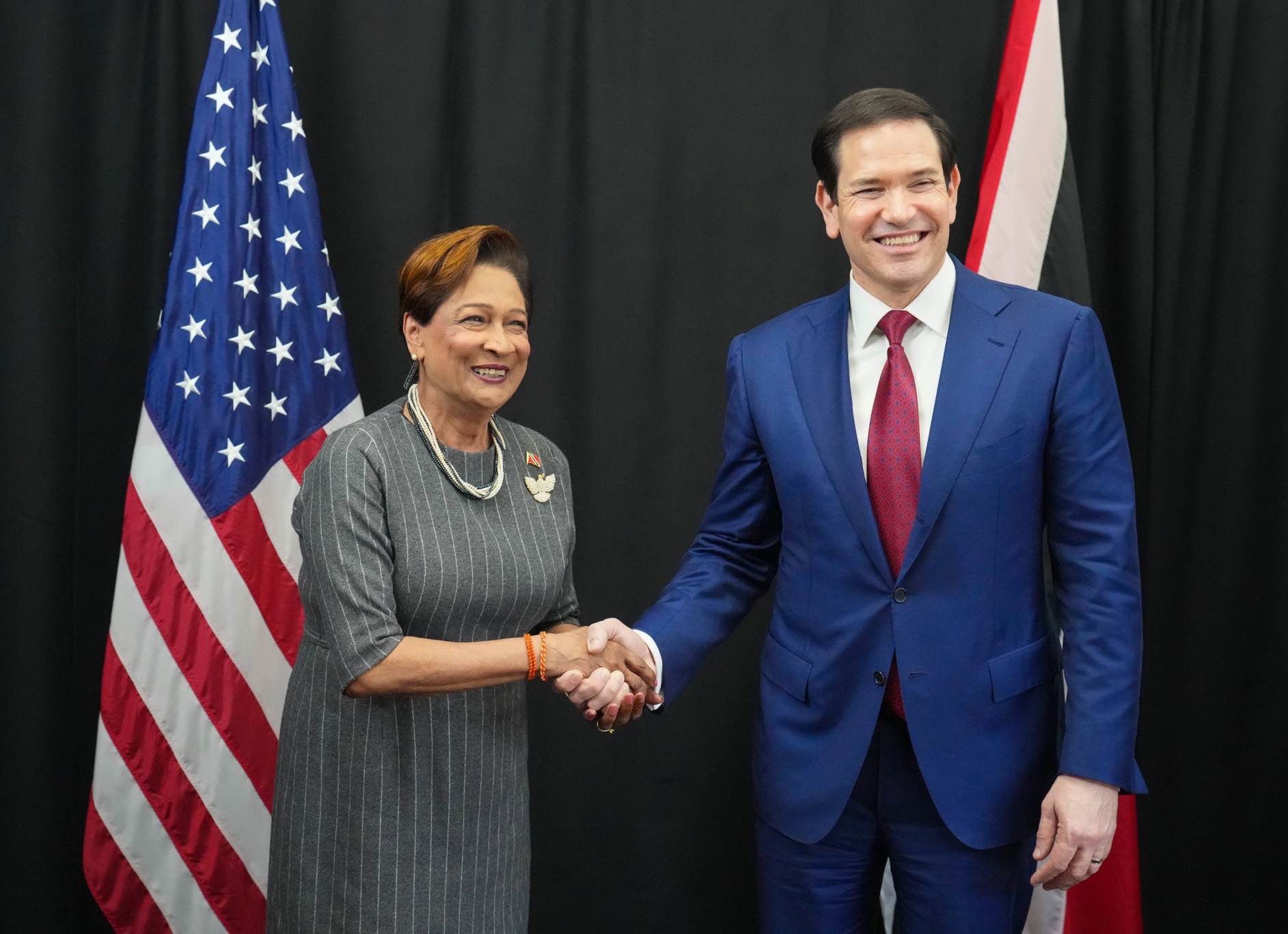
The most zealous member of the Shield of the Americas in the Caribbean is T&T’s current Prime Minister Kamla Persad-Bissessar.
Persad-Bissessar welcomed the USS Gravely, an Arleigh Burke-class destroyer, into T&T’s Port of Spain and was enthusiastic about training exercises that U.S. forces planned to conduct with T&T forces.
She has also welcomed the construction of a U.S. military installation in T&T, which Persad-Bissessar describes as a U.S. radar station with a “support office” staffed by U.S. troops.
When asked about the Trinidadians who were killed in a U.S. Southern Spear air strike on their boat, allegedly for trafficking drugs, Persad-Bissessar told journalists that the U.S. should kill all those engaged in the illegal drug trade “violently,” disregarding the need to provide evidence for its claim that the murdered citizens were indeed trafficking drugs.
Just like Holness, Persad-Bissessar is dismissive of the view that gang violence is primarily rooted in socioeconomic realities and fueled by the availability of guns.
Persad-Bissessar points to the fact that T&T “had over 600 murders last year and almost every year counting.” She is dismissive of those who “have not had that experience” and insists that “the reality is we are crime-ridden, we are drug-ridden.”
Despite Persad-Bissessar certainty that drugs are fueling gang violence, a 2019 report by the University of South Wales concluded that there “is little evidence to suggest that the spike in violence in Trinidad and Tobago is primarily drug-related.” Instead, the report emphasized a violent street culture, an under-resourced criminal justice system, police corruption, and competition among criminal gangs for government contracts.
Homicides spiked in T&T in 2024 with over 600 murders. Winston Dookeran, former T&T minister of foreign affairs and retired professor of practice at the University of the West Indies, explained that “at the core” of the rise in violence from organized criminal groups “is the ease of trafficking high-powered small arms and ammunition.”
Persad-Bissessar is unmoved by these analyses, choosing to brush aside the root causes of gang violence in order to draw in investment from the U.S. and its allies.
Indeed, journalist Erica Caines pointed out that the T&T government’s neoliberal policies have exacerbated social inequalities, fueling existing social unrest. “Emphasizing privatization, deregulation, and reduced government spending, these policies have widened income inequality and weakened social safety nets,” Caines argues. The result is “insufficient governance and failing state institutions further marginalize the most vulnerable, perpetuating cycles of poverty and crime.”
Yet Persad-Bissessar seems determined to follow the same failed neoliberal policies, welcoming billions of dollars in investments from U.S. companies. The T&T government recently announced three memoranda of agreements in July 2026. These include a 300-megawatt data center, a proposed artificial intelligence infrastructure and data center project, and refurbishing a steel manufacturing plant.
This announcement came shortly after the World Bank agreed to establish an office in T&T. Minister of Planning, Economic Affairs and Development, Dr. Kennedy Swaratsingh believes this “will unlock major financing for T&T’s private sector.”
Support for U.S. military expansion and political dictates leads to major investments
Like Persad-Bissessar, Holness has played a key role in facilitating the Trump administration’s “national security” policies in the Caribbean, including Operation Southern Spear and JTF-WHEM.
Holness recently took another step towards transitioning Jamaica to the role of a leading neocolony by opening the door to the permanent presence of U.S. forces on Jamaican soil.
On Aug. 20, 2025, the two governments announced a “Status of Forces Agreement” (SOFA). According to the Jamaica Observer, the SOFA “establishes the terms under which members of the United States Armed Forces may be temporarily present in Jamaica for mutually agreed activities, including training exercises and joint operations.”
Holness also shamelessly expelled 277 Cuban doctors in March, 2026 following pressure from the Trump administration. (He at first resisted.) This ends nearly 50 years of cooperation under the Health Agreement. Jamaica is one among five Caribbean countries which have ended their health agreements with Cuba under Washington’s pressure. (Interestingly, T&T has refused to end their medical study program with Cuba, and, in Haiti, where Cuban doctors have saved hundreds of thousands of lives over 30 years, the de facto government has not asked Cuban doctors to leave.)
Jamaica plays key CARICOM role in subjugating Haiti
In the aforementioned meeting with Jake Sullivan, Holness was thanked for “his steadfast support for a Multinational Security Support mission to Haiti and Jamaica’s leadership in facilitating an inclusive political dialogue among Haitian society.” Holness hosted the meeting where Blinken orchestrated the CPT’s formation.
Indeed, Holness has played a significant diplomatic role in the Caribbean to facilitate U.S. imperialist policy aims for Haiti.
For example, Uzra Zeya, Undersecretary for Civilian Security, Democracy, and Human Rights under former President Joe Biden, lauded Holness for “the international leadership that Jamaica is showing in its public commitment of 200 personnel” for the MSS.
More recently, Trump’s Secretary of State Marco Rubio praised Holness at a joint press conference in March 2025: “I can think of no better friend in the Caribbean and frankly in the Western Hemisphere than Jamaica and your government, Mr. Prime Minister.”
In his speech, Holness praised the U.S. government’s “instrumental” role in Jamaica’s fight against organized crime. He also emphasized the two countries “significant policy alignment” in regard to the “global war on gangs.”
Holness also identified the “extraordinary humanitarian, civil, and national security challenges” in Haiti as an “acute threat” to Jamaica, saying he looked “forward to continued partnership with the United States” on Haiti.
This “continued partnership” has seen Holness lead diplomatic efforts to pursue Washington’s imperialist goals in Haiti.
In May 2025, Marco Rubio branded the Viv Ansanm as a “terrorist” organization.
CARICOM provided a rubber-stamp for the CPT and the MSS. Later, CARICOM threw its support behind Rubio’s expanded Gang Suppression Force (GSF) that replaced the MSS in October 2025.
By agreeing with Rubio’s labeling of Viv Ansanm as “terrorist” and reclassifying his own local gangs as homegrown “terrorists,” Holness can now claim that a foreign terrorist organization is importing firearms into Jamaica, providing further justification for the U.S. to grow its military presence in the region to combat the “acute threat.”
The Trump administration’s classification of Viv Ansanm and Gran Griff (in Haiti’s Artibonite Valley) as Foreign Terrorist Organizations is also intended to prevent formal dialogue between the armed groups and authorities. This prolongs the violence and massacres that the PNH, their associated paramilitary brigades, and Prince’s Vectus Global soldiers-of-fortune are committing against residents of territory governed by armed groups.
Their strategy is clear: murder and terrorize the residents of these popular neighborhoods in Port-au-Prince until they revolt against the local armed group leader.
Armed group leaders in Viv Ansanm have made repeated requests for formal dialogue with authorities.
Meanwhile, Haiti’s bourgeoisie and political class continue to benefit from the violence. Political leaders suspected of arming and funding criminal armed groups remain the staunchest opponents of dialogue with armed groups. Is it any surprise that some of these same politicians endorsed designating Viv Ansanm as a terrorist organization?
The decision by CARICOM to embrace the reclassification of gangs as “terrorist groups” not only plays to Washington’s imperialist goals by opening up their countries to occupation by U.S. forces; it also prevents meaningful social change by forbidding dialogue with gangs or armed groups, which is the path that can lead to peace and social change that benefits the poor and working-class.
The demonization of Haiti’s armed groups as “terrorists,” growing neoliberal reforms, and an increasing military presence and tactics virtually guarantee an escalation of violence in the poor neighborhoods where the armed groups reside and ignores the central problem of the constant influx of firearms from the U.S. into the Caribbean.
Travis Ross is based in Montreal, Québec. He is also the co-editor of the Canada–Haiti Information Project. Travis has written for Haiti Liberté, Black Agenda Report, The Canada Files, and TruthOut. All his articles are collected on Substack. He can be reached on X.