


(Français)
On Mon., Apr. 2 at about 11 a.m., agents in an armored vehicle, at the corner of Avenue Monseigneur Guilloux and Rue Tiremasse in Belair, fatally shot and wounded a motorcycle taxi driver, about 30 years old according to witnesses, leaving him to die in agony over the course of about 20 minutes.
Local residents did not know whether the gunmen who committed the cold-blooded murder were Haitian National Police (PNH) officers or soldier-of-fortune magnate Erik Prince’s Vectus Global mercenaries. Most people hide when their patrols come around.
The driver and a colleague had just purchased some second-hand clothes (called “pepe” in Kreyòl) on the “piste” (runway), an area at the junction of the Croix-des-Bossales market and Avenue Haile Selassie, which used to be the capital’s Bowen Field airport.
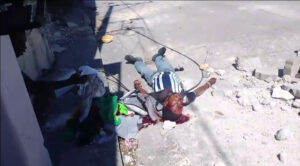
The “char” (armored car) shot the two men as they were on their way on the motorcycle to sell their used garments – shirts, pants, and shorts – on Avenue John Brown, colloquially known as Lalue. The other man, about 40 years old, bleeding, dragged himself away on his belly towards Rue Tiremasse, where he died.
“Is it only here in the ghettos that they kill so many people like this?” asked a young man who was watching the fatally wounded motorcycle driver die. “I have learned that there is an online media team who are helping us get this message out [a reference to Haïti Liberté among very few other outlets like the Whatsapp channel Verite Presizyon] because the world should see how people are dying here.”
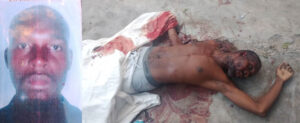
Marc Arthur “Toto” Alexandre, known as Belair’s spokesman, could not determine the identity of the two slain clothing vendors, and the driver’s corpse was chewed on by dogs.
“Now in Haiti, dogs do your funeral,” Alexandre explained sardonically. “When you die in a neighborhood where you are unknown, your body remains in the street, and dogs eat you… He was a poor guy, like the other guy… and their families, if they knew, were afraid to come.”

Belair had a particularly terrible month in January, when PNH/mercenary units killed many people, often in their homes, with roving armored vehicles and drones.
One of the worst days was Jan. 29, the day after Haïti Liberté had published a long article on the carnage there. Alexandre updated Haïti Liberté with photographs of six victims from that day.
Jackson Aupont, 41, was killed by a char sometime between 8:00 and 9:00 a.m. on Thu., Jan. 29.
Frizner Jean-Charles, who would have turned 44 on Mar. 28, was killed between 4:00 and 5:00 a.m. that day.
Jocelyn Jonka, 66, was gunned down by a joint team of cops and mercenaries, also between 4:00 and 5:00 a.m. the same day.

Alexandre could not remember the name of one of the victims killed, but believes he went by the nickname “Fanfane 1983.”
Marc Antoine Prosper, whose family had fled the area, was also killed between 4:00 and 5:00 a.m.. He was 61 years old and had sold bread and pushed a hand-cart (bourèt) for a living.

Unidentified victim #2, whose family Alexandre and his neighbor could not find, was also killed between 4:00 and 5:00 a.m..

Another poor neighborhood targeted by the PNH and Vectus Global is Martissant. On Mar. 25, an unidentified middle-aged woman was grievously wounded in the head when a police drone struck her home. Two men tried to transport her to a hospital, but she died en route.
Previously, on Mar. 19, in downtown Port-au-Prince, two unidentified hand-truck pushers (bourètye) were senselessly gunned down by a PNH patrol.

While there is almost no coverage of this carnage by the U.S. or Haitian bourgeois media, on Apr. 10 the New York Times did publish an op-ed by Diego Da Rin and Renata Segura of the International Crisis Group (ICG), a prominent establishment think-tank.
The piece obliquely recognizes that the bloody police and mercenary crackdown in Haiti’s shanty towns may be counterproductive and urges the government to “strike the right balance between a show of might and a readiness to negotiate.”

“By turning to foreign contractors and the use of armed drones, [de facto Prime Minister Alix Didier Fils-Aimé’s] government has helped put gangs on the defensive and sent some of their leaders into hiding,” Da Rin and Segura argue. “But those same tactics are perilous for bystanders, dozens of whom have been killed over the past year by drones alone.”
In fact, there has been a dramatic escalation in police massacres in downtown Port-au-Prince since January.
The op-ed authors approve of the growing deployment of the Washington-concocted-and-directed Gang Suppression Force (GSF), but recognize that “while foreign troops could help Haiti’s embattled government… weaken the gangs,… force alone will not rid the country of these groups.”
Instead, “once the balance of power on the ground has shifted, the Haitian authorities should be prepared to turn to the negotiating table if they want to see these groups dismantled for good,” the authors conclude.
“Haiti can’t drone strike its way to peace — especially not when bombing gang targets might mean [and has meant!] killing children. Bringing gang members back into society won’t be easy. But force alone will only prolong the country’s ordeal.”

While Fils-Aimé and his ruthless troops may have taken back downtown Port-au-Prince for now, conflicts are increasingly popping up in Haiti’s countryside. On Mar. 28 and 29, in the rice-growing Artibonite Valley, battles between the Gran Grif (Big Claws) armed group, allied with the Viv Ansanm (Live Together) alliance of greater Port-au-Prince, and a pro-government armed group called Ti Mepris (Little Contempt), allied with the PNH-auxiliary Kowalisyon (Coalition), resulted in somewhere between five and 20 people killed (human rights groups like the National Network for the Defense of Human Rights or RNDDH greatly exaggerated the death toll up to 70).

Meanwhile, on the night of Apr. 13, an unidentified armed group attacked, sacked, and made off with weapons and jeeps from the PNH station in Seguin, a remote rural town outside of Jacmel. Both cops and civilians were killed in the assault, and many houses and cars were burned. While some of the press has attributed the attack to the Viv Ansanm, the group has not claimed responsibility and its president and principal spokesman, Jimmy “Barbecue” Cherizier, has rarely emerged from the silence he has kept since his house was blown up and he was driven from his Delmas 6 neighborhood in mid-January.

While the lines of battle in Haiti are shifting and the nation’s future decidedly unclear, it is significant that the U.S. establishment’s ICG acknowledges the need for negotiations that Cherizier has been regularly proposing for the past two years, with statements like: “The only thing that can extract Haiti from the hole it is in right now is dialogue. Let us talk to each other and explain what we need.”
As Haïti Liberté columnist Marie-Paule Florestal recently concluded: “Without political representation, input, and participation from the poorest of the poor in the ghettos where Viv Ansanm is based, Haiti will never have real democracy, lasting security, inclusive, lasting development, or social harmony.”