


Nuclear Issue: The False Question
Just as with Gaza— where the narrative in the West has remained stuck on 7 October 2023 (even though the underlying problem dates back decades earlier)—with Iran everything revolves around the nuclear issue. Let us assume, for the moment, that this is indeed the real problem.
“Iran had “rights” under the Nuclear Nonproliferation Treaty to develop nuclear technology […] the Iranians declared that they had the “right” to a full nuclear fuel cycle, including reprocessing of spent fuel. […] No country ‘has a right to dictate nuclear policy to another.’” These words do not come from the mullahs, but rather from Akbar Etemad—the official responsible for atomic energy under the Shah in 1977. The United States eventually overcame its fear that Iran might develop nuclear weapons and moved toward an agreement to construct up to 20 nuclear power plants across the country—noting that the construction of the first 6 to 8 plants alone would generate $6.4 billion for U.S. companies, led by Westinghouse. These negotiations were cut short by the overthrow of the Shah in 1979.
Serving as Secretary of State under Gerald Ford, Henry Kissinger justified this policy in 1976: “The introduction of nuclear energy will serve both the growing needs of the Iranian economy and the objective of freeing up remaining oil reserves for export or for conversion into petrochemical products.”
Yet, while the Iranian mullahs follow exactly the same line as the Shah’s officials did, two decades later—in 2005—Kissinger opined that “For a major oil producer like Iran, nuclear energy is a waste of resources.” When Dafna Linzer of The Washington Post asked him what accounted for this dramatic shift, Kissinger replied: at the time “they were an allied country.”
Akbar Etemad, under the Shah in 1977: “No country has a right to dictate nuclear policy to another.”
Also serving in the administration during the 1970s were Dick Cheney—future vice-president of the United States—Donald Rumsfeld, future secretary of defense, and Paul Wolfowitz, future deputy secretary of defense, all under George W. Bush in 2005. “It is absolutely incredible that the very same players who made those statements then are making completely the opposite ones now,” said Joseph Cirincione, a nonproliferation expert at the Carnegie Endowment for International Peace. “Do they remember that they said this? Because the Iranians sure remember that they said it.” Just as they remember perfectly that it was Britain’s MI6 (Operation Boot) and the CIA (Operation Ajax) that overthrew the democratic government of Prime Minister Mohammad Mosaddegh in 1953—a leader who had dared to nationalize Iran’s oil industry—only to subsequently install the pro-Western monarchy of the Shah.
The rest is history. Since 2003, Israel—and Netanyahu in particular—has tirelessly reiterated that Iran is on the verge of acquiring a nuclear weapon. Chas Freeman, a former U.S. diplomat, recounts: “I was told in 1991 to go to the then crown prince Abdullah when I was ambassador in Saudi Arabia [from 1989 to 1992] and warn him that Iran was two years away from a bomb. That was 1991.”
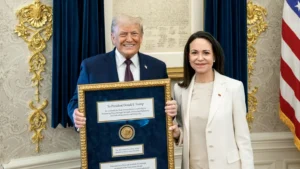
They repeat it even now, months after Trump claimed to have “obliterated” the nuclear program during their attack in June 2025. It is also well known that it was Trump who, in 2018, withdrew from the nuclear deal painstakingly secured in 2015 by the Europeans and the United States. He did so essentially because it was Obama’s legacy—much like a jealous child who wants to destroy someone else’s toy. Just like his obsession with the Nobel Peace Prize he so desperately wanted, and the delighted grin he wore when Venezuelan opposition leader Maria Corina Machado presented him with hers: “Maria presented me with her Nobel Peace Prize for the work I have done. Such a wonderful gesture of mutual respect. Thank you Maria!”
Netanyahu himself declared following their joint attack on Iran last June: “We achieved a historic victory. We removed the nuclear missile threat. We eliminated Iran’s nuclear project and its missile industry.”
So why attack?
The real issue: Israel’s hegemony in the Middle East, and that of the United States globally.
The neoconservatives mentionned earlier had articulated their mission in the Project for the New American Century: “We must ensure support for global U.S. leadership,” founded upon “a bold foreign policy” and a strong military. To quote Dick Cheney—who at the time was Chairman of the well-known company Halliburton: “There seems to be an assumption that, somehow or other, we know what is best for everyone. And that we are going to use our economic power to force everyone to live the way we would like.”
Chas Freeman, U.S. Ambassador, in 1991: “Iran was two years away from a bomb.”
This was in 1996–1997—that is, before the attack on the Twin Towers in New York and the issue of the Iranian nuclear program. And before the 2003 invasion of Iraq, of which Wolfowitz would be the principal architect. This vision, however, does not appear to have changed—albeit that it is now being pursued more crudely and haphazardly by the current gangsters.
Here are the very recent remarks made by Republican Senator Lindsey Graham, whom we quoted in Part 1: “When this regime goes down, we are going to have a new Middle East, and we are going to make a tonne of money […] Venezuela and Iran have 31 percent of the world’s oil reserves. We’re going to have a partnership with 31 percent of the known reserves. This is China’s nightmare. This is a good investment […] [The U.S.] will blow the hell out of these people .”
Graham is so fired up that, during an interview with the austere Wall Street Journal, he admitted to having visited Israel several times, spoken with their intelligence services (“They’ll tell me things our own government won’t tell me”), and advised Netanyahu on how to convince Trump to attack Iran—including by appealing to his ego as a global leader who does not want to appear weak. He did the same with Saudi Crown Prince Mohammed bin Salman, who has always been in competition with Shiite Iran. In general, Graham has campaigned—visiting the White House or playing golf with Trump—in favor of an attack ever since the election results in November 2024.
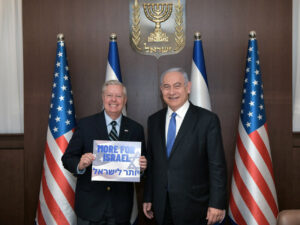
U.S. Senator Lindsey Graham: “When this regime goes down, we are going to have a new Middle East, and we are going to make a ton of money
French demographer-historian Emmanuel Todd delves deeper into this distinction: “Shiism embodies a vision in which the world is a place of injustice that must be transformed. Whereas Sunni doctrine is, so to speak, ‘closed,’ Shiite doctrine is ‘open.’ It possesses a tradition of dissent that, unlike Sunni Islam, values debate.”
Israel, too, harbors a hegemonic agenda. This view was echoed by Mike Huckabee—a Baptist pastor holding a bachelor’s degree from the obscure Ouachita Baptist University in Arkansas (ranked 178th out of 185 colleges in the U.S.)—whom Trump appointed as the U.S. Ambassador to Israel in April 2025. During an interview, he asserted that “Israel is a land that God gave through Abraham” and that “It would be fine if they took it all”—a reference to the “Greater Israel,” a concept defined in 2024 by former Israeli military officer and politician Avi Lipkin: “eventually, our borders will extend from Lebanon to the Great Desert, which is Saudi Arabia, and then from the Mediterranean to the Euphrates […] and then we’re gonna take, I believe we’re gonna take Mecca, Medina and Mount Sinai, and to purify those places.”
Most experts, therefore, agree that the nuclear issue is not the primary concern, and that the so-called negotiations initiated by Trump in April 2025 were a sham. According to Professor Jeffrey Sachs, cited at the beginning of this article, the United States, for one, lacked any experts in the matter—“there is no expert in the room in the US side. Nobody that knows what they’re talking about. No nuclear experts, no one that is involved at a level of understanding what this is really about.”
Why Attack Iran Now?
a) In accordance with their plan for regional domination, “Israel has had the policy that the United States should clear the way of any government in the Middle East that opposes Israel’s hegemony,” explains Sachs. Netanyahu and Senator Lindsey Graham have thus been constantly badgering Trump. Since coming to power in January 2025, Netanyahu has met with Trump seven times! The second-to-last meeting took place at Mar-a-Lago on December 28 and 29, where he told him—as reported by Alastair Crooke, none other than a former member of the British intelligence agency MI6 and European Union Special Envoy to the Middle East—the following:
U.S. Ambassador Mike Huckabee: “Israel is a land that God gave through Abraham”
“Listen, the nuclear issue isn’t the issue. […] The first priority is the Iranian missile system.” According to Chas Freeman—the former U.S. Ambassador to Saudi Arabia, who learned this from an Israeli source—it was at that moment that the timing of the attack was determined.
The most recent meeting took place at the White House on February 11, two weeks before the attack—“a hastily-arranged visit which included a three-hour meeting at the White House, uncharacteristically closed to the press.” Drawing on information published in Hebrew, Crooke—now based in Beirut—recounted in detail to the renowned U.S. journalist Chris Hedges: “Netanyahu was very clear in saying to Trump, ‘If you try and come up with some nuclear way through, look, I’m the one who gives this a kosher certificate. He used those words, kosher certificate. You’re not going to get a kosher certificate for a nuclear agreement anyway. And you know, you know that the right-wing in America will take their lead from me. No certificate, you will be seen to fail. And what’s more, if you don’t do it still, we will do the first attack and let’s see you not join us. Of course, you have no choice. You have to join us.’ So really in some respects you could say that Trump had no option.” This also explains his administration’s endless about-turns in attempting to justify this war to the public, as he cannot publicly acknowledge this.
b) Badr al-Busaidi, Oman’s Foreign Minister and the principal mediator in these so-called nuclear negotiations, had announced significant progress during the final meeting in February: “Now we are talking about zero stockpiling and that is very, very important because if you cannot stockpile material that is enriched, then there is no way you can actually create a bomb.”
That was on Friday, February 27. With the Iranians doing everything in their power to secure an end to sanctions, there was—ironically—a danger that an agreement would be reached, thereby eliminating any nuclear threat and the primary pretext for war. The very next day, Israel and the United States launched their attack.
c) On that same Friday evening, February 27, Trump had just arrived at Mar-a-Lago when he was informed by his intelligence services that they believed they had located the Iranian Supreme Leader, Ayatollah Ali Khamenei, who was scheduled to meet with several of his top advisors in Tehran on Saturday morning.
d) Action had to be taken swiftly to capitalize on the fact that Congress is in Republican hands—the vast majority of whom are afraid to oppose Trump, even if they are against the war. There is a (strong) probability that they will lose their majority in the legislative elections this coming November.
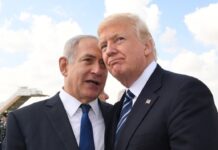
Netanyahu to Trump: “You have no choice. You have to join us.’
On March 1st, Netanyahu was thus able to boast: “In bombing Iran, Israel has now the assistance of the United States, my friend, President Donald Trump, and the US military. This coalition of forces allows us to do what I’ve yearned to do for 40 years.”… And on March 2nd, he added: “I have tried to persuade successive American administrations to take firm action, and President Trump did.”
Thus, if Trump can offer only fanciful reasons for the war—reasons, moreover, that he shifts at any moment, true to form and his short attention span—it is simply because he cannot openly state that the conflict serves to defend Israel’s interests; for, apart from that objective, the war makes no sense for the United States. Yet he attempts to reassure everyone: “He is allowing the hawks to believe the campaign continues, wants markets to believe the war might end soon and his base to believe escalation will be limited.” He is forced to perform verbal acrobatics: “the United States has already won the war, which we’ll win soon, which we haven’t won enough, which is both over and just getting started.” Even more comical are his successive positions regarding the Strait of Hormuz: “we’ve gone from: 1. Don’t need help 2. We need help 3. Why aren’t folks helping? 4. Helps on the way 5. Not telling you who is helping 6. Helps not actually on the way but we don’t need it anyway 7. We may just abandon it and leave it to everyone else.”
In any case, one should take nothing he says at face value.
Other countries are also attempting to obscure Israel’s dominant role—such as the French newspaper Le Monde, which, on March 15, put online an editorial by Gilles Paris titled “Iran: Why the United States Is Attacking Now,” whre he barely mentioning Israel at all—doing so to appease the Israeli lobby and shield Macron. Emmanuel Todd speaks of the taboo that prevails in France against any interpretation that deviates from the “Western” line: “State-run broadcasters (France-Inter, France-Culture, France 2, France 3, La 5, France-Info, etc.) act as particularly active—and incompetent—agents of geopolitical opinion control.”