

The Russians under Tsar Alexei Mikhailovich invaded Ukraine for the first time in 1658 (they were preceded by the Mongols in 1236 and the Tatars from 1450 to 1769, and followed by the French-Greeks-Romanians in 1918).
The French first invaded Algeria in 1830, Senegal in 1855, Tunisia in 1877, Sudan in 1879, the Congo in 1880, Ivory Coast in 1882, Madagascar in 1883, Gabon in 1885, Dahomey (Benin) in 1890, Upper Volta (Burkina Faso) in 1896, Guinea in 1898, and Niger in 1899, Mauritania in 1903, Morocco in 1907, Togo (then under German rule) in 1914, Cameroon (then under German rule) in 1916 – to name only those in Africa.
Chad for the first time in 1891.
“French Equatorial Africa has always been considered the ‘Cinderella’ of our colonies,” the (French) Governor-General told André Gide, advising the future Nobel laureate in literature against going to the Congo and Chad [Gide p. 531]: “Why don’t you go to Ivory Coast instead?” he told me. “Everything is going well there. The results we have achieved are admirable. In the Congo, almost everything remains to be done.”
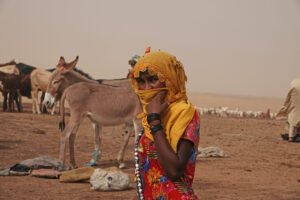
And Gide argues: “The word [Cinderella] is not mine; It perfectly expresses the situation of a colony that could undoubtedly become one of the richest and most prosperous, but which, until now, has remained one of the most miserable and neglected; it deserves to cease being so. In France, they are beginning to take notice of it” [La détresse de notre Afrique Equatoriale, André Gide, Revue de Paris, 15 octobre 1927].
A century after André Gide wrote these lines, we have not seen that anyone has taken notice of it. On the contrary. Coming from Mali and Niger, Chad appears much poorer and more destitute, disorganized and divided.
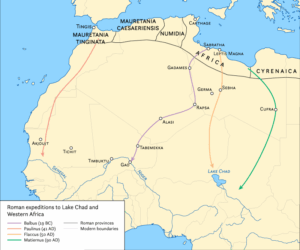
“After conquering Chad, France lost interest in it. Indeed, the country is poor compared to other colonies. Being a colonial administrator in Chad is the lot of novices or tantamount to a punishment” [Chad, Petit Futé, 2017, p. 48]. Some call it the “Dead Heart of Africa.” After spending four months in Chad as governor, Félix Éboué, from French Guiana, considered his appointment a “true disgrace,” as he wrote on June 3, 1939, to his friend in Guadeloupe, the lawyer Meloir.
To reach Fort-Lamy, the name of the capital under French colonialism, “one takes the boat from Bordeaux to Pointe-Noire, the train to Brazzaville, the river to Bangui, a car to Fort Archambault, and then another boat to Fort-Lamy: it takes 60 to 70 days.”
[FCDG, Fonds Eboué F22/16, Dossier 4, Lettre d’Eboué à Meloir, 3 juin 1939 in Arlette Capdepuy. Félix Eboué, 1884-1944: mythe et réalités coloniales. Histoire. Université Michel de Montaigne- Bordeaux III, 2013].
Chad remained one of France’s most miserable and neglected colonies.
Arid, landlocked, and with sufficient rainfall only from June to September, even agriculture struggles. In N’Djamena, the capital, small fruit stalls line the roadside, selling bananas, apples, and oranges—an apple is worth the equivalent of half a euro. They all come from neighboring Cameroon. In the countless grocery stores, mango, guava, and orange juices come from Saudi Arabia or Libya. Trade flows in both directions. On the very long desert track that connects N’Djamena to the north of the country, we encounter numerous large trucks, their loads so high they threaten to tip over. Sometimes, a dozen people are perched on top of them, their clandestine destination being Europe, via Libya and the Mediterranean.
From Chad to Europe on Foot
Sitting under a leafy palm tree in the Lake Chad region, Hassan Adam, a 52-year-old Boudouma nomad, asks us: “Can I walk to your country?” It’s 5,000 kilometers to the European Union border, passing through the deserts of Libya and Egypt, the Middle East, and Turkey. It skirts the dangerous Mediterranean but crosses the even more dangerous occupied Palestine.
In the first half of 2023 alone, 2,000 migrants drowned in the Mediterranean; in the second half of the same year, there were ten times as many deaths in Palestine, both in Gaza and the West Bank.
The Boudouma are just one of the 200 ethnic groups in Chad! (with over 1,800 throughout Africa…) They inhabit the shores of Lake Chad and are part of the Kanembu people, who descend from the great, millennia-old Kanem and Bornu empires that lasted from the 8th to the 19th centuries in the center of the country and extended into neighboring countries. Together, the Kanembu and the Buduma—former enemies—represent nearly 10% of Chad’s population.
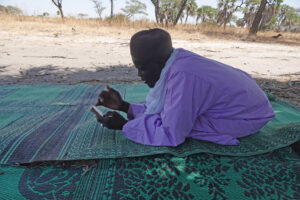
Our Boudouma hosts spread their cell phones out on the mats and placed small chargers in the sun. That’s all they have as a sign of modernity. They don’t even have wells since they’re constantly on the move. But many Chadian villages have them, built by NGOs. The water that comes out is usually brownish. You constantly see women on donkeys carrying water in yellow jerrycans along the roads. Often they have to travel for 3-4 hours. So what would walking 5,000 kilometers to reach the European Union be like?!
Next to Hassan Adam sits Adam Moussa, the clan chief. He had rugs spread out for us on the brushy sand. And he gave the customary speech, “We are deeply honored that you have come from such a distant land to meet us and learn about our customs,” etc., etc. We would hear these words again everywhere we were welcomed. Either our guide only knew Chadian Arabic and couldn’t communicate with the people of the lake who speak their own language, Yedina, and was making things up, or this was the discourse that had been instilled in all Chadians, which I think is the case.
Public spending allocated to the education and health sectors is low
Moussa served us fresh, unpasteurized milk from Kouri cows in a plastic bowl. Kouri cows live only around Lake Chad. Milk is a precious commodity for the Boudouma people and is as vital as water. And not just for its nutritional value. A man takes an oath on “milk and butter.” To welcome a visitor and create a social bond, they offer milk, tobbel kodo, or literally “the stranger’s drop.” “Conversely, refusing to share milk signifies the breaking of this social bond,” explain the Malian ethnologist Amadou Hampâté Ba (1900-1991) and the French anthropologist Germaine Dieterlen (1903-1999).
The children tend the herd, but the women manage the milk distribution. “Milk is first and foremost a sign of a woman’s social status and symbolizes social relations and hospitality. It is also a sign of a woman’s beauty.”
At 51, the chief had two wives, like the majority of Chadians, one divorced and one deceased. Then two more wives, with 11 children in total, a minimum in this country. A 40-year-old taxi driver told us: “I have six children, but I’m not finished.”
“Why do you have so many children?”
“We need it to tend the herds and work in agriculture” – they sow corn, beans, and the ubiquitous millet. The women wash and cook, and take care of the young children. While we talk with the elders, a group of men sit on mats under another tree, chatting. Women come and go around the most rudimentary shelters made of plastic sheeting and branches. Little girls throw stones to knock down palm seeds.
“What are your main problems?”
“It doesn’t rain. That’s bad for agriculture. And then there’s the health of our animals.”
They complain about receiving no help from the government. In fact, according to the World Bank itself, “Public spending on education and health is low and inefficient, with Chad currently having the lowest Human Capital Index (HCI) in the world” (2019). And only 2% of GDP goes to education and 4.8% to health. This should be compared to oil revenues which, since production began in 2003, have reached 80% of earnings.
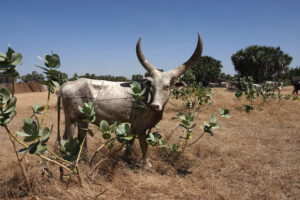
Only NGOs give pills to the Boudoumas to vaccinate the cows. Near the village of Kangalom, between their camp and the chiefdom of Kouloudia, we come across a large herd of Kouri cattle with enormous and large horns (both cows and oxen) in the shape of a lyre that can reach about fifty centimeters. During his visit to the region, André Gide was appalled by the “monstrous horns [which] surpassed not only anything I had ever seen, but even anything I thought possible” [Gide p. 250]. Kouri cows produce up to six liters of milk a day! But they need to bathe in the nearby lake because they don’t tolerate the heat well. This is why they are only found in this region. Using their horns, they are good swimmers and are fond of aquatic plants.
Only NGOs are giving pills to the Boudoumas to vaccinate the cows
The Kouri animals are constantly on the move, watched over by children and teenagers armed with sticks. None of them go to school. While school enrollment is only 75% in the settled south, it doesn’t even reach 8% in the nomadic center (Sahel) and north (Sahara). There, one finds a plethora of deserted and abandoned schools, whose equipment, except for the blackboards, has been stolen. On some schools, the inscription still shows: Funding by the European Union or by an NGO.
The largest lake in the world
The surface area of Lake Chad has shrunk dramatically, as explained by Chadian Hindou Oumarou Ibrahim, who founded the Association of Fulani Women and Indigenous Peoples of Chad (AFPAT) “to mobilize the traditional knowledge of indigenous peoples in order to provide solutions for adapting to and mitigating climate change,” because these peoples are bearing the brunt of the impact of climate change: “When my mother was born, Lake Chad covered approximately 25,000 square kilometers of water. When I was born, 30 years ago [1989], it was 10,000 square kilometers. And in fact, now [2019], that represents about 1,200 square kilometers of water.”
And what about going further back in our Holocene epoch, some 7,000 years ago, when the so-called Mega-Lake Chad covered… 400,000 km², larger than the Caspian Sea! Thanks to satellites, we can see its ancient shores hundreds of kilometers north of the current lake. We would like to believe that it was on such a shore, in the Mourdi Depression of the Ennedi Saharan Plateau, a large rock formation some 900 kilometers to the northeast, that one of our jeeps nearly overturned some twenty meters below; the dazzling sun on the crescent-shaped orange sand dunes makes it difficult to see the steep drops. No wonder seashells are found in the Mourdi.
Between the 1960s and 1990s, Lake Chad shrank from 25,000 km2 to less than 2,000
But these drops can go back much, much, much further in time, to the Karoo glaciation, the second of the Paleozoic era, the third era in Earth’s history, some 360 to 255 million years ago, when large ice sheets covered the Earth’s surface, notably in the Ennedi. During the time of the supercontinent Gondwana, when Africa and Europe were joined, the Ennedi ice sheet probably reached the Tethys Ocean around the 40th parallel south! (The Ennedi is currently around the 17th parallel north). Some of these ice sheets are now covered in sand, but visible through new satellite image data analysis techniques.
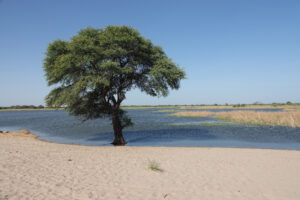
Coming back to Lake Chad, it’s important to note that the major loss in modern times occurred between the 1960s and 1990s, when its surface area shrank from 25,000 km² to less than 2,000 km². Since then, the water level has not only stabilized but has also recovered significantly, and is currently (2025) around 14,000 km². The drying up of Lake Chad receives considerable media attention because there are significant interests at stake, starting with the private companies behind the Transaqua Inter-Basin Water Transfer (IBWT) project by the Italian company Bonefica. This project aims to bring water from the Congo River via a 2,400-kilometer-long canal! This project, dating back to the 1970s, stalled for a time before being revived more recently, and a contract has been signed. In 2017, with the company PowerChina, China invested heavily in the African continent, particularly in infrastructure. Local politicians, eager to capitalize on the financial windfall of a project estimated at US$50 billion, and likely more, are pushing the project forward.
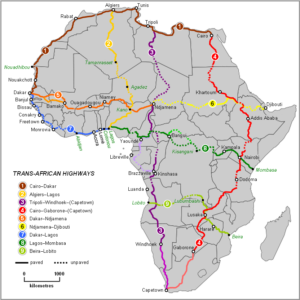
On the other hand, such a mega-project would help open up not only Chad, but the entire continent, as the canal connects to two major highways: the Trans-African Highway 8, Lagos-Mombasa, which links the Indian and Atlantic Oceans, and the Trans-Saharan Highway, Lagos-Algiers, which connects the Gulf of Guinea and the Mediterranean.
106
Major trans-African highways, many planned, some under construction, with the help of China
After greeting the Boudouma people, we continue along the track. A little further on, we see numerous branches leaning against trees, erected to shelter refugees from the floods of July-August 2022, when the heaviest rains since 1990 fell, to the point that some streets in the capital itself were only accessible by dugout canoe! Officially, at least 22 people died and 1,312 homes were destroyed. Chad wasn’t the only country affected; the rains claimed 2,100 lives in 25 African countries, including neighboring Nigeria, which lost 610 people.
It’s easy to believe: when we passed through a month after a normal rainy season, the main road leading to Gaoui, a Kotoko pottery village about ten kilometers northeast of the capital, was riddled with potholes—more like craters—filled with dirty water that had to be crossed at a walking pace, one lane at a time. It took nearly an hour to travel the 12 kilometers. Our taxi driver (who told us he had 14 children) had to maneuver with only his left hand, his right arm having been paralyzed in a crash on the road in neighboring Cameroon. Many Chadians go to the wealthier neighboring country, either to work or to bring back fruits and vegetables.
In 2022, the rains caused 2,100 deaths in 25 African countries
The very rudimentary shelters around Lake Chad are now unoccupied. At first glance, a paradox. Too little or too much water? The nomads complain about the lack of rain. Because it falls suddenly over a short period, mainly in summer, and causes flooding.
Boko Haram, or the “Community of Followers for the Propagation of Holy War and Islam”
Fluctuations in water levels are not the only danger in the lake basin, which borders four countries: Chad, Cameroon, Niger, and Nigeria. It was in the north of Nigeria that Boko Haram emerged in 2002, a Sunni anti-Shia group so deadly (tens of thousands of victims, including 300,000 children) that even ISIS disavowed them. This is, in fact, an argument used by the promoters of the Transaqua inter-basin water transfer (IBWT) project: the lack of resources and employment is pushing young people to join Boko Haram – or to emigrate to Europe. These are two factors that frighten Westerners, and first and foremost the Italians, where most of the Africans crossing the Mediterranean arrive. Their Prime Minister, Giuseppe Conte, said in 2019 that Europe “cannot remain indifferent to the drying up of Lake Chad. If this continues, there will be increased poverty and therefore an increase in emigration and the terrorist threat.” It should be noted that the Bonifica company was initially owned by the Italian state…
Disastrous socio-economic conditions are a major factor in the creation of Boko Haram, as well as in its recruitment. Before being killed by Nigerian police in 2009, its founder, the young preacher Mohammed Yusuf, denounced the ruinous legacy of colonialism and the corruption of the Nigerian elite. “After decades of political turmoil and military coups, oil extraction has made Nigeria the richest country in Africa, and yet the percentage of people living in abject poverty increases every year. The Europeans created the situation we are in today.” The only way out was to establish a caliphate in Nigeria. The group’s name is Jama’atu Ahlis Sunna Lidda’awati wal-Jihad in Arabic, meaning “Community of Followers for the Propagation of Holy War and Islam.”
Disastrous socio-economic conditions are a significant factor in the creation of Boko Haram
The group opposes education, especially Western education. In this, it is far from alone. Particularly in the Islamist north of Nigeria, many politicians and academics have opposed it, labeling Western education ilimin boko (“false education”) and secular schools makarantar boko (“Western/unIslamic school”).
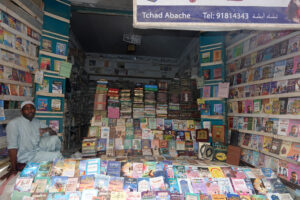
Elsewhere, others are cautious, bitter, ambivalent, attentive. In one of the few bookstores in Chad, tucked away in the vast souk of Abéché, a major city in the northeast of the country, we found “L’Aventure ambigüe” (1961) by Senegalese author Cheikh Hamidou Kane, which earned him the Grand Literary Prize of Black Africa. It is an autobiographical account of the author receiving a traditional Muslim education before going to Paris to study law at the Sorbonne, and then returning to government in Senegal and to UNICEF in Nigeria and Ivory Coast.
In his work, the young Samba Diallo also goes into exile and separates himself from his African roots without, however, becoming fully French/Western. “The book speaks of his quest for cultural/spiritual identity, and ultimately he is torn between the two.” Then he returns and has a madman speak of the “land of the Whites”: “Master, they no longer have bodies. They have been eaten by objects. To move, they equip their bodies with large, swift objects. To feed themselves, they place iron objects in their hands and mouths.”
[L’Aventure ambigüe”, Cheikh Hamidou Kane, 1961, pp181-2]
But the currents run deeper. Africa—and parts of other peoples of the so-called Global South—is merely following in Europe’s footsteps, albeit with a lag of a few centuries. Since the Renaissance, Westerners have embarked on a process of secularization that began, “initially timidly, by putting God ‘in parentheses.’ Then, two centuries later, having gained more confidence, they declared ‘God is dead’ upon becoming “masters and possessors of nature.”
“God was no longer there to measure and justify… Industry was blind, even if, ultimately, it was still possible to embrace all the good it produced… But that phase has already passed… After the death of God, what they are now announcing is the death of man,” says Cheikh Hamidou Kane, outlining the dilemma of his contemporaries: “How can they escape the cultural and material underdevelopment that is at the root of their defeat and subjugation without losing the presence of God in the hearts of men?”
After the death of God, what they are now announcing is the death of man
It’s not simple at all. During a discussion organized in 2019 by the Woodrow Wilson Center, a Washington-based think tank, former Nigerian President Olusegun Obasanjo (and a former general) said that “the low level of literacy and education in the northern regions of the country contributes to the perpetuation of Boko Haram. According to Obasanjo, illiterate and uneducated children are more likely to be recruited into the ranks of the terrorist organization.” He cites a 53% literacy rate in the northeast compared to 94% in the south.
“We have 14 million children that should be in school, that are not in school. It doesn’t matter what we do with Boko Haram today. Those 14 million are Boko Haram of 10-15 years from now, unless we do something about it”, said H.E. Olusegun Obasanjo, former President of the Federal Republic of Nigeria.
But this brings us back to the ambiguity between traditional spirituality and the West. It means that the former Nigerian president places education, inevitably Western, above his own culture. As salvation for his country. An uncertain future. The founder of Boko Haram had a university education—theology from the University of Medina in Saudi Arabia. Obasanjo himself holds a doctorate in theology, and his studies in his country, in India, and in England sensitized him to colonialism. Even as a teenager, he rejected his nickname “Matthew” as an anti-colonial act and later supported South Africa’s anti-apartheid struggle. Education often raises young people’s awareness and makes them see the socio-economic ills of the West, which they otherwise only perceive culturally.
So they will inevitably ally themselves with Boko Haram or with the movement, with the ideology that succeeds it and will undoubtedly be more hypocritical but just as fatal, even more fatal. (Or illegally recruited into the army – see below) History will tell us. The tens of thousands of victims of Boko Haram have to be compared historically with the hundreds of millions of civilians killed in genocides in North America by the Anglo-Saxons (more than 5 million), in Latin America by the Spanish and Portuguese (56 million), the massacres in India and Kenya by the British, in the Belgian Congo by the Belgians, in Ethiopia by the Italians, in Namibia by the Germans, in Indonesia by the Dutch, in Armenia by the Turks, in Algeria and Indochina by the French, in Vietnam by the United States, etc. etc. etc., not to mention in Europe the 6 million Jews and a quarter to half a million Roma and 8 million Soviets exterminated by the Germans (military and civilians, not just the Nazis/SS).
The tens of thousands of victims of Boko Haram have to be compared historically with the hundreds of millions of civilians killed in Western genocides.
Ravensbrück, a German women’s concentration camp from 1939 to 1945, was located in the village of Ravensbrück, 90 km north of Berlin. “Ravensbrück’s Kinderzimmer, or ‘children’s room,; where inmates who came to the camp pregnant were forced to abandon their babies; the newborns were left to die of starvation or be eaten alive by rats.”
And what about the genocide perpetrated these past few months in Gaza by Israel? The tortured have become the torturer through a classic psychological process.
It’s worth noting that Boko Haram is based on an ideal of justice through the strict application of Islamic law, whereas the goal of the Nazi “Final Solution” was the extermination of Jews and Roma as “foreign peoples” of Europe.
On the other hand, the author of “L’Aventure ambigüe” offers a more nuanced perspective—not all of the West is materialistic, and not all of Western culture can be reduced to materialism, even if it is the dominant trend of modern times. Sheikh Hamidou Kane says that his region of Diallobé—the Fulani people—is entirely governed by a culture of faith. This is also true in the Lake Chad Basin. Caught between their spirituality and nature and a modernity of which they know only a few tools… and images, young people flee simply for survival. The Turkish Airlines flight attendant who took us back to Istanbul was also Senegalese. While the passengers on that night flight slept, Oumar told me, in perfect French, about his journey from Dakar to Istanbul, where he hopes to pursue a career in football: “I love coming back to my country, but it pains me to see the problems. And largely, it’s due to incredibly corrupt governments.”
Another perspective: U.S. reporter Ben Taub, who wrote a long article on Chad in the New Yorker in 2017, confides: “I got the impression that almost everyone there—and especially those in the Presidential palace—has a stake in Boko Haram’s continued existence as a distant, manageable threat.” Dutch journalist Linda Polman, for her part, writes in “The Crisis Caravan: What’s Wrong with Humanitarian Aid?”: “”If you use enough violence, aid will arrive, and if you use even more violence even more aid will arrive”. Indeed, the small town of Baga Sola, on the shores of Lake Chad and near the Nigerian border, has received waves of Nigerian refugees fleeing Boko Haram since 2015, only to be subsequently hit by floods. And now, “Baga Sola is three times bigger than it was when we all moved in. It’s amazing how the money flowing in from humanitarian assistance has changed the city,” Florent Méhaule, head of the United Nations Office for the Coordination of Humanitarian Affairs in Chad, told Taub.
We had barely left Lake Chad two days earlier when Boko Haram launched a series of attacks in Yobe State in neighboring Nigeria, killing 39 people within a week—half of them in a vehicle that struck a landmine—and losing six of their own in the villages of Geidam, Babangida, Jororo, and Lingir, the latter 80 km from the lake. On the very day we left Chad, the group carried out an attack that claimed around 40 victims in the Geidam region, some 200 kilometers from Lake Chad. This pales in comparison to another massacre, this one of 2,000 victims, perpetrated by the group in January 2015 in Doro Gowon, on the Nigerian western shore, 150 km from the Chadian town of Kouloudia, the capital where the Sultan had signed our residency permit and from where we set out in search of the Boudoumas. A stark example. The Nigerian soldiers fled in haste, leaving the civilian population alone. Two years earlier, in April 2013, these same soldiers had burned thousands of homes and killed some 200 civilians in retaliation for an ambush by Boko Haram, which believed the population supported the group.
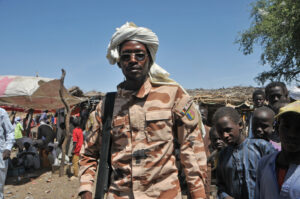
“Recent attacks and abductions signal that, despite being pushed into remote areas, Boko Haram will likely continue to disrupt the region’s development for some time,” says Alexander Thurston, a professor of political science at the University of Cincinnati and a specialist in Islam in West and North Africa. He adds, “Boko Haram represents an ugly paradox: its ideas have limited appeal but significant staying power. The group can be crushed militarily, yet state violence fuels its narrative of victimhood.”
Boko Haram can be crushed militarily, but state violence fuels its narrative of victimization
It is the same struggle, in a different form, that is being waged, says Cheikh Hamidou Kane, by “all those who tried strongly to resist the colonial West in the country of the Diallobé , as the Senegalese Sufi masters, fought in the name of faith in order to keep God in men’s hearts and dwellings.” The difference is that the fierce and disproportionate repression by the security forces—massacring civilians and their followers—has radicalized Boko Haram.
But let us not place the blame solely on Africans. Cheikh Hamidou Kane said in 2016, at the age of 88: “Their battle still continues today in the context of globalization, where we see those who are not part of the West “in all latitudes, aquiver with covetousness, then metamorphosing themselves in the space of one generation, under the action of this new egotism which the West is scattering abroad.”
Treasures of the Desert
After getting lost on countless tracks, crossing a stream, encountering a salt caravan, and sleeping under a full moon, eaten breakfast in the company of spirited goats, we stop at the colorful Friday market in Isseirom, a small town east of the lake. Among other things, they sell spirulina, a type of green algae found in Lake Chad. It contains up to ten times more protein than meat, as well as vitamins A and B12. 12,000 kilometers away, the Aztecs were also consuming it half a millennium ago! The Belgian botanist and professor Jean Léonard studied spirulina, which is misnamed because it belongs to the genus Arthrospira.
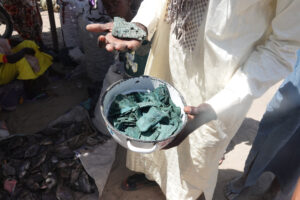
At the edge of the market are dozens of camels, goats, horses, and donkeys, and owners and buyers haggle. Ahmed guides us. A recent economics graduate, he has long hoped for a position in the public sector. There are more than 700 like him. In the meantime, he lives with his parents and three sisters in this village 270 km from the capital, a mere four-hour drive, as a good portion of the road—built by a consortium of countries—is in impeccable condition, a rarity here.
We leave two capitals to our left: the modern Mao of the department, and, a few kilometers away, the ancient Njimi, capital of the Kanem Empire from the 11th to the 14th centuries, and follow the trail of the old caravans of slaves, gold, and ivory.
The first stop heading north is Moussoro, where we linger at the police station, in a simple hut, for a thorough check of our passports and travel permits. This is the capital of Barh El Gazel, one of the country’s 23 administrative regions. We set off again; here begins the true desert. Without a guide, it’s impossible to find your way. Everything is flat, with few landmarks. Less than a year ago, in December 2022, a pickup truck left here with 27 migrants. They got lost. They were found dead of thirst. But even with a guide… Ours tells us how half a dozen jeeps also left last year to reach Nigeria by skirting Lake Chad. They ran out of gas. We found one jeep further on, probably having set off with the last drops of gasoline, searching for a way out. The bodies scattered across a large area. The image remains etched in my mind of people setting off on foot in search of water and help.
Bahr el Gazel, the “River of Gazelles,” but during our visit, a strong wind filled the air with millions of sand particles, fueled by the completely flat landscape. Through this dark orange haze, we only glimpsed about ten gazelles, startled but curious, darting by at full speed, then observing us from a safe distance.
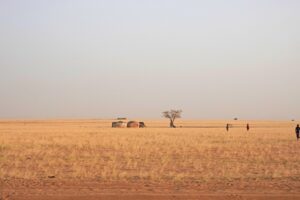
It is, in fact, a phenomenon unique in the world. Initiated in 1995, Anglo-American scientific studies, aided by NASA satellites, show that Chad “produces” 20% of all global “dust,” or between 60 and 120 million tons of mineral aerosols per year—from quartz-rich windblown sands to diatomite, siliceous algal sediments—originating from the Bodélé Depression (500 km long, 150 km wide, and 160 m deep), where the now-dried-up mega-Lake Chad once lay. A hyper-arid climate and the absence of vegetation promote high erodibility. Very strong surface winds lift these particles to an altitude of nearly 4,000 meters, from where they reach the Amazon River, 9,000 kilometers away, in about ten days, carrying nutrients to the Atlantic Ocean and the rainforest.
Very strong winds lift the sediments which reach the Amazon River, 9,000 kilometers away, in about ten days
At more or less regular intervals, wells serve as rallying points for caravans of camels, cattle, and goats, which often compete for the precious liquid. We encounter several Toubou Daza or Gorane, Salamat Arabs, Fulani, and Zaghawa peoples during our three-day crossing of the vast, flat expanses of the eastern Sahara. Chad is much more heavily trafficked than neighboring Niger and Mali. The drivers who take us to the great Ennedi Desert are all Toubou (4% of the population). Some say that “Bou” means man, and “Tou” means rocks or mountains—in any case, it refers to the Tibesti Mountains, the northernmost part of Chad, along the Libyan border. They were very pious warriors. Muslims, like practically everyone else in the northern desert. At each stop, the drivers spread out their prayer mats and pray. However, our two cooks, Gilbert and Marie, are Catholic. Coming from southern Chad, they clearly seem ill at ease, out of their element, and the drivers rarely speak to them.
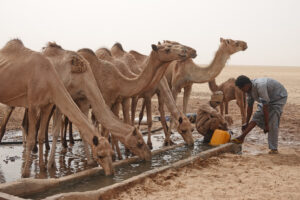
But Sherif is also very caring – and an excellent driver – and when he smiles, you can see his great humanity. He has two wives, one in the capital and the other 80 kilometers away, in his Sahelian hometown of Massaguet, which we passed. He and his family own about a hundred camels, which his brothers tend while he drives visitors.
Less than 100 kilometers before reaching the town of Koro-Toro, we turned northeast. Koro-Toro is famous for two completely contrasting events. Modern times: the high-security prison (which doesn’t mean much in Chad, where you can escape by bribing the guards) where Boko Haram fighters are held, as well as the (numerous) Chadian rebels – that is, those who haven’t been summarily executed.
Even more interesting is the site where a Franco-Chadian paleoanthropological mission, led by paleontologist Michel Brunet, discovered the 3.5-million-year-old Australopithecus bahrelghazali in 1995, during the Pliocene epoch (5.33-2.58 million years ago). This was the first time an australopithecine, or hominid—an ancestor of humankind—had been found in Central Africa, 2,500 kilometers from the Great Rift Valley of East Africa. This rift valley stretches 7,000 km from Lebanon to Mozambique, passing through the Red Sea, where they were thought to be confined to a lake environment with sparse vegetation, similar to the present-day Okavango Delta in Botswana. At that time, the region of Lake Chad was teeming with insects and aquatic creatures. It is believed that they traveled from east to west through the “Central African Shear Zone,” a geological fault that stretches 4,000 km from the Sudanese coast on the Red Sea (Port Sudan) to the Cameroonian coast on the Gulf of Guinea – and some say it continues under the Atlantic Ocean to the Pernambuco Fault in northeastern Brazil, a region, incidentally, famous for the 17th-century slave revolts against the Portuguese, notably Quilombo dos Palmares, a community of escaped slaves. So, a geological fault and a slave trade connect the two continents!
We find Michel Brunet again in 2001-2002, analyzing a skull and other fragments found by Chadian scientists and a Frenchman just 200 km further west, in the Djurab Desert, according to my calculations, near the Dalakora well. Even more remarkable, this time it’s Sahelanthropus tchadensis, dating back 7 million years, to the end of the Miocene (23.03-5.33 million years ago), making it twice as old as Australopithecus bahrelghazali, and the oldest known hominid. “The ancestor of humanity is Chadian… The cradle of humanity is in Chad. Toumaï is your ancestor,” the French paleontologist announced to the Ministry of Foreign Affairs and a television audience in N’Djamena, using the name proudly bestowed upon him by Idriss Déby, then President of the Republic of Chad. In the local Daza language, Toumaï means “hope of life,” a name given to children born just before the dry season, who therefore have a rather limited chance of survival.
The oldest hominid, dating back 7 million years, was found in Chad
Research has been ongoing for two decades to confirm that this is indeed a hominid and not a “common” ape! One of the main criteria is that it must be bipedal. This can be determined by the skull and femur. “The passage through which the spinal cord connects with the brain points downwards in the skull, as it does in humans and other upright walkers, while in quadrupeds it points backwards towards a more horizontal neck.”
But only the main shaft of the femur remains, the two joints having likely been eaten by a porcupine, this small rodent thus depriving humanity of crucial clues! “The neck of the femur, which connects to the hip socket, would reveal whether the femur was adapted to support the entire body weight on one leg at a time. Similarly, the distal end of the knee would show whether the alignment kept the body weight below the body’s center of gravity, another sign of habitual bipedalism.”
On the other hand, two arm bones found are similar to those of a chimpanzee, and show that it still spent a lot of time in trees, “a type of hybrid lifestyle that could have persisted among early hominins for some three million years.”
One thing is certain: “it lived during the era when humans branched off to evolve separately from the apes.”
[Seven Million Years Ago, the Oldest Known Early Human Was Already Walking,
Analysis of a femur fossil indicates that a key species could already move somewhat like us.
The West firmly stands with dictatorships, in secrecy
In fact, President Déby named the Sahelanthropus tchadensis after Toumaï, also to commemorate one of his comrades-in-arms, who lived in that region and was killed fighting to overthrow the then-president (1980s and 90s) Hissène Habré, supported by France and the United States.
Indeed, the desert north of Chad has also been the scene of endless internal conflicts. All were trying to overthrow dictatorial regimes, maintained in place thanks to the French military. We wouldn’t have the space here to list and describe all the opposition groups, armed or not; suffice it to say that in August 2022, negotiations took place in Doha, Qatar, at the end of which the Déby regime concluded a major peace agreement with more than 40 armed groups!
Throughout the country’s history, I have identified 36 armed groups and political parties, starting with the Chadian Progressive Party in 1947, still during the colonial era, led from 1959 onward by François Tombalbaye, who would become Chad’s first president. From the United Front for Democratic Change (FUC), led by Mahamat Nouri, which attempted to seize N’Djamena in 2006, to the Rally of Democratic Forces (RAFD), which became the Rally of Forces for Change (RFC) in 2007, headed by Timane Erdimi, a nephew of Déby whom he was trying to overthrow.
Mahamat Nouri himself had been ambassador to Saudi Arabia under Déby, whom he was now also trying to overthrow. Known as “the old man” (*), he had fought in the north since the 1970s under the notorious FROLINAT (National Liberation Front of Chad, a rebel group active from 1966 to 1993) of the equally infamous Hissène Habré, who ruled the country with an iron fist from 1982 to 1990, ultimately becoming the first former head of state to be convicted of human rights violations by a court in another country (Senegal). [Chad, Petit Futé, 2017, p. 66]
(*) “Old men” refers to men and women over 50 in a country where half the population is under 15 and the average life expectancy is 53 years, ranking 194th out of 194 countries in the world.
Average life expectancy = 53 years, 194th out of 194 countries in the world
While Idriss Déby initially tolerated multiparty politics upon coming to power in 1990—a first in Chad since its independence in 1960—and promulgated a general amnesty in 1994 (with the exception of Hissène Habré), and had a new constitution approved in 1996, he abolished term limits and was thus able to rule for over 30 years, a record for the country. During this time, he appointed more than 15 prime ministers and hundreds of ministers “as easily as changing one’s shirt,” and sponsored ten constitutions. He remained in power until his death in combat against the Front for Change and Concord in Chad (FACT) in 2021. His son, Mahamat Déby, a general, illegally seized power, dissolving parliament and promising elections within 18 months.
France has publicly defended this military takeover by Déby’s son, despite its unconstitutionality. Its foreign minister, Jean-Yves Le Drian, asserted that it was necessary in “exceptional circumstances,” namely the fight against Boko Haram and its allies. Significantly, he made no mention of the 18-month term promised by Déby’s son.
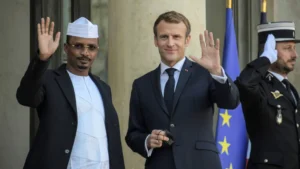
This same Le Drian had, however, denounced the military coup of May 24, 2021, in Mali, which, in contrast, went against his country’s interests: “France condemns in the strongest possible terms the act of violence that occurred yesterday in Mali.”
After 18 months, “In October 2022, he [Mahamat Déby] extended the transition for another two years and declared himself finally eligible to run. Outraged opposition groups took to the streets. Chadian security forces killed at least 128 people in a single day and imprisoned hundreds more.”
France condemned the violence, but not the government!
A year later, November 2023, same French hypocrisy: “After the debacles in Niger and Mali, France thinks pushing Mr Déby to honour his promise not to run and to hold a free election is ‘a luxury we cannot afford’”, said a Western diplomat…
Behind the scenes, the usual “opacity,” as described by Reuters correspondents, is unfolding in the relationship between France and its former colonies. “Eighteen months is too long, Macron will pass the message on to the African presidents in the region so that they, in turn, put pressure on Mahamat so that he doesn’t act like an idiot,” a French diplomatic source declared in their usual vulgar language.
France has publicly defended the military takeover by Déby’s son, despite it being unconstitutional
Presidential elections were held on May 6, 2024, and the National Election Management Agency (ANGE) declared Mahamat Déby the winner with 61% of the vote. Parliamentary, regional, and municipal elections were held on December 29, 2024, and the National Election Management Agency (ANGE) declared the ruling party, the Patriotic Salvation Movement (MPS), the winner with 66% of the vote.
A family protected by France, a father, Idriss Déby, who reigned for 30 years (1991-2021), a son, Mahamat Déby, who illegally seized power for three years (April 2021 to May 2024), an electoral body, ANGE, established by the regime that announced the results, more than ten opposition parties boycotting the parliamentary elections, the main presidential candidate (former minister and cousin of Déby’s son), Yaya Dillo Djérou, killed by the army two months before the elections, presidential results announced two weeks before the scheduled date, on May 9, just three days after the vote, in a country completely lacking in communications, election observers reporting “a series of irregularities, including ballot stuffing and multiple voting,” etc. It’s difficult to call this a democracy.
“A small number of individuals believe they can make people believe that the election was won by the same system that has been ruling Chad for decades,” says Succes Masra, prime minister under Déby and presidential candidate, who, according to ANGE, won 18.5% of the vote.
Opacity and double standards
It is high time to address the harmful and ongoing role of the former colonial power in Chad.
“Opacity” is the word Saleh Kebzabo used with RFI (Radio France Internationale) and AFP (Agence France-Presse) correspondent Sonia Rolley in 2007. At the time, he was an opponent of Déby Sr., before being appointed prime minister by Déby Jr.
There is a lack of transparency in the links between France and its former colonies
“‘Déby Sr. was practically escorted to Chad by French agents; he benefits from this French support and has a special relationship with President Chirac [soon to be replaced by Sarkozy],’ he explains. ‘Now, we know that these are privileged relationships that take precedence over state-to-state relations. What I criticize about this system is its opacity,’ he argues. ‘It poses a real problem for democracy, including in France. It means that a whole aspect of French foreign policy is shrouded in secrecy, that even members of parliament don’t have access to it… That after fifty years, France is still there supporting regimes spewed by its population, is totally anachronistic and archaic […] I dare to hope that, with the elections in France, and given their ages, the new leaders will have a different culture than the neo-colonial one”
[Retour du Tchad. Carnet d’une correspondante, Sonia Rolley, 2010, p73].
François-Xavier Verschave, a French economist and leading expert on neo-colonialism, defined Françafrique as follows: “a nebula of economic, political, and military actors, in France and Africa, organized into networks and lobbies, and focused on monopolizing two sources of revenue: raw materials and Official Development Assistance. The logic of this exploitation is to prohibit any initiative outside the circle of initiates [emphasis added]. The self-destructing system recycles itself through criminalization. It is naturally hostile to democracy”
[Retour du Tchad. Carnet d’une correspondante, Sonia Rolley, 2010, back cover].
This is reminiscent of the English now illegally sending weapons to Israel for its genocide against Gaza from their base in Cyprus, with the Ministry of Defence blocking all parliamentary inquiries into these activities.
“Action on Armed Violence, une ASBL anglaise enquêtant sur la violence armée contre des civils dans le monde entier”]
There is “no legal basis” for intervention in Chad, replied the defense attaché at the French embassy to Sonia Rolley, the RFI correspondent, who had unsuccessfully sought a response from several officials. “France prefers this ambiguity,” she concludes [Roley p. 72]. This is by no means limited to this country. As we have seen, the criterion of democracy is only applied against the so-called enemies of the West—represented here by France, the United States, and England—notably China and Russia.
Let us add two more damning aspects: human rights violations and child soldiers. Regarding the first, let us quote Ben Taub’s report from the field: “Although French military advisers stationed at Chadian outposts had witnessed human-rights abuses, they did not intervene, saying that it was not their responsibility to come between the state and its people.” And: “In Chad, the International Committee of the Red Cross is the only international organization that has access to prisons. In order to maintain access, the I.C.R.C. keeps any atrocities it sees confidential.”
French military advisors stationed in Chad witnessed human rights violations but did not intervene
Let’s consider just one event. (We’ve already discussed the October 2022 crackdown when Déby’s son extended the transition period by two years and the Chadian army killed more than 128 protesters in a single day.) On June 11, 2001, a demonstration of about one hundred women from the Association Tchadienne pour la Promotion et la Défense des Droits de l’Homme (ATPDH) took place in front of the French embassy in N’Djamena, protesting the irregularities of the presidential election of Déby Sr. Jacqueline Moudeina, a lawyer and member of the association, was specifically targeted for her human rights work and was seriously injured by a grenade—one of several—thrown at her feet by a soldier. Her condition required a 15-month stay in a hospital and rehabilitation center in France, where she received political asylum following numerous death threats.
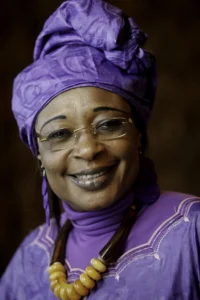
The ATPDH, co-founded by Delphine Djiraibe, also a human rights lawyer, fights against child slavery. “Poverty and lack of education lead many farmers in Chad to sell their children for the equivalent of about ten US dollars to herders seeking cheap labor to tend their flocks, but children are also sometimes abducted without their parents’ consent. Children who do not perform their tasks to the herders’ satisfaction are beaten or even murdered” [“The Challenge of Human Rights in Chad,” Witness, April 13, 2005].
Another important area covered by the ATPDH concerns children illegally recruited into the army, which has earned Jacqueline Moudeina the most threats. She has evidence that children are trained in garrisons in the Bourkou-Ennedi-Tibesti desert and in Moussoro, some 150 km north of the capital, where we underwent a rigorous identity check.
The French journalist Sonia Rolley has extensively examined the issue of children soldiers, and France’s totally hypocritical position, to which she devotes a seven-page chapter entitled “Taboo” in her book “Retour du Tchad” (2010). The worst part is that UNICEF, supposed to protect children worldwide, is fully complicit in concealing the presence of hundreds of children in the Chadian government army – 10,000 is a figure put forward by the UN itself!
[Retour du Tchad. Carnet d’une correspondante, Sonia Rolley, 2010, pp81-87].
France and UNICEF are covering up the presence of hundreds of children in the Chadian government army
The recruitment of children into the military is considered a war crime by the International Criminal Court. Furthermore, in 2008, the United States Congress prohibited sending military aid to countries using child soldiers. Implicitly acknowledging the problem, Obama invoked the same exception. He “secured a waiver for Chad, arguing that it was in the national interest’ of the United States to train and equip Chad’s military.”
The “vagueness” we were discussing, which allows Western powers to define which regimes are democratic or not, doesn’t only benefit governments. “A Chadian minister announces that the budget is not being respected, that weapons are being purcha,sed en masse, and that the country risks going into debt for years… And the World Bank applauds the government’s effort at transparency and affirms that it is on the right track!” Rolley reports following a 2007 budget meeting between Chadian ministers and donors, who, in private, spoke of the “reign of incompetence and immorality” [Rolley 100-101].
Africa Rebels
We landed in N’Djamena on one of the first civilian flights authorized since the military coup of July 26, 2023, in neighboring Niger. Turkish Airlines had canceled all its Istanbul-N’Djamena-Niamey flights for a month and a half. Only Ethiopian and Egypt Airlines were still connecting Chad to the rest of the world, and of course, Air France.
Before Niger, coups d’état had taken place in Mali on May 24, 2021, and in Burkina Faso on September 30, 2022. Following Niger, a coup d’état occurred in Gabon on August 30, 2023, to end the reign of the Bongo family, who had been in power for over half a century through fraudulent elections. The Bongos owned 39 properties in France, 70 bank accounts, and nine luxury cars worth a total of €1.5 million, in a country very rich in terms of GDP per capita ($10,149 in 2023) thanks to oil revenues, despite a population of only 2.3 million, yet very poor, where a third of the population still lives below the poverty line of $5.50 a day. And all these countries expelled French troops while welcoming Russian mercenaries.
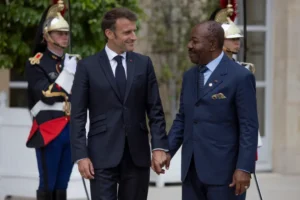
France has just announced that it will “drastically reduce its military bases” in Senegal and Ivory Coast. It also specified that it will increase its cooperation in the region with the United States. This is inevitable, since the US has managed to maintain a certain presence. In June 2022, Gabon and Togo—another former French colony—joined the Commonwealth of Nations, recognizing the British monarch as its head of state!
The countries of the so-called Global South see France’s military impotence and, above all, its political insignificance—just like that of the European Union—and its hypocrisy regarding Ukraine, Palestine, and elsewhere, and they sense which way the wind is blowing. This is especially true of the younger generations—including those from former colonial powers—who support the overthrow of regimes subservient to France. Furthermore, Russia, China, and Turkey have never been colonial powers in Africa. There is now a strong resurgence of interest in joining the BRICS (Brazil, Russia, India, China, South Africa), which is seen as a counterweight to the arrogant Western G7. Iran, Saudi Arabia, the United Arab Emirates (UAE), Ethiopia, and Egypt officially joined the group in early 2024, and 34 other countries have recently applied. And, very importantly, the group is trying to replace the US dollar in the global trading system.
The countries of the so-called South see France’s military impotence and, above all, its political insignificance
But Chad remains – so far – an exception. The poorest country and the most fragile “government” in the Francophone world is the closest ally, or rather the state most firmly controlled by its neo-colonial master. It should be noted, however, that since his formal accession to the presidency was secured in May 2024, Mahamat Déby announced that Chad was ending its defense cooperation agreement with France, without announcing a date for the withdrawal of French troops. Foreign Minister Abderaman Koulamallah described France as an “essential partner” but stated that it “must now also consider that Chad has grown, matured, and is a sovereign state very protective of its sovereignty.”
Chad must proceed with diplomacy. Aliou Dia, head of the UNDP’s Disaster Risk Reduction and Climate Change team in Africa, stated: “The inability of fragile governments to meet the needs of their population or provide protection in the face of climate change-induced hardship can trigger frustration, lead to tensions between different ethnic and religious groups within countries, and to political radicalization”
[Addressing Radicalization and Violent Extremism Through Climate Action, UNDP’s blog “Our Perspectives”, 3 January 2017].
And it would be difficult to find a more fragile government than Chad’s. Motorists are not allowed to stop on the avenue that runs alongside the presidential palace and other ministries. Before boarding our return flight, we underwent a triple security check at N’Djamena airport, the last one right at the foot of the aircraft where the military confiscated even empty plastic bottles and small pottery items, presumably something they considered usable as weapons! Unprecedented, a sign of fear, and therefore of weakness.
During the colonial era, the country offered little to the French, apart from the forced production of cotton in the fertile south. It is considerably more useful in modern times, and not only to France.
Giving Blood for the Metropolis
A major exception was the Second World War when Chad provided an essential commodity to the metropolis: its blood. The country suddenly became “the key to our imperial defense,” in the words of its governor, Félix Eboué. General Charles Mangin – known as “the Butcher” for pushing for all-out war during the First World War – to whom we owe the recruitment of Africans, famously said: “Whoever controls Chad controls Africa.”
Faced with the surrender of Marshal Pétain’s French government, the (newly promoted) General de Gaulle launched numerous appeals for resistance against the Nazis. For example, on June 22, 1940, three days after his arrival in England, he declared: “France is not alone […]. She has a vast Empire behind her!”
On July 30, from London, he broadcast on the radio: “High Commissioners! Governors-General! Governors! Administrators! Residents of our colonies and protectorates! Your duty to France, your duty to our colonies, your duty to those whose interests, honor, and lives depend on you, consists in refusing to implement these abominable armistices. You are the guardians of French sovereignty, currently in decline. Several of you have already joined me to continue the war alongside our Allies; these will be rescued. I appeal to the others. If necessary, I appeal to the people.”
In his memoirs, he wrote: “It was in Africa that we French had to resume the fight […]. In the vast expanses of Africa, France could, in fact, rebuild its army and its sovereignty.” And Chad is at the heart of Africa.
[Mémoires de guerre, Général de Gaulle, L’Appel, 1940-1942. Plon, 1954. p. 113]
De Gaulle in 1940: “It was in Africa that we French had to resume the fight”
“Chad’s rallying to the cause gives de Gaulle a vast territory with men and resources.” And French historian Jean Lacouture could write: “Thanks to Eboué, at the end of August 1940, de Gaulle ceased to be a squatter on the banks of the Thames”
[Félix Eboué, 1884-1944: mythe et réalités coloniales. Arlette Capdepuy. Histoire. Université Michel de Montaigne- Bordeaux III, 2013, p279].
It was from Brazzaville, capital of French Equatorial Africa (Gabon, Central African Republic, and Chad), that de Gaulle announced in October 1940 the formation of the Conseil de défense de l’Empire in his “Manifeste de Brazzaville”. “It is therefore from Brazzaville that Vichy is challenged, from Brazzaville that the Empire will be defended, and from Brazzaville that the fight will be waged.”
[François Broche, Georges Caïtucoli, Jean-François Muracciole (dir.) Dictionnaire de la France Libre, article d’Eric Jennings : Brazzaville, p.196-198]
Head of the Kanem department under Eboué, Henri Laurentie admitted: “One of our least favored territories, Chad, decided to seize its opportunity, and its initiative was the origin of this general rallying that led to the reconquest of the Fatherland.”
[L’Empire au combat, Siriex-Hertrich, Office français d’édition, 1945. L’introduction est de Henri Laurentie.]
It should be noted that this took place during the governorship of Félix Éboué (1884-1944), “this ardently French Black man,” as described by De Gaulle in his Memoirs, considered “a patriot” by Georges Mandel, the French deputy who sought to establish a government in exile during World War II.
Born in French Guiana, Éboué was the perfect henchman for the French, fully reproducing colonial politics and mentality with all its prejudices. As early as the summer of 1939, just before the start of hostilities, seeking the support of the indigenous chiefs, Éboué organized a trade fair in Fort-Lamy, which he described as “an excellent opportunity to display French power… such a demonstration would very favorably influence the chiefs and the population of Chad, who, like all Muslim populations, are sensitive to events surrounded by a certain pomp and enhanced by the prestige that the deployment of the military apparatus holds in their eyes. This meeting would also allow me to consolidate the position of the chiefs faithfully serving our influence” [Lettre d’Éboué au gouverneur général, FCDG, F22/16, dossier 4, 15 juillet 1939].
During the two months of hesitation between the French capitulation and Chad’s decision to follow De Gaulle, Éboué addressed his officials several times to temper feelings of defeat and, above all, to avoid reactions of revolt and independence from the local population: “Let us control our nerves and not forget the natives who are watching us; let our resolve and our hope be calm and evident; it is our duty as civil servants, as colonial officials, as Frenchmen”
[Félix Eboué, 1884-1944: mythe et réalités coloniales. Arlette Capdepuy. Histoire. Université Michel de Montaigne- Bordeaux III, 2013, p261].
And he adds, like the excellent administrator he is at the service of the metropolis: “Chad is the key to our imperial defense”…
[FCDG, Fonds Éboué F22/16, Dossier 4. Souligné par Eboué. Lettre d’Eboué à Meloir, 3 juin 1939 in Félix Eboué, 1884-1944: mythe et réalités coloniales. Arlette Capdepuy. Histoire. Université Michel de Montaigne- Bordeaux III, 2013, p246].
The grateful nation expressed itself through De Gaulle: “Under the impetus of its leaders, Governor Eboué, governor, and Colonel Marchand, the territory’s military commander, demonstrated that Chad remained, par excellence, a land of valiant Frenchmen. Despite a particularly perilous military and economic situation, the territory of Chad refused to accept a shameful capitulation and resolved to continue the war until victory. By its admirable resolve, it showed the path of duty and signaled the recovery of the entire French Empire.”
[Extracts from Chad documents, SHD-GR, 6H8, sub-file 7, June-September 1940].
It is no wonder that Éboué was the first Black person—and, moreover, a descendant of slaves—to be buried in the Panthéon in Paris on May 19, 1949. This occurred at a time when there was strict racial segregation—primarily within the administration—and compared to the 15 million inhabitants of French West Africa, of whom only 2,500 “natives” were granted the status of “native citizens” between 1830 and 1946. Author of several books on African dialects and languages, Éboué was a federalist, a reformer at best. The perfect example of Frantz Fanon’s “Black Skin, White Masks” (1952).
As a side note, Éboué’s daughter, Ginette, married Léopold Sédar Senghor, the future president of Senegal. And on the occasion of the transfer of his ashes to the Panthéon, along with those of Victor Schœlcher (1804-1893), a French deputy and senator who spearheaded the definitive abolition of slavery in France, Gabriel Lisette (1919-2001), a French deputy from Chad of Panamanian-Guadeloupean origin and founder of the Chadian Progressive Party (PPT), presented a bill granting amnesty for political offenses in the overseas territories to honor the work of Schœlcher and Éboué. It was unsuccessful. However, as president of the National Committee of Remembrance Associations, Lisette succeeded in having two inscriptions engraved on the walls of the Panthéon in Paris in April 1988. One is dedicated to the memory of Toussaint Louverture (1743-1803), the hero of the Haitian Revolution, and the other to Louis Delgrès (1766-1802), a Martinican who led the resistance movement in Guadeloupe against the reoccupation and re-establishment of slavery by Napoleonic France in 1802.
Thus, Chad was the first—and one of the only—French colonies to send troops to the aid of the French army, which was in dire need of them. These troops brought France its first victory since the 1940 capitulation: the capture of Koufra in Libya from the Italians in February 1941.
Chad was the first French colony to send troops to the rescue of the French army
Only about fifty were French soldiers from the famous Leclerc column; 85% of the troops were Chadians and Cameroonians, misleadingly named the “Chadian Senegalese Rifle Regiment.” They were conscripted into the French army either as volunteers (if one can call someone seeking social advancement or financial gain a volunteer), or by force, by any means necessary, such as roundups during festivals or ceremonies, “as had been the case in the Central region, in Batha, in 1938, where Lieutenant Verdier took advantage of a celebration amidst a festive atmosphere to round up 103 young men.”
[Histoire économique du Tchad, Kolandi L. Mindemon, doctoral thesis, Université Paris I, 2000, p. 216, p. 213 in Le repositionnement géostratégique du Tchad et sa contribution économique et financière dans la seconde guerre mondiale, Abdoulaye Abakar Kassambara et Goni Ousman Abakar, Maîtres de conférences à l’Université de N’Djamena, Guerres mondiales et conflits contemporains, no 278/2020].
Furthermore, African soldiers perished in greater numbers, and for a country that wasn’t their own, because they were sent into the greatest danger, paid a fraction of what their French counterparts were paid, only to be forgotten after the war. In a 2015 interview with Deutsche Welle, the German international broadcaster, Congolese veteran Albert Kunyuku, then 97 years old, recounted returning home in 1946 after fighting in Burma with Belgian troops and stated that he received only 5 Euros a month in war pension… “I was working in a textile factory when they came for us. Then they went to other companies. All the young workers were recruited.”
The aforementioned battle was followed by the “Oath of Koufra”: “Swear that you will not lay down your arms until our colors, our beautiful colors, fly over Strasbourg Cathedral.”… More than a million Africans were recruited during World War II to defend these Allied “beautiful colors,” more than half of them by the English. The remaining 289,000 were French (West Africans) and Belgian.
During the First World War, two million Africans perished in European mass graves – half a million in France. To this must be added a million deaths from starvation in Africa itself, as agricultural workers were recruited as soldiers by the colonial authorities, resulting in crop failures. The monument to the “Black Army,” erected in Reims in the 1920s, was removed by the Nazis during the Second World War and has never been re-erected.
Furthermore, the vultures – pardon, the victors of the First World War – rushed to seize the German colonies of Cameroon (taken over by the French), Togo (taken over by the British and French), Southwest Africa (Namibia, taken over by the British), and East Africa (Tanzania, Burundi, Rwanda, taken over by the English, Belgians, and Portuguese).
The misfortunes of 1939-45 in Europe drove Africans towards liberation struggles
On the positive side, this experience pushed Africans towards liberation struggles in the aftermath of World War II. The Senegalese writer and filmmaker Ousmane Sembene, himself a former colonial soldier, told Deutsche Welle: “’During the war, we saw naked white men, and we haven’t forgotten that image.’ African soldiers saw Europeans lying in mud and filth, suffering and dying. ‘They then understood that there were no differences between peoples.” And above all, that Europeans were not invincible.
Stability versus democracy
“Chad acts as a buffer between several conflagrations in the region: civil war and genocide in Sudan; Jihadist violence in the Sahel; conflicts in the Central African Republic and Libya, where Russian mercenaries from the Wagner Group operate in both countries.”
The country must remain within the French sphere of influence, now more than ever, as China invests heavily in the continent’s infrastructure and Russia attracts the support of younger generations of Africans.
French base in Abéché (we crossed paths with a French military convoy heading there), French military aircraft using N’Djamena airport, Chadian soldiers participating in UN missions in Mali and the Central African Republic, Chadian officers being trained and/or studying in France (since the coup in Niger, France has even rejected Nigerien students).
This acknowledged by Idriss Déby’s regime itself, through his Foreign Minister Ahmad Allami, speaking to journalist Sonia Rolley in 2007: “The French presence contributes to the stabilization of the country in everyone’s interest.” This was confirmed by, according to Rolley, “one of the most important figures in N’Djamena, the commander of Operation Epervier,” French Air Force Colonel Vincent Tesnière: “The French forces in Chad are there to ensure the stability of Chad.” He added: “What we want above all is to oppose the seizure of power by force. By opposing the seizure of power by force, we are convinced that we will succeed in anchoring the democratic process in Chad.” [Rolley p. 73].
The French presence contributes to the stabilization of the country
Let us be more precise: to oppose the seizure of power by force by a party hostile to France and/or pro-Russian. Fourteen years later, France endorsed the seizure of power by force when, upon his father’s death, Idriss Jr. dissolved parliament and illegally seized power. A fine lesson in democracy. But, “after the debacles in Niger and Mali, France believes that pushing Déby to honor his promise not to run and to organize free elections is ‘a luxury we cannot afford,’” declares a Western diplomat.
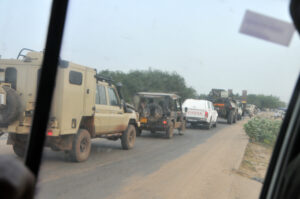
The aforementioned Operation Epervier (1986-2014) was a French military mission in Chad to protect its interests and repel enemies—notably Libya—of its regime in N’Djamena. It replaced Operation Manta (1983-1984) and was itself extended by Operation Barkhane (2014-2022), which covered the entire Sahel region and targeted jihadists. Operation Barkhane was supposedly discontinued in 2022 by Macron.
As Rolley said, “The French army has practically never left Chad since independence in 1960 [since colonization in 1900, one should say…] all the seizures of power have been by force of arms. If I were being cynical, I would say that we are taking our time to entrench this democracy” [Rolley p. 74].
But this policy, however sincere, doesn’t make sense. As U.S. reporter Ben Taub said in 2017:
“in pursuing stability, it strengthens the autocrat, but, in strengthening the autocrat, it enables him to further abuse his position.”
Furthermore, says English political scientist Nathaniel Powell, the French presence is also “potentially destabilizing as well, as the protection it provides helps remove incentives for reform, delegitimizes the government and provides effective international cover for the regime’s repression.”
Stability that suits the West rather well wherever it interferes or attempts to interfere, brandishing the concept of democracy when it suits its purposes. Succès Masra, former chief economist at the African Development Bank (AfDB), who became Prime Minister of Chad on January 1st of this year after being the subject of an international arrest warrant issued by the regime (!), puts an end to this: “France and [the United States of] America have always considered Chad useful for security. What about the expectations of our people? [emphasis added]” he asks, as reported by The Economist last November.
“France and the United States have always considered Chad useful to their security. What about the expectations of our people?”
As an aside: Stability is the same grand concept that governs China and drives it toward these policies—above all, the fear of a Muslim uprising in Xinjiang—that baffle Western populations and are exploited by Western propaganda.
Suspended Between Creation and Destruction
After being neglected as a colony, “The country spent the next several decades ‘suspended between creation and destruction,’ as the South African historian Sam Nolutshungu writes, in ‘Limits of Anarchy: Intervention and State Formation in Chad’ [1996].”
In Massaguet, our first stop 80 km northeast of N’Djamena, we stopped for tea and doughnuts at one of the roadside eateries along the main street. Our driver, Sheriff, has a house and a wife in this small town. It was here that, in early 2008, government forces personally led by Idriss Déby tried to halt a major offensive by rebels from the Union of Forces for Democracy and Development (UFDD) and the Rally of Forces for Change (RFC), who had come from the east of the country. They managed to enter the capital, but faced with tanks and helicopters of the Chadian army and aided by French logistics, they were repelled after two days of fighting that left several hundred dead, mostly civilians. This was a replay of the 1994 evacuation of Westerners by UN forces—in this case, French forces—in Rwanda, who had abandoned the Tutsi refugees who were being massacred. [Rolley p. 149]
Two years earlier, in April 2006, other rebels, from Mahamat Nour Abdelkerim’s United Front for Democratic Change (FUC), had already attempted to seize the capital. Idriss Déby boasted to journalists that he and his (fourth) wife, Hinda, were waiting for them, “listening to the cannon fire, because we knew they were coming, as we took our breakfast of strong coffee and warm croissant. It was amateurish, really. I am not going anywhere. They were petty mercenaries.”
Going back further, to 1979-1980, during the civil war, the city was partially destroyed when units from five separate Chadian armies fought in its streets. This explains the prohibition against stopping when driving past the palace and government ministries on Avenue du Général Kerim Nassour, to avoid being shot by the paranoid sentries.
Libya was one of the reasons for the Western presence in Chad
When we turned northeast after leaving Koro-Toro with its Australopithecus bahrelghazali and its prison, we skirted the Kapka massif on our right, which forms the border with Sudan about a hundred kilometers to the east. It was there, in 2007, that Timane Erdimi’s Rally of Forces for Change (RFC) launched its fight against the government forces of his uncle, Idriss Déby. The government forces joined the rebels because both sides were Zaghawa, a large ethnic group straddling Chad and Sudan. [Rolley p. 129]
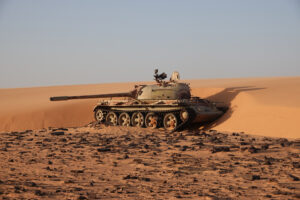
Further north, between the towns of Kalait and Fada, we came across tank wrecks and human remains in the middle of the dunes. The remnants of the “Toyota War”…
Libya was one of the reasons for the Western presence in Chad, which shares more than 1,000 kilometers of border in a straight line with the former Socialist People’s Libyan Arab Jamahiriya. Between 1978 and 1987, there were four Libyan interventions in Chad, allied with Chadian rebels, which were repelled by the Chadian army supported by France. It was only at the end that the Libyan-rebel alliance collapsed, leaving the approximately 300 Libyan tanks, with little infantry support, easy prey for the mobility of the Chadians in their famous Toyota pickup trucks equipped with anti-tank missiles.
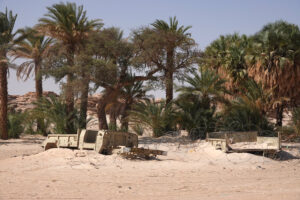
In September 1987, thanks to logistical support from France and the United States, which provided them with satellite intelligence, the Chadians destroyed the key Libyan airbase at Maaten al-Sarra, just a hundred kilometers from the border. Two hundred kilometers away on the Chadian side, in the village of Ounianga Kébir, we were able to see the remains of Libyan vehicles. (Ounianga had already been attacked in June 1977 by the Libyan-backed People’s Armed Forces (FAP) and saved by French troops. The FAP would later rebel against the Libyans and become the main faction of Chad’s Transitional Government of National Unity (GUNT) (1979-1982).)
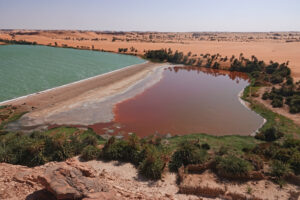
A series of brightly colored lakes in this region of sand dunes. In fact, since 2012 they have been a UNESCO World Heritage Site. While this may seem surprising given that less than 2 millimeters of rain falls annually, it’s worth remembering that some 7,000 years ago, there was the Mega-Lake Chad. There is a lot of water stored in desert aquifers—and not just oil! A thousand kilometers to the northwest, in Ubari, in the heart of Libya, lie magnificent lakes amidst towering dunes. The Sahara was not always a desert. The formidable winds that sweep across these regions carry tons of sand and alter the lakes’ landscape.
Lakes amidst towering dunes: The Sahara wasn’t always a desert
Just a few dozen kilometers south of the lakes, French aircraft under the command of François Mitterrand had already bombed the Libyan base at Ouadi Doum in occupied Chadian territory in February 1986. This marked the beginning of the infamous French military operation, Epervier, with its thousand troops, which was to last 28 years until 2014, extending well beyond the Libyan conflict, under the pretext of consolidating the democratic process, as we have seen.
Operation Epervier was immediately replaced by Operation Barkhane (named after crescent-shaped dunes), this time with more than 5,000 troops, against Islamists in the Sahel – later joined by the British, Estonians, and Swedes. It ended in 2022, “almost universally been interpreted as a massive disaster on the part of the French.” But French soldiers are still in Chad, and we encountered them in a long convoy en route to Abéché, a major city in the east flanked by a French military base.
After lengthy negotiations, and much to the dismay of the Reagan administration, which had hoped to use the war to overthrow Gaddafi, the two countries finally reconciled, especially after Idriss Déby—a protégé of Gaddafi—overthrew Hissène Habré in December 1990.
Gaddafi’s ambitions referred to a strip of desert called the Aouzou, roughly 100 kilometers wide, along the Libya-Chad border. His goal was “the creation of a client state in Libya’s ‘underbelly’, […] expulsion of the French from the region; and use of Chad as a base to expand his influence in Central Africa.”
[“The Roots of Violence: A History of War in Chad”, Mario J. Azevedo, 1998]
But this story goes back to the colonial era and is typical of the machinations of the former great powers. It all began in the aftermath of World War I, when the victors divided up the (relatively small) German colonies, leaving Italy a few crumbs as a reward for joining the Allies. The British gave a small portion (three times the size of Belgium) of Kenya, and the French dragged their feet until 1935, allowing the Italians to occupy Ethiopia—then independent under Haile Selassie—and ceding to them the desert strip—rich in uranium—of Aouzou. Far from being an act of generosity, it was in the hope that Mussolini’s Italy would support France against the rising power of Hitler’s Germany. A very poor calculation, as we know. The Franco-Italian Accords were signed in Rome by French Foreign Minister Pierre Laval and Italian Prime Minister Benito Mussolini on January 7, 1935. (In October 1936, Italy and Germany signed a memorandum of understanding establishing the famous Axis). Aouzou thus passed from French-occupied Chad to Italian-occupied Libya! But although ratified by the parliaments of both countries, the instruments of ratification were never exchanged.
However, in 1955, a “Treaty of Friendship and Good Neighborliness” was signed between Libya and Chad. And it was this treaty that the International Court of Justice preferred in 1994 to definitively delimit the border between the two countries, awarding the Aouzou Strip to Chad. Needless to say, the opinion of the Arabic-speaking tribes who inhabited it was never sought. “the court deemed irrelevant the de facto exclusive effective occupation by indigenous ihabitants of disputed uranium-rich territories which were clained by Libya and Chad was irrelevant.” This is a traditional practice of colonialists who declare that the lands they invade and occupy belong to no one, certainly not to any state, and that the inhabitants do not constitute a state, therefore they can appropriate them – the theory of terra nullius, also applied to Palestine in 1948 or to Africa during the scramble for new lands at the end of the 19th century, when seven European countries appropriated 90% of the continent by 1914. In 1870, they had only 10%.
The current trend in international humanitarian law is to guarantee the territorial rights of Indigenous peoples, that is, to require their free, prior, and informed consent (FPIC) to any exploitation of their lands.
[Indigenous Peoples, Title to Territory, Rights and Resources – The Transformative Role of Free Prior and Informed Consent, Cathal Doyle, New York : Routledge, 2015]
Indigenous peoples must give or refuse their consent to any exploitation of their lands
Human trafficking continues to this day
After our push northward towards Libya, we are now heading south again. Near Fada, the famous guelta – water pocket in Arabic – of Archei, at the foot of high glowing red cliffs, is the only one in the Sahara to contain water all year round, and there are some specimens of the West African crocodile (Crocodylus suchus), probably stuck in this corner of the desert when the waters receded a long time ago.
Abéché is 500 km away and takes a day to reach on a good, straight track. It is the capital of the Ouaddai Sultanate, founded in the 19th century by Arabs from the vast Abbasid Caliphate, which covered the entire Middle East, extending as far as India and North Africa, and reaching into present-day Sudan. They entered Chad either by following the Nile Valley and then Darfur in Sudan, or via the Fezzan and Tibesti Mountains, along the caravan routes. It was also through this region that the Toubou people—nicknamed the “Black Nomads of the Sahara”—descended. Our drivers and several Chadian officials, such as President Hissène Habré, come from this region.
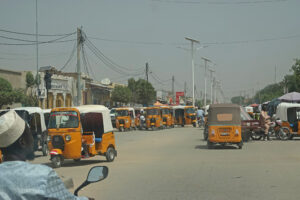
Abéché, for its part, lay directly on the caravan routes, with—as just one example—merchants bringing European fabrics, clothing, sugar, books, brassware, and horses from Morocco to Sudan to trade for civets (for perfume!), gold, and… slaves. The exchange rate could reach as high as one slave for twenty horses.
A gold mine: the slave trade. Initially centered in the Ottoman Empire, then on the African continent. In the north, from the 15th to the 17th centuries, according to the Ukrainian-Canadian historian Orest Subtelny, the Tatars, operating from their base around the Russian cities of Kazan and Samara, repeatedly invaded Ukraine to capture peasants and sell them in the slave markets of Constantinople or elsewhere in the Middle East via the Black Sea slave trade. Genoese and Venetian merchants, for their part, controlled the slave trade from Crimea to Western Europe.
In the south, as early as the 1st century CE, Arab merchants were buying slaves in the Sahel and Sudanese regions of Africa and transporting them across the Red Sea to the holy cities of Mecca and Medina, and as far as Baghdad, the Abbasid capital. In fact, the Hajj, the pilgrimage that every Muslim must undertake to Mecca, was “the greatest vehicle of slavery.” African tribal chiefs offered the journey to the faithful, leading them to believe they were going to the holy city, and as soon as they arrived, they were put up for sale in the slave markets. During the adoption of the United Nations’ Universal Declaration of Human Rights in 1948, which declared slavery a crime against humanity, the British & Foreign Anti-Slavery Society (founded in 1839) noted that there were still approximately one million slaves in the Arabian Peninsula! Meanwhile, England and the United States turned a blind eye so as not to embarrass their Arab allies. John F. Kennedy himself was eventually forced by newly independent countries and leaders in the Global South, such as Egypt’s Gamal Abdel Nasser, to take action against this human trafficking.
England and the United States turned a blind eye to human trafficking so as not to embarrass their Arab allies, but were eventually forced to act
The South-North slave trade is even older, dating back to the 3rd millennium BC when Egyptian pharaohs sought Nubian slaves in Sudan. In the 5th century BC, the renowned Greek historian Herodotus wrote of the Garamantes of Fezzan, in Libya, who owned Ethiopian slaves. Ancient Rome had a voracious appetite for slaves, who came from equatorial Africa via its colonies of Carthage and Leptis Magna, aesthetically magnificent on the Mediterranean. But it was primarily the Arabs, having introduced camel caravans, who multiplied this human trade tenfold, offering substantial profits to African chiefs… and to the inhabitants of the desert. While the Arabs led this trade, nomads worked as guards, guides, and camel drivers, while the Tuareg imposed a transit tax!
It is estimated that 10 million slaves—Black, but also some Arabs traveling in the opposite direction—passed through the trans-Saharan route. Before the New World, in turn, further fueled the demand. As renowned Harvard professor and Africa specialist Henry Louis Gates Jr. stated:
“The historians John Thornton and Linda Heywood of Boston University estimate that 90 percent of those shipped to the New World were enslaved by Africans and then sold to European traders. The sad truth is that without complex business partnerships between African elites and European traders and commercial agents, the slave trade to the New World would have been impossible, at least on the scale it occurred.”
It should be noted that the infamous and deplorable practice of female genital mutilation is linked to the trafficking of female slaves, according to a detailed scientific study on its historical origins conducted by an Italian team: “female slaves were sold as concubines in the harems, and infibulation was believed to enhance their chastity, decrease the likelihood of pregnancy during the journey from Africa to the destination countries, and to increase the concubines’ fidelity to their master upon arrival. Consequently, infibulated women commanded a higher price on the slave market in recognition of their higher ‘quality’”.
This concerns only East African women sold in the Arabian Peninsula, who were primarily destined for harems (thus the ratio was two women to one male slave). Other routes involved slaves destined for labor and therefore mainly affected men.
Another “discovery” has emerged recently: hundreds of migrants from Ghana, Nigeria, Cameroon, Zambia, Senegal, Gambia, and Sudan are being abducted and sold into slavery by officials upon their arrival in Libya, with women being forced into prostitution. “Salman, a human trafficker, detailed his routes through Libya, telling Al Jazeera by phone that his business had multiplied several times since the fall of Muammar Gaddafi.” Yet another fine result to be attributed to the West, which preferred to overthrow secular leaders like Saddam Hussein and Gaddafi—the latter being a great champion of women—only to see them replaced by fanatics, religious or otherwise.
A Chadian Darfur
According to Murray Gordon, author of “Slavery in the Arab World,” the trans-Saharan slave trade for centuries formed “the basis of the prosperity of the Kanem-Bornu empire,” which stretched across all of modern-day Chad. It is no wonder that Abéché, right on the trade route, both west-east and south-north, and also one of its origins, was the largest city in Chad when the French arrived at the beginning of the 20th century. The current capital, N’Djamena, didn’t even exist then, having been founded by the colonial authorities in 1900.
The city then rapidly declined, battered by taxes levied by the occupying power, the end of the slave trade, emigration to neighboring Sudan, and epidemics. But when we visited, it was still very active, with a large, labyrinthine, and bustling souk, a French hospital and base, and a significant presence of humanitarian NGOs: UNHCR, the Red Cross, UNICEF, and the German GTZ. Inevitably, Abéché is only about 150 km from Sudan and its region… Darfur, the humanitarian crisis—also called the first genocide of the 21st century—is the most publicized in the world since the Rwandan genocide of 1994. Actors and actresses Angelina Jolie, Brad Pitt, George Clooney, and Mia Farrow have all been there, as well as Richard Branson, the British magnate and co-founder of the Virgin Group, which controls more than 400 companies in various sectors.
Five weeks before our arrival in Abéché, a UN delegation, including the High Commissioner for Refugees, Filippo Grandi, and the US Ambassador to the UN, Linda Thomas-Greenfield, had visited one of the dozen Sudanese refugee camps in eastern Chad. There were some 500,000 crossing the border using rudimentary means—carts, donkeys, on foot—sheltered under plastic tarpaulins hung from bushes. And it was expected that many more would arrive before the end of 2023. These figures fluctuate and are impossible to determine, just like the nearly 400,000 Sudanese killed by the Janjaweed Arab militias since 2003, when the Sudan Liberation Movement (SLM), composed of three ethnic groups from Darfur (meaning: the House of the Furs): the Furs, the Zaghawa, and the Masalit, and the Justice and Equality Movement (JEM) rose up against the discriminatory policies of the Khartoum government, which in turn unleashed these Janjaweed Arab militias against the insurgents.
Darfur: One million Sudanese refugees in Chad?
Several parallels can be drawn with Chad. First, the Sudanese civil war was nicknamed the “Land Cruiser War,” just as the Chad-Libya war was the “Toyota War,” due to the presence of these pickup trucks in both cases! There, too, the government in Khartoum is dominated by Muslim Arabs from the north, while the south is sedentary, non-Arab, Christian and animist, and formed by colonialists. There are numerous land disputes between semi-nomadic herders and those practicing sedentary agriculture.
There, too, the United States (in Chad, it’s France) has downplayed its criticism of the Sudanese government accused of genocide in Darfur because, like Chad, Sudan is a “strong partner [of the West] in the war on terror,” according to the US State Department, and moreover, it possesses significant oil reserves. And as in Rwanda, the UN has merely observed the crisis. Gérard Prunier, a specialist in African conflicts, believes that the world’s most powerful countries have limited themselves to expressing concern and demanding that the United Nations act. “The UN, lacking initiative and will, initially allowed the African Union to deploy a symbolic force without a mandate to protect civilians.”
[Le Darfour : un génocide ambigu, Gérard Prunier, Paris, La Table ronde, 2005, pp. 124–148]
Similar condemnations come from the London-based Minority Rights Group (MRG), through its executive director Mark Lattimer: “Darfur simply would not be in this situation if the United Nations bodies had acted together after Rwanda: their action was too little, too late. This level of crisis, the killings, the rapes, and the displacement could have been foreseen and avoided.”
“As early as 2001, the UN Commission on Human Rights’ Special Rapporteur on Sudan began paying particular attention to Darfur, expressing concern about the deteriorating situation in the region. Despite this, in 2003, the UN’s main human rights monitoring body, the Commission on Human Rights, removed Sudan from its monitoring list and terminated the Special Rapporteur’s mandate!”
“The UN has had several opportunities to act in Darfur, but has failed to do so,” concludes Zoe Gray, MRG’s conflict and genocide expert.
Jan Egeland, UN Under-Secretary-General for Humanitarian Affairs and Emergency Relief Coordinator from 2003 to 2006, was the only one to blame the three governments involved in the conflict: Chad, Sudan, and the Central African Republic. Indeed, these governments accuse each other and act through rebels in their neighboring countries. In 2006, RFI correspondent Sonia Rolley witnessed the aftermath of intercommunal conflict on Chadian soil, including the testimony of an elderly woman, Djidé, severely burned in her home in Tamadjour, Chad, about sixty kilometers from the Sudanese border: “They burned my house. I was inside, I tried to get out, but I felt the roof collapsing on my back. When I finally managed to get out, I saw the Janjaweed killing everyone.” The Arab horsemen. The same ones who had wreaked havoc on the other side of the border, the perpetrators of the Darfur genocide, armed by the Sudanese government.
Hélène Caux of the United Nations High Commissioner for Refugees (UNHCR), who was familiar with the Sudanese side, drew a parallel with Chad: “These images of burned villages, charred bodies, and fleeing populations are the same as in Darfur,” as reported by Rolley, who specifies: “The horsemen sought to create a panic among the inhabitants and, by burning their huts, to condemn them to exile. There is therefore a desire to ‘displace’ populations, as is often the case in attempts at ethnic cleansing” [Rolley pp. 17-18].
Chad: “These images of burned villages, charred bodies, and fleeing populations are the same as those in Darfur”
Incidentally, this is precisely what the Israelis are currently doing – 2023-2024 – by relentlessly bombing Gaza and attacking the West Bank, creating panic and driving out the inhabitants in order to empty their territory and seize it for themselves.
It is worth noting the difference in importance given to Sudanese refugees sheltered under plastic tarpaulins hung from bushes, mistreated, raped, and ignored by the international community, compared to Ukrainian refugees welcomed with open arms in the West, whose “miserable conditions” we are constantly bombarded with.
Hélène Caux summarizes: “On one side, there is the Chadian army, the Sudanese rebels of Darfur, and the ‘African’ militias. On the other, the Sudanese army, the Chadian rebels, and the Sudanese or Chadian Arab militias” [Rolley pp. 22-23]. It’s difficult not to oversimplify.
It becomes even more complicated when you add the ethnic groups, for example, the Zaghawa. They are present both in the Chadian government (notably under Presidents Déby, father and son) and among the Chadian rebels, among Sudanese refugees and Sudanese rebels, and in the past, they were victims of slave raids…
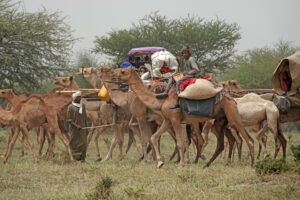
Another difficulty: leaders from the same clan and family vie for power, moving from rebellion to government, or vice versa. In the early 1980s, Déby father, was actually a high-ranking commander in the army of President Habré, whom he eventually overthrew. Saleh Kebzabo, mentioned above, was the main opposition figure under Déby father, before being appointed prime minister by Déby son…
We resume our journey south along the long, narrow asphalt road, riddled with potholes in several places, forcing us to drive on the track alongside it. There we encountered caravans of nomads, those who trade exclusively in livestock. We had never seen so many, one after another, heading south along the 750 kilometers of road that connects Abéché to the capital. A few horse-drawn carts, hundreds of donkeys carrying women and numerous plastic water containers, brightly colored clothes, yellow containers, thousands of beige camels with all the nomads’ camping equipment on their backs, topped by the chief’s wives, tens of thousands of white or brown oxen, often adorned with large horns, kicking up dust as they passed, hundreds of thousands of goats tended by children.
Numerous caravans of nomads: camels, oxen, donkeys, goats
One morning, we saw about a hundred military pickup trucks speeding along the road, loaded with equipment and soldiers, machine guns in hand. They passed us at over 120 km/h. This reminds me of the “speed of advance of the attackers” noted by journalist Rolley during the attacks on Abéché and N’Djamena [Rolley p. 31]. Suddenly, a crowd gathers at the roadside. Sheriff rushes over, and I follow behind. Soldiers with blood-covered faces are brought in and laid on the ground. A Toyota pickup truck has overturned. The driver had fallen asleep after driving for two days straight, a distraught officer explains. They were returning from an operation in the east of the country, near Sudan.
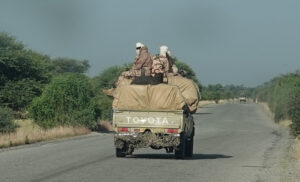
Apart from the military and convoys, there is very little traffic on this main thoroughfare. A few civilian pickup trucks and lorries, crammed full, and intercity buses speeding by even faster. At the entrance to the capital, the usual military checkpoints and paranoia: “Do you have weapons?”
Halfway between Abéché and N’Djamena, the road passes through the Guéra province, just north of the Zakouma National Park, which stretches to the Central African border. There you come across “The Queen of Guéra,” a large granite peak resembling the “Mindif Tooth” in neighboring Cameroon. This peak features in Jules Verne’s adventure novel, Five Weeks in a Balloon, published in 1863, in which three Englishmen fly over Africa from Zanzibar on the Indian Ocean coast to Saint-Louis in Senegal, passing over Lake Chad.
This peak was popularized by explorers such as Siegfried Passarge (1866-1958), a German who traveled through northern Cameroon, along the Chad River, with Lieutenant Ernst von Uechtritz, both Prussians. Passarge was a geographer and physician whose fanciful racial theories were adopted by the Nazis, notably his book “Judaism as an Ethnological and Landscape Problem” (1929). Needless to say, he placed the Prussians at the top of the human hierarchy and “the Negroes of the African coast” at the very bottom. The perfect racist. Between these two groups, he admired the Arabs and the Toubou, as well as the M’bororo Fulani for their Semitic traits… We will soon encounter these people in southern Chad.
[Adamawa. Rapport de l’expédition du comité allemand pour le Cameroun au cours des années 1893-1894, Siegfried Passarge, Paris, Karthala, 2010, p446]
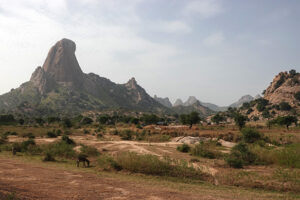
In the capital
A day of rest in N’Djamena before heading south. Living in a tent for three weeks, in temperatures of 40 degrees Celsius during the day and 5 degrees Celsius at night, with a “saken” (kettle, in Chadian Arabic) of water for washing, and canned food is grueling. But what about the Chadians?!
10% of houses are built with modern materials, 79% do not have latrines. Only 1% of the population has electricity
In the capital, you see 10% of the country’s houses built with modern materials, but 79% don’t have latrines. Only 1% of the Chadian population has electricity. Even in N’Djamena, at the Catholic mission in Kabalaye where we were staying, we went three days without electricity. The wealthy neighborhoods, of course, don’t experience power cuts. Residents of NGOs tell us they live in large villas and play tennis and go horseback riding. Meanwhile, Chadian civil servants walk to work because they can’t afford bicycles. While Chad ranks 10th in the world for oil reserves, it ranks 187th out of 192 on the United Nations Development Programme’s Human Development Index (0.394 compared to 0.967 for Switzerland, number one).
During the conflicts with neighboring Sudan and Chadian rebels in 2005–2010, “Chad earned between 10 and 11 billion dollars from oil production, and estimated 4 billion dollars were invested in the army” [“Chad and the West: Shifting Security Burden?”, Celeste Hicks, Africa Policy Brief: 1–2. Egmont Institute, Brussels, JSTOR, 2015]. The government simply added “national security” as a priority development sector within the framework of the World Bank’s economic plans, not that it followed them to the letter. It should be noted that the army does not serve to defend the country but to keep the president in power.
After that, when I see frivolous advertisements for Westerners to use foot massagers… The gap between the rich and the poor is immense and unsustainable in the medium term, both inside and outside the country.
We had just left N’Djamena at the time of Hamas’s offensive against Israel on October 7, 2023, and remained in Chad throughout October. We heard no news and saw no demonstrations against the genocide perpetrated against the Palestinians in Gaza. As the great Pakistani political scientist Eqbal Ahmad (1933-1999) (himself a victim of the partition orchestrated by the British when they finally left India) wrote in 1992, during the genocide of Serbs and Croats against Bosnian Muslims in the former Yugoslavia: ““As for the well-touted ummah, it is difficult to recall a more demoralized and corrupt community in the annals of history. Each of the thirty-odd ‘Islamic’ governments is dominated by self-serving rulers and country sellers. With the exception perhaps of Iran, all are beholden to a foreign power more than to their own people. All are addicted to armaments and to dependence on suppliers. All are littered with machines but command no technology. Not one is home to a university or research center of repute. They lack the will no less than know-how necessary to transform wealth into capital, importance into influence, resource into power”
[“The Selected Writings of Eqbal Ahmad, A Time to Remember”, p. 269]
“Each of the thirty ‘Islamic’ governments is dominated by selfish leaders and country-buyers. All are beholden to a foreign power.”
The Ummah is the community of Muslims, regardless of their nationality, or umma islamiyya, “the Islamic nation.” Such inaction and widespread betrayal regarding the Palestinians. Then and now.
If Chad was the sixth country to recall its chargé d’affaires from Israel on November 4th, after Turkey, Honduras, Chile, Colombia, and Jordan, it is because the current genocide has undoubtedly become too much, especially since the population is enraged. And a symbolic gesture costs the dictatorship little.
The Wodaabe of the Sahel
Massenya is only 165 km southeast of N’Djamena, but it took five hours by road and then track to reach it. Scattered houses here and there, dusty streets, litter—you wouldn’t guess that this “city” was once the capital of the Baguirmi Sultanate, founded in 1522 by the Barma, a people who came from… Yemen. This becomes clear when you learn that they were constantly at war with the two other kingdoms encompassing Chad: Kanem-Bornu and Ouaddaï (capital Abéché). Massenya was pillaged and destroyed several times. The last attack was fatal: “In 1871, Ali, son of Mohamed Chérif and Sultan of Ouaddaï, reappeared. His troops attacked Massenya again, pulverized its ramparts with gunpowder, looted the city, and took 20,000 to 30,000 prisoners, including all the artisans who would later contribute to Abéché’s prosperity at the end of the 19th century.” He also took the royal princes, who were then raised at the Ouaddaï court. [Smart pp. 41-43] King Sakine, for his part, had to pay a tribute: 100 male slaves, 30 female slaves, 100 horses, and 1,000 tunics.
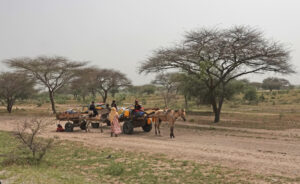
“Mass” means tamarind, and “Enya” is said to be the name of a woman met by the founder, Dala Irni, the second king of the Baguirmi Sultanate. The region is sandy, covered with these shrubs and acacia trees. This is the Sahel, the preferred territory of the Fulani—allies of the Barma, founders of Baguirmi—an ethnic group numbering up to 80 million individuals, difficult to estimate because they are scattered across some fifteen countries. Most likely originating from the north, they are established throughout West Africa and have genes that are one-fifth European (from migrations across the Strait of Gibraltar) and a few percent East African.
Although they converted relatively late, the Fulani were among the first to be Islamized in West Africa, where, starting in the 18th century, they established several Sunni caliphates (the caliph, successor to the Prophet, is a political and religious leader) or sultanates (the sultan is more politically powerful), the most important being Sokoto – I will return to this later.
The Wodaabe, a sub-ethnic group of the Fulani, are the only true nomads to have preserved their animist traditions
We arrive in the preferred territory of the Wodaabe, the only true nomads who have maintained their animist traditions – though superficially Muslim – and who only intermarry within their own group. The Wodaabe are a sub-ethnic group of the Fulani, known as “the people of taboos”—or pejoratively, M’bororo—because they follow strict traditions. “We have a code of behavior that emphasizes semteende (reserve and modesty), munyal (patience and fortitude), hakkilo (care and forethought), and amana (loyalty). This way of life, along with our many taboos, was given to us by our ancestors”
[African Ceremonies, Carol Beckwith & Angela Fisher, Abrams, New York 1999, p. 174]
There are still flooded areas because we are just at the end of the rainy season. Surprisingly, there are no mosquitoes where we are camping. Instead, there is a swarm of grasshoppers that end up in our food. And a swarm of Wodaabe watching us with curiosity. The feeling is mutual, as it also coincides with the Gerewol festival, a very special and colorful wedding ceremony that takes place after the rainy season. Beauty is a defining characteristic of the Wodaabe, who consider themselves very handsome, and are all tall and slender (like many other Chadians, for that matter).
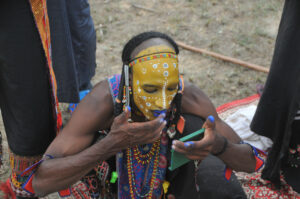
Sitting under the trees, the men spend the entire cool morning applying makeup to their faces with fine dots and a line across their noses. Their entire faces can be yellow, a magical color, or red, the color of war, but the Wodaabe are not violent, and instead of waging war, they dance. They use plant- or mineral-based pigments, such as ochre or blue powders made from battery acid, which they apply to their lips, or kohl, an artificial lead-based mixture that has been used since antiquity as an antibiotic or to boost the immune system. Widespread in North Africa as far as Somalia, women in Pharaonic Egypt already used it for aesthetic purposes, drawing the characteristic black halo of the time all around the eye, the hieroglyphic term “mesdemet” meaning “to make the eyes speak, expressive.” And the Wodaabe certainly do!
Their long tunics are equally elaborate, prepared by female relatives and adorned with countless beads, sequins, and tiny cowrie shells in as many colors as possible. Their headdresses—from which finely woven braids cascade—are four-meter-long turbans that they help each other wrap around their heads, or tall, multicolored, and meticulously crafted fezzes, topped with a feather, preferably ostrich, which replace the traditional conical hats of this nomadic people.
Watching them meticulously paint themselves in front of a small mirror, one sees that they follow symmetrical shapes, which they consider perfect. Everything indicates that “art is as much part of everyday life for the Wodaabe as finding grass and water for the animals,” as Mette Bovin, a Danish anthropologist and filmmaker who lived among them between 1968 and 2000, puts it. She believes these ceremonies are “a form of cultural resistance against the marginalization of their minority ethnic group that allow them to distinguish themselves from settled Muslims.”
It is also a way to escape their increasingly harsh daily lives, searching for pasture and water in the face of fierce competition—as evidenced by the countless caravans we encountered. They change locations once or twice a week.
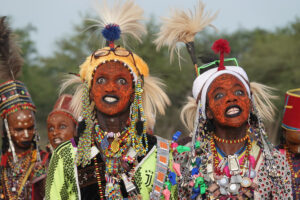
Art and spirituality are intertwined, as the designs they draw on their faces are full of symbols and protective and healing qualities, much like the talismans that hang from their necks or arms. These talismans are both traditional, like those contained in small leather pouches similar to those of the Tuareg, and modern, such as plastic whistles, small combs, or other miniatures. They particularly appreciate sunglasses with brightly colored frames, as do the little girls who playfully try to snatch them from us!
“What is not missing from their clothing are the gri-gris, small leather pouches that are completely closed and contain herbs, leaves or roots with magical properties, as well as small pieces of paper with suras from the Koran. They are used for things as varied as:
Making a man irresistible to women
Being invisible in the night
Protecting yourself from snakes
As a shield against the words of demons
And protect yourself from enemies
The Wodaabe also use many traditional remedies made from leaves, the bark of certain trees, or fruit. To fight madness, to cure venereal diseases, snake or scorpion bites, and so on and so forth.”
Cattle herds constitute the main economic and social wealth of the WoDaAbe
When the men are ready, they gather in groups of twenty or thirty at a time and form a circle, shoulder to shoulder, to perform the Yaake and Ruume dances for an entire week. They hop about frenetically to demonstrate their slenderness and endurance, singing high-pitched melodies that are as repetitive as they are hypnotic, smiling, grimacing, and rolling their eyes to show their whites, striving to imitate, this time in an active, aesthetic form, “the grace and elegance associated with the long-legged white cattle egret, attempting to harness the power of the bird,” as slender as the cranes or egrets they resemble. In fact, the dance and colors of the Wodaabe men resemble the ceremonies of male birds trying to attract a female.
This is why their cattle herds constitute their main economic and social wealth through their milk production. “Milk gives the body certain properties, its whiteness to the skin, but also to tooth enamel and the whites of the eyes. It gives the skin a shine that poetry compares to a mirror and a gold coin. Cow’s milk also gives the skin a certain softness, a radiance. Skin considered beautiful is thus based on the possession of two interdependent qualities, softness and radiance, which are obtained through regular milk consumption.”
“In the aesthetic appreciation made by women, other criteria are also considered, such as cleanliness and the animal’s ‘spirit.’ The cow is thus considered to possess a certain intelligence, because it ‘knows the way, knows how to stay in single file’ on narrow paths, without the shepherd having to show it the way, unlike goats and sheep. Cows are considered the only clean animals, because they do not lie down near their excrement, unlike hens or roosters. In women’s imagery of animals, their aesthetic appreciation is formulated according to how men use them. What is considered beautiful is what conforms to the domestic utility of the Fulani people; animals deemed ugly are those that are neither eaten nor used in their work. The descriptive terminology existing in the Fulfulde language and the attribution of qualities to the cow testify to its social importance.”
“The link between female status and milk is revealed in the rite of passage of the marriage, because the young girl receives from her mother the milk-measuring utensils and the calabashes that will hold the milk.”
And they are present. Dressed in equally colorful attire, the young women watch or dance in a circle, clapping their hands to the rhythm of their punctuated songs. Their faces are heavily tattooed; practically all of them, including the girls, have geometric designs created through scarification. For them too, charm lies in “having fine, regular features and a slender figure,” and they use kohl to “accentuate the contrasts between the light and dark areas of the face.”
They smile often. Ndiaye especially, staying by our side with her two-year-old child, smiles constantly. “A smile is a sign of affability and kindness and reveals beautiful white teeth.” A smile is essential to charm: “Even if you’re pretty, the jewelry you wear, the clothes you put on, it’s as if it’s all hanging from a piece of dead wood.”
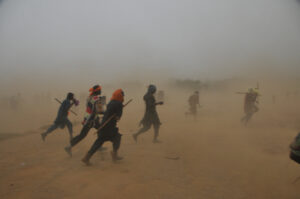
This is nothing without poise, or faro, the third element of feminine charm, after ŋari and blood, among the Djeneri Fulani of Mali, in the case studied by Dorothée Guilhem, an anthropologist at the CNRS – University of the Mediterranean in Marseille: “A ‘beautiful’ gait is characterized by a slow rhythm of step and arm movement. The arms are held close to the body to accentuate the silhouette.” This is a beautiful description of the Wodaabe women here in Chad, who are above all very human, laughing, joking, and curious from childhood. Like little Hawa, who never stops skipping around us with her friends.
[“Le charme féminin chez les Peuls Djeneri du Mali: Un «objet» de la nature ou de la culture?” Dorothée Guilhem, revue Anthropologie et Sociétés, Volume 32, numéro hors-série, 2008, p. 11–17].
Wodaabe women have strong personalities; they choose their men and can have several, and change them
Suddenly, in a matter of seconds, a wind rises so strong that the air fills with sand, obscuring the sky and the earth. Everything turns orange; visibility is limited to the end of one’s nose, and one must cover oneself with whatever cloth is at hand. Then comes the flight toward the protective trees. It lasts long enough to calm the spirits and coat every orifice with fine particles of sand. Among the trees are also the denki or suudu, the Wodaabe “huts,” rudimentary two-story structures resting on a dozen simple sticks, no more complicated to dismantle than tents. The first level serves as a bed, while above it they store all their belongings: gourds, baskets, cooking pots, teapots, jerrycans, and clothing. Here, young children play while their mothers prepare millet and yogurt, along with milk, the essentially vegetarian and constant diet of the Wodaabe, who do not like to slaughter their livestock. Not only to ensure their sustenance but also as a matter of social status, the more animals one owns, the more respect one commands.
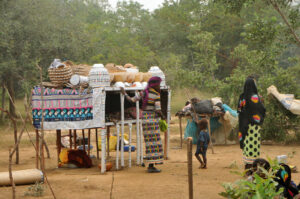
In the evening, the dances intensify under the light of flashlights. Inside the circle, the elders supervise and maintain the dancers’ posture and rhythm, and chase away any overly forward children. Then comes the Gerewol, the final phase. Shy but attentive, the young women choose one of the dancers as a husband or simply as a lover. As in Islam, “A woman must conceal her emotions from others during social interactions.” Semteende, modesty, and restraint are the code of conduct of the Wodaabe, who have the expression: “a woman walks like a cow,” because she looks at her feet as she walks. Dragging their bare feet or wearing stockings, they approach the dancers one at a time, covered with a thin veil, touch the heart of their chosen one, and quickly retreat. At the end, the clan chief gives a speech.
Wodaabe women have strong personalities. Not only do they choose their husbands and can have several, even changing them, but it was they, not the men, who came to visit us at the camp. In fact, on all our trips, it’s the women and girls who have real conversations, while the men and boys generally just stick to macho posturing. As we saw, it’s a Fulani woman, Hindou Oumarou Ibrahim, who represents the Association of Fulani and Indigenous Women of Chad (AFPAT), and who gave this excellent presentation on Lake Chad at the famous TED conference in California.
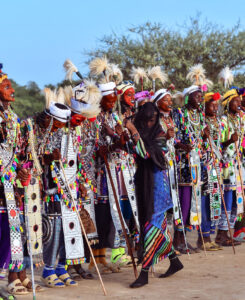
She explains: “Men talk always, women just sitting there, but in the back. They are not there to take any decision. So after the men figure out all the knowledge, we say, well, you call the women, “Come and have a look.” They say, “Yes, sure,” because they’ve already done the first work.”
“When the women come, and they look at the map, they’re like, ‘Mm, no. This is wrong. Here’s where I collect the medicine. Here’s where I collect the food. Here’s where I collect’… So we changed the knowledge in the map, and we called the men. Well, they think about what women said. All of them shaking their heads. ‘They are right. They are right. They are right.’ So that’s how we build the capacity of the women in giving them a voice in this 3D participatory mapping, so women get the detailed knowledge that can help the community to adapt. And man have the bigger picture knowledge. So when we put it together, this map helps them to discuss but to mitigate the conflict between the communities to access the resources, to share better these resources, to restore it and to manage it for the long term”.
[Indigenous knowledge meets science to take on climate change, Hindou Oumarou Ibrahim, TED Women 2019
Where do the Wodaabe Fulani come from? This is a question that arises because they are quite different from other Chadians and West Africans, “neither white nor black, as their skin is rather coppery. Their hair is “straight and long”, and their facial features are fine.” They are instantly recognizable. A bit like the Kalash of the Pakistani Himalayas, who are physically and culturally distinct from the general population and whom some claim are descendants of Alexander the Great’s soldiers, a claim that has not been scientifically proven.
The South
We leave the Wodaabe and head towards the Sara, a catch-all term used by the French colonialists to refer to some twenty rather heterogeneous ethnic groups living in what they arrogantly called “useful Chad,” meaning productive for the metropolis, as opposed to the northern desert. Still ignorant and disdainful of indigenous cultures, for them the “Sar” were “the first people anyone heard of in Europe, following the publication of the Memoirs of Count d’Escayrac de Lauture” (1826-1868), a French explorer and diplomat.
[Mémoire sur le Soudan, Escayrac de Lauture, p. 150-200 in “Terres de lignage et Etat chez les populations dites « Sara » du sud du Tchad (XIXe-XXe siècle)”, Jean-Pierre Magnant, p. 395]
The country’s leaders came from the south before the northern nomads took power in 1979
We are in the region of the Chari and Logone rivers, which meet at the capital before flowing into Lake Chad. Joseph, a Massa—another ethnic group along the Logone—welcomes us to Bongor. This city of some 44,000 inhabitants marks the beginning of the bush in the southern half of Chad, a much more populated, literate, Christian, settled… and green region. The country’s leaders came from here—notably François Tombalbaye (1918-1975), Chad’s first president (1960-1975)—before the nomads from the north seized power in 1979. Their power was vastly disproportionate to the population: 53 inhabitants per square kilometer in the south compared to 0.1 in the Borkou and the Saharan Ennedi. One million inhabitants in the city of N’Djamena (100 km²), compared to 25,000 in the entire Tibesti region to the north (100,000 km²). And the Sara people represent a third of the country’s population. We also met several southerners in the north working in healthcare and other public administrations, as they are more educated and… more numerous.
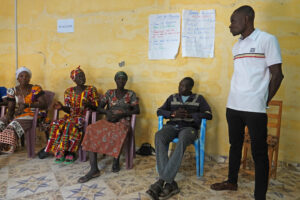
Joseph and Rachel, his Swiss wife, founded Akwada (a name meaning “that’s very good, agreed, OK!” in the local language) in 2012, a non-profit organization that aims for the socio-economic and cultural development of the inhabitants of Bongor and its surrounding area. They are even expanding their reach by organizing a festival of the Peoples of the Logone Valley. Given the needs, they have numerous projects, especially in education, and have created a primary school to address the lack of educational facilities and the low level of teachers. It’s difficult to find someone who doesn’t make grammatical or spelling mistakes. At the time, André Gide complained about teachers who were only capable of teaching “errors” [Gide p. 223]. (The same was true in Europe, by the way. Some time ago, a Swiss doctoral student in biology sent me a request for ornithological information… riddled with spelling and stylistic errors.) Gide describes “children so attentive, so eager to learn, so miserably helped by such inadequate teachers.” The same applies to the content dictated by Paris. In Nola, a prefecture across the border in the Central African Republic, he saw that children in these equatorial regions were being taught that “slow-burning stoves are very dangerous” and that “Our ancestors, the Gauls, lived in caves”… [Gide p. 222-3]
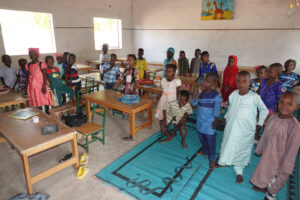
In Chad, the national education budget barely exceeds 2% of GDP (the world average is close to 4%) and reaches 3% for military spending (world average 2%). To send their children to this private school in Akwada, parents pay around fifty euros per school year, which covers operating costs, including a morning snack and the creation of additional grade levels. But the private sector plays only a negligible role. Thus, in 2014-2015, only 11% of all students were enrolled in private primary schools and 6% in lower secondary school [World Bank budget].
At recess, we were surrounded by a swarm of smiling, curious children, excitedly crowding around us after patiently lining up for a plate of very tasty and nutritious beans (we got some too!). The less interested children were riding and pushing a large tortoise that had just given birth to a series of babies.
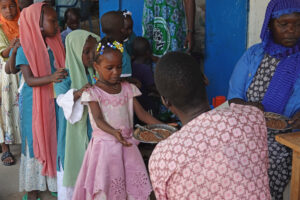
A young French couple volunteering for a Catholic diocese in the south joined us. All the dioceses are located in the southern part of the country, and the further south you go, the greater the Catholic presence: 16% in Laï, 28% in Moundou, 29% in Goré on the border with the Central African Republic, where they represent 38% of the population compared to 20% in Chad. As for Congo—the neighboring country—nearly half the population is subject to the Pope, the Church having benefited from, and fully supported the colonial power (hence the attacks it suffered at independence, unlike Protestant missionaries), as also happened in Latin America with the conquistadores and this same papal church. They are spread across 41 dioceses compared to Chad’s six! Moreover, the few nuns we met in N’Djamena all came from Congo.
The further south you go, the greater the presence of Catholics
The two French people tell us how their local priest openly embezzles funds. The bishop turns a blind eye. He knows that becoming a priest in these regions is often more a way out of poverty than a true vocation. Perhaps less so among Protestants, who are a clear minority. Sects—generally headquartered in England or the United States—do not cater to the “starving masses.” Becoming a member of a sect is, in a way, a form of ennoblement, observes the highly humanist Polish traveler and journalist Ryszard Kapuscinski—a Nobel Prize in Literature nominee and friend of Gabriel García Márquez—who crisscrossed Africa overland starting in 1957 [Ebène p. 332].
In any case, this Western belief seems more superficial than Islam in the north. According to Gide, “Through contact with Islam, this people becomes exalted and spiritualized. The Christian religion, from which they too often adopt only the fear of hell and superstition, too often makes them cowards and deceitful” [Gide p. 223]. Thus, in the south, ancestral practices continue. Especially magic and sorcery, and in particular initiation—the yondo—a phenomenon as astonishing as it is enigmatic because it is so secretive. In short, young adolescents are taken for a few days into the bush and subjected to rites administered by the elders so that they can enter adulthood. Above all, they learn respect for their elders, a disgust for theft and violence, and the meaning of suffering. When they return, they are supposed to be like newborn babies, without remembering who their family, friends, or surroundings are. They even bear a new name. The two Frenchmen reported the case of an acquaintance who did not recognize his family. They themselves had to remain locked inside their home for three days during the day to avoid the risk of being targeted during these rather violent rituals, during which they heard terrifying screams. Incidentally, only boys go through this; for girls it’s… female genital mutilation, but only in more isolated regions, and it’s a practice that is strongly opposed.
When he was administrator in Ubangi-Shari, present-day Central African Republic, which borders Chad, Félix Éboué, who was very keen on sport as a training discipline and as a way to enhance one’s standing in the eyes of the Whites, believed that initiates were the “custodians and jealous guardians of the rites and customs that [non-initiates] must observe without having to interpret them, the role of these initiates being precisely to ensure the survival and respect of the law established by the ancestors.” Thus, initiation “disciplines the individual and enables him to make himself useful to the community.”
[Félix Éboué, Le sport en Afrique Équatoriale, Le Monde Colonial Illustré, n°103, mars 1932, p. 60-61 in Félix Eboué, 1884-1944: mythe et réalités coloniales, Arlette Capdepuy, Histoire, Université Michel de Montaigne- Bordeaux III, 2013, p410-412].
Chad’s first president launched the Cultural Revolution in 1973 to assert African authenticity and reject Western values
After him, Chad’s first president, François, who took the native name of N’Garta Tombalbaye (1918-1975), a very authoritarian figure, launched the Cultural Revolution in August 1973 to assert African authenticity and reject Western values. Chadians were forced to Africanize their names, and Fort-Lamy became N’Djamena. University professors, ministers and other high-ranking officials, bankers and businessmen—especially those educated abroad—were sent into the bush for several weeks to undergo the yondo. Those who refused were killed, sometimes buried in the sand with only their heads protruding, like more than a hundred Protestant pastors. This paralyzed the already troubled country. It’s worth noting that Tombalbaye was a Sara, from the south. After him, the Muslims from the north seized power and never relinquished it.
To think or not to think
Perhaps we should indeed speak of superstition. Gide, who spent nearly a year in French Equatorial Africa, from July 1926 to May 1927, recounts the difficulty of conducting censuses because the peasants believe that “counting a herd and identifying the individuals brings bad luck to them. ‘How many goats do you have?’ ‘If I count them, they’ll all die,'” and he reports the words of the philosopher-anthropologist Lévy-Bruhl, according to whom the concept of chance does not exist for the native. Thus, “the crocodile is ‘naturally harmless,’ and if it happens to bite a man, it is because a sorcerer has delivered him” [Gide p. 248-9]. Or, if a man falls into the water and drowns, one must absolutely not rescue him because it is divine will and the consequences may fall upon whoever dares to go against it.
Here is a rather harsh and lengthy passage from Lévy-Bruhl, which I will abridge—it concerns a native: “He falls into the water by accident and is about to drown: immediately he becomes an object of fear and repulsion. Not only is there no haste to rescue him, but if he appears to be saving himself, he is prevented from doing so; if he reappears on the surface, he is pushed back into the water. Even if he manages to survive, the social group refuses to admit that he has escaped death. He is no longer recognized. He is an outcast. The feelings he inspires, the treatment he receives, are reminiscent of the excommunicated of the Middle Ages” [Gide p. 329], another era rife with superstition.
The English missionary William Holman Bentley (1855-1905) noted, regarding the Bantu people of the Congo who carried bales of cloth along the Congolese coast: “Every one said that the cloth was made by dead men under the sea. The whole thing was so hopelessly mixed with magic and the occult, that their ideas only went as far as they could see’” [“Pioneering on the Congo”, W.H. Bentley, I, p. 256 in Lévy-Bruhl p10]. These supernatural beliefs seem to contradict what the Jesuits reported about the Iroquois in North America, namely that they only believe what they see [“Jesuit Relations, 1611-1672”, Volume LVII, p125 in Lévy-Bruhl p2 & 3].
What is far from sight, or rather from reality—their reality—can thus be magical. The 52-year-old Boudouma who asked us if he could walk to Europe, in turn, asked me my age, and I had him guess. “100 years old?” he ventured…
Lévy-Bruhl distinguishes between the two fundamental mentalities of humanity: “The primitive mind does not differentiate the supernatural from reality but uses “mystical participation” to manipulate the world. According to Lévy-Bruhl, the primitive mind does not address contradictions. The modern mind, by contrast, uses reflection and logic.” [Gide p. 249]
What is out of sight, or rather out of reality, can be magical
This needs to be qualified. “The African, Negro or Bantu, does not think, does not reflect, does not reason, if he can do without it [emphasis added],” W. H. Bentley specifies. But he is fully capable of doing so if the need arises. Answering questions he deems non-essential is not. The Protestant missionary David Crantz of the Moravian Church said of the inhabitants of Greenland, where he stayed in 1759: “Their reflection or invention unfolds in the occupations necessary for their subsistence, and that which is not inseparably associated with this never stops their thought” [The History of Greenland, 1765-1766, I, p. 135 in Lévy-Bruhl p. 2].
One day, our Spanish fellow traveler Pablo asked Sherif what he thought of our group of foreigners and our customs—something which, as a more experienced traveler, would not have been my own. It never occurred to me to do this:
Pablo – “What do your children think when you come back from a trip with foreigners?”
Sherif, after thinking for a moment – “They don’t think anything, they just know I was with white people to make money.”
This was of no interest to our driver, who considered himself happy and satisfied to be doing his job well – driving very safely – and at the end of the three weeks, to be able to return to his family without having to ask himself questions he deemed useless, or even harmful.
Thus, the husband of a Boudouma woman held captive by Boko Haram used to disappear almost every night. When the U.S. reporter Ben Taub asked her if her husband had participated in jihadist raids on those nights, she didn’t know: “He never told me what he was doing, and I never asked him any questions.”
W.H. Bentley notes, regarding the Bantu of the Congo, that “A man who dabbled in such philosophy would be a marked man, a witch, a danger to the community.”
[Pioneering on the Congo, I, p. 256 in Lévy-Bruhl p10]. Did not Europe also experience this in the Middle Ages with the persecution of so-called witches, when misunderstanding and primitive ignorance prevailed?
On the other side of the world, the Danish-Greenlandic anthropologist Knud Rasmussen (1879-1933), who lived for a year among the Eskimos, reported about them: “All their ideas revolve around whaling, hunting and eating. Apart from that, thinking about them is generally synonymous with boredom or sorrow.”
[Neue Menschen; ein Jahr bei ben Nachbarn des Nordpols, pp. 140-1 in Lévy-Bruhl p. 3]
It is therefore a matter of cultural trait and a conscious choice based on constraints, generally financial, and not of intellectual capacity. Thus, the children of immigrants—or those who have the opportunity to study in a Western institution in their country—achieve at least as good a performance as Westerners, and often better.
“Although there are minds among them as capable of the sciences as those of Europeans, nevertheless their education and the necessity of earning a living have reduced them to such a state that all their reasoning does not extend beyond what pertains to the health of their bodies, the successful pursuit of hunting, fishing, trade, and war. And all these things are like so many principles from which they draw all their conclusions, not only for their dwellings, their occupations, and their way of acting, but even for their superstitions and their deities” [Lévy-Bruhl p. 2].
The English vlogger Harry Jaggard brings back the same image from Afghanistan: a lack of thought and education. Welcomed into the tent of Gulap Khan, leader of a nomadic encampment of about thirty families, near Kandahar, he asks questions through an interpreter.
Harry: What do they think of the Western world?
– They only remember the charities they received from the NGOs in the past, but now it has stopped and he receives nothing
– Do they have any questions they want tor ask me
– No. All their life they are just living in the desert that’s why he cannot read and write because they are poor
Then, in town, he meets 72-year old man working with mill on the floor:
– I have no money that’s why I have to work
Harry: “people are often too busy fighting to survive, so they don’t have time think about happiness, happiness does not come into the equation”
Harry: the level of English is so bad here, most people are illiterate, they cannot write even in their own language, and that reflects the level of education here in Afghanistan
To another Afghan man:
Harry: “ask him what’s their favorite thing about Afghanistan”
– “He doesn’t have an answer because it’s the first time he has been asked this kind of question but he’s happy with his life.”
But even in the West, there’s this race for survival that leaves no leisure time, much less time for reflection. And even in intellectual circles, this distinction exists. One could say that thought, especially philosophical thought, is a luxury and superfluous, not directly relevant to our survival. I remember my Greek friend Dimitri, an allergist and researcher at Harvard, telling me how lucky I was to be able to write and to have time to think. He himself only devoted the necessary time to the subjects that concerned his scientific research, those under his microscope. That is, the search for allergens or foods.
After spending nine years in Greece where I completed my secondary education, I returned to Belgium for university and was astonished to see that Belgian students were preoccupied with and discussed three main topics, in order of importance: beer, cars, and their pensions—even sex came last. This was a far cry from our societal and political concerns under the military dictatorship (1967-1974) in Athens. Necessity is the mother of invention. Some events force you to think.
A parallel can be drawn again among the Mossi of Western Sudan, where Father Eugène Mangin (1877-1922) spent ten years of his life: “Conversations revolve almost exclusively around women, food, and, during the rainy season, crops” [White Fathers, The Mossi. Anthropos, X-XI, p. 325 in Lévy-Bruhl p. 10]. The West is no exception to this rule. People think as little as possible, only when forced to do so to solve a personal problem. There is even a tendency to view intellectuals with suspicion. Even the Petit Robert dictionary defines the adjective “intellectual” as the second word: “Having a pronounced (or excessive) taste for matters of the intellect and mind!” How could one possibly have too much taste for intelligent subjects, topics, or a way of life? This is a tendency that we should, on the contrary, be promoting in our hyper-materialistic society: asking questions, lots of questions.
In our time, a new Middle Ages, faith is once again taking precedence over reason
Thus, my friend Dimitri—a true Greek, from a country that straddles the line between developed and developing—looked at me almost with irritation or even perplexity. This echoes what Rasmussen reports: “‘What are you thinking about?’ I asked one day, while hunting, an Eskimo who seemed deep in thought. My question made him laugh. ‘Well, you white people, so preoccupied with thoughts; we Eskimos, we only think about our meat caches: will we have enough or not for the long winter night? If there is enough meat, then we no longer need to think. I have more meat than I need!’ I realized that I had offended him by attributing ‘thoughts’ to him.”
[Neue Menschen; ein Jahr bei ben Nachbarn des Nordpols, pp 140-1 in Lévy-Bruhl p3]
I will extend Lévy-Bruhl’s conclusion to the entire planet, including the West, especially in our era of a new Middle Ages where faith is regaining ground over reason: “In short, the set of mental habits that excludes abstract thought and reasoning properly speaking seems to be found in a great many inferior societies, and to constitute a characteristic and essential trait of the mentality of primitives” [Lévy-Bruhl p11]. We are the new primitives.
Ah, but I haven’t introduced Lucien Lévy-Bruhl (1857-1939), a French philosopher who specialized in sociology and anthropology. He graduated first in his class in the philosophy agrégation at the École Normale Supérieure in 1879, was president of the French Institute of Sociology, and author of “La Mentalité primitive” (1910), which some consider a “precise and valuable contribution to anthropology, perhaps even more so than the better-known work of Claude Lévi-Strauss.” In 1904, he also contributed to the creation of the newspaper L’Humanité—initially socialist before becoming communist—with more than a quarter of its capital. Incidentally, Lévy-Bruhl was a cousin by marriage of Alfred Dreyfus, whom he defended… Quite a great intellectual who had the opportunity to reflect!
Superior Peoples and Inferior Peoples
On one positive note, I should mention that our fellow traveler Pablo’s question to our driver at least had the merit of placing him in the very small category of foreigners—visitors, politicians, journalists—who are interested in the local population, their interests, their needs, their way of life. In our own group, my partner and I were the only ones to converse and fraternize with the local drivers. All our companions were interested in was seeing sites and taking photos, and in the evening, getting together to drink amongst themselves, ignoring the locals who were at their service. Typical. A double lack of respect, given the prohibition of alcohol in the Muslim religion to which the drivers firmly adhered.
“What interested Parisian newsrooms and their readers” was the fate of the French rather than that of the Chadians
The French journalist Rolley made the same distinction during the rebel attack on N’Djamena in February 2008, reporting that “what interests Parisian newsrooms and their readers” was the fate of the French rather than that of the Chadians, even though several hundred of the latter had lost their lives in the fighting [Rolley p. 161]. She also recalled how UN peacekeepers evacuated foreigners, abandoning the locals during the Rwandan genocide in 1994 [Rolley p. 150].
This difference in mentality obviously had a direct impact on colonialism. Recently, the French historian of philosophy and anthropologist Frédéric Keck reports: “From a more political point of view, Lévy-Bruhl’s work, because it aimed to demonstrate that each society has unique and coherent frameworks through which to understand reality, led to the uncovering of the destructive and dramatic consequences of the contacts imposed by Europeans on other peoples, and a fortiori of colonization. For this reason, it fueled the discourses of reformist colonial administrators calling for respect for so-called indigenous cultures, but also radical critiques of colonization, for example in Paul Nizan.”
[Préparer l’imprévisible. Lévy-Bruhl et les sciences de la vigilance, Paris, PUF, 2023]
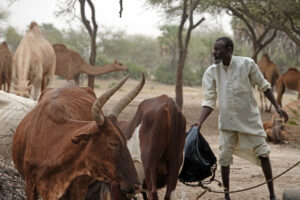
Jules Ferry (1832-1893), on the other hand, President of the Council of Ministers, minister, pamphleteer, etc., the quintessential colonialist, spoke of France’s “civilizing mission” and believed that “Superior races have a right over inferior races; they have a duty to civilize inferior races.”
This was the official thinking of the time. Joshua J. Mark, professor of history and literature at Marist College in New York State, says: “Although late-19th/early-20th-century CE European scholars made much of the “civilizing” influence of the Romans on the “natives” of Sub-Saharan Africa, modern scholarship makes clear the people with whom the Romans interacted already had highly developed civilizations and rich cultural heritage.”
The European conquest was more of a unification, carried out brutally, by force of arms and fire
I take this opportunity to correct the common view that Europeans divided Africa (along artificial borders). Professor Roland Oliver (1923-2014), who traveled extensively throughout the continent at the same time as Kapuscinski and who initiated its contemporary study by founding the Seminar on African History at the School of Oriental and African Studies (SOAS) at the University of London, argues on the contrary that “It was more of a unification, carried out brutally, by fire and sword! From two thousand [small states, kingdoms, ethnic unions, federations], we went down to fifty” [The African Experience, 1991 in Ebène p. 371].
Eurocentrism, everywhere, always
This is an opportunity to reiterate my credo: do not be Eurocentric when approaching other cultures. The Polish traveler and journalist Kapuscinski identifies two problems. First, the mentality of those venturing into these new territories, alongside a small minority of scientists, whom he aptly describes as “obscure, stubborn, boorish, insensitive, illiterate mercenaries,” in other words, “an obscurantist class” that established initial relationships based on “the most primitive criterion: skin color” [Ebène p. 369].
Then, language: “Every European language is rich, but its richness serves to describe its own culture; it is there to represent its own world. When it tries to approach and describe another culture, it reveals its limitations, its immaturity, its semantic disarray” [Ebène p. 371].
So even with good intentions, approaching a very different people is very difficult and requires a great deal of time, sensitivity, and open-mindedness, because prejudices are deeply ingrained from early childhood and are formed within the surrounding culture. As Gide said: “The people of these primitive tribes, I am increasingly convinced, do not have our way of reasoning; and that is why they so often seem stupid to us. Their actions escape the control of [Western] logic, which, from our earliest childhood, we have learned, and through the very forms of our language, to be unable to do without” [Gide 334-335].
Émile Bruneau de Laborie (1871-1930), a French duelist and boxer before going to “explore” Africa, also learned this lesson, he who “was initially irritated by certain faults [according to the author, Gide] of the natives of this country, faults which unbearably contradicted our methods and habits: ‘One then distinguishes, in these primitives [according to the author, Laborie], rugged and strong qualities, unsuspected at first; one discovers them to be sensitive to kindness, faithful in their attachment and gratitude, hospitable, capable of forgetting their greed for unexpected liberality, their selfishness for generous assistance’” [Gide 342].
Bruneau de Laborie, while serving as a hunting inspector in the colonies, detailed his “exploits” in his book “Chasses en Afrique française: carnets de route” (“Hunting in French Africa: Travel Diaries”): “In May 1925, while in the Chad region, he killed eight buffaloes, a lion, and a panther. Later, in August 1927, still in Chad, he killed four buffaloes, three rhinoceroses, five elephants, and three lions […] Numerous trophies adorned his Parisian apartment”
[Bruneau de Laborie : homme d’épée, explorateur, chasseur de grands fauves (Man of the Sword, Explorer, Big Game Hunter), Pierre d’ Hugues, Société d’éditions géographiques, maritimes et coloniales, Paris, 1939].
In a twist of fate, he died in Bangui, the capital of the neighboring Central African Republic, at the age of 59, from a lion bite.
Gide, for his part, witnessed the killing of hippos by his paddlers during his journey on the Logone River [Gide p. 339-345].
No doubt we shouldn’t judge by our own time either. Keoladeo National Park in Rajasthan, India, offers an enchanting landscape of savannah and marshland, as well as excellent birdwatching opportunities. We saw several of the 400 bird species, including a pair of Spotted Owls (Strix occidentalis) cuddling, a pair of Yellow-legged Green-Pigeons (Treron phoenicopterus) perched on a branch, and three species of magnificent kingfishers.
The Maharaja of Bharatpur used Rolls Royces, which he converted into hunting vehicles, to transport his guests in Ghana
But it wasn’t always so idyllic, as evidenced by a commemorative plaque celebrating the “exploits” of those dear Englishmen who, after massacring a thousand unarmed Sikh protesters at Jallianwala Bagh (Amritsar) on April 13, 1919, under the orders of Colonel Reginald Dyer, became “civilized” only to exterminate, two decades later, in the person of the Viceroy, Lord (again, those bogus titles) Linlithgow, “only” 4,273 wild ducks and geese in November 1938.
Indeed, this park—also known as Ghana (Dense)—had been created in the 19th and 20th centuries by the local maharaja as a hunting ground for himself and his English guests. “The maharaja of Bharatpur used Rolls Royces, which he converted into shooting brakes, to transport his guests within Ghana”, “their great duck shoots were a major event in the sporting (sic) calendar of old Imperial India, and the british pro-consuls and generals used to vie for invitations”, notably this Linlithgow who “had two loaders to help him reload, and his guns got so hot that they had to be cooled down by sloshing them regularly with water.”
Even environmentalists didn’t have the sensitivity we have—at least some of them—today. During his journey up the Logone River, Gide compassionately describes the illness and death from pneumonia of his pirogue’s captain. This man had been Percy Powell-Cotton’s (1866–1940) guide to Chad. Another Englishman! Back in his country, he founded an ethnographic and natural history museum, but with “the largest collection of game ever shot by one man!” 6,500 mammal specimens that he killed and brought back from Africa and Asia. He too was bitten by a lion he was trying to kill, but, unlike the Frenchman Laborie, he survived.
What a journey mentalities have undergone in a century! We no longer slaughter animals—except for poachers—but still do people. As for me, I’m content to snap photos of these impressive mammals that we encounter in large numbers in the river, often in family groups, with only their heads breaking the surface: I’m talking about hippos.
Marc Allégret, Gide’s companion on this African journey, filmed them. With this documentary, he began his career in film, launching the careers of some of the most famous French actors and artists: Fernandel, Raimu, Jean-Louis Barrault, Josephine Baker, Simone Simon, Michèle Morgan, Bernard Blier, Danièle Delorme, Gérard Philipe, Daniel Gélin, Brigitte Bardot, Jean-Paul Belmondo, Alain Delon, and Johnny Hallyday.
On the Logone River with André Gide
Lack of motivation, education, and material and financial resources: the level of culture is very low. The national museum in N’Djamena is bare, especially considering the size of the building that replaced the old town hall, requisitioned in 1964 to house the collections, two years after the museum’s founding. Some ceramics and other everyday objects presented very simply, the history of rock art with photos, and a Sao burial described by the French ethno-archaeologist Jean-Paul Lebeuf (1907-1994) as a large urn in the bottom of which the deceased was placed in a curled-up pose, “arms surrounding legs folded on the chest, chin resting on knees, the corpse previously embalmed (?), rubbed with oil, dressed in its finest clothes and adorned with jewelry”.
All of African origin. We are all migrants
There are also a few political facts, including a photo of King Faisal of Saudi Arabia’s visit to Fort-Lamy in November 1972, where he was welcomed by N’Garta Tombalbaye. And there’s an introduction to Bourkou Louise Kabo (1934-1919), the first woman elected to the Chadian National Assembly in 1962, who fought against female genital mutilation and child marriage.
The museum’s main attraction is a presentation on prehistory, of which Chadians are, quite rightly, proud, entitled: “All of African Origin.” “We are all migrants,” a sign proclaims.
The culinary tradition is limited to millet balls, served with various sauces. I won’t mention the river fish, especially the excellent Nile perch (Lethrinus genus), and the meats cooked over an open fire, which are nothing special except for being tough because they are often cooked too hastily. Like the goat our drivers bought from a nomad in the middle of the desert—chosen from the herd frolicking among the rocks—then quickly cooked over a wood fire.
The ceramics made by the potters of Gaoui—a major pottery center, no less—or of Bongor, whose workshops we visited, are very basic. The pieces are shaped by hand, sitting on the ground—seated because it is women who practice this purely utilitarian craft. And they are fired simply in front of their homes, right there in the street (on earth), over a fire made of branches gathered nearby, a fire surrounded by pieces of sheet metal to serve as a kiln. The temperature is very low (500 degrees Celsius, whereas a minimum of 1000 is needed for thorough firing) and the time is very short (two hours). The pieces don’t last long. So it keeps the potters busy.
This poverty is all the more astonishing given that pottery in Chad is an art form dating back to the Neolithic period, with pieces from the 7th millennium BCE found in the Ennedi region—well before the ceramics of the Nile Valley!
[“Historical Setting,” Chad: A Country Study, John L. Collier, ed. (1990), Country Studies (2nd ed.), Washington, D.C.: Library of Congress, p. 13].
On the other hand, here one perceives a symbiosis with nature and a respect for the land. One morning, we board a long motorized dugout canoe. Joseph and Rachel take us north, to villages along the Logone River. The Musgum live there. Towards the end of the 19th century, they were rivals of the Fulani, who wanted to convert them, but were driven back to the Fulani kingdom of Adamawa, some 200 km to the west, the easternmost part of the Sokoto Empire I mentioned earlier. (Shortly after, from 1899 to 1907, there was war between the Fulani and the German colonizers.) Since then, the Musgum and Fulani have coexisted, the former living from fishing, the latter from livestock farming.
The Logone River forms the border artificially created between Chad and Cameroon by French and German colonialists
Along the way, we towed another dugout canoe carrying about ten market women to Cameroon. They had been adrift since the previous day, their engine having broken down. The passengers disembarked with their baskets on the opposite bank. Indeed, the Logone River (for about half of its 1,000 km) forms the border artificially created by the French and German colonialists, the latter having occupied Cameroon until after World War I, before being forced to cede it to victorious France.
Now, three times as many Musgum live in Cameroonian territory as in Chad. There are waves of westward migration during the inevitable floods that occur almost every year, when the river’s flow increases from 50 cubic meters per second in March to over 1,500 in September-October—a 30-fold increase! The Cameroonian administration is more efficient than the Chadian one at managing crises. Sandbags cannot contain the floodwaters. We saw long submerged dikes, as well as flooded houses around the village of Gouaye. Not to mention the crops. In 2022, a year of particularly heavy rainfall, more than 2,700 hectares were destroyed.
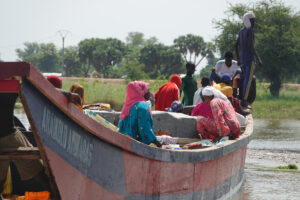
Sometimes emigration flows in the opposite direction, as in August 2021 when Musgum fishermen and Arab Choua cattle herders clashed over water access. Forty villages were burned, and 10,000 Cameroonians crossed the Logone River to seek refuge in Chad. “Sometimes it’s the Mousgoum fishermen themselves who fight over access to water,” says Midjiyawa Bakari, the governor of the Far North region. “In the north and the desert, we saw how the few wells are jealously guarded by the different ethnic groups: Arabs, Toubou, and M’bororo.”
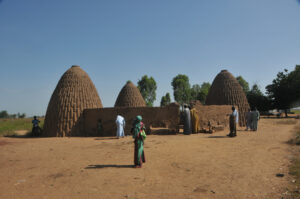
It takes four hours of slow boat travel to reach Mouhouna, where we will stay in a “shell house,” called a tolek. This is the most well-known architectural feature of the Mousgoum people, built entirely of sun-dried mud, thatch, and water, as wood is scarce in these riverine regions. Shaped like a catenary arc (hence their French name “obus,” meaning shell), with the base of the wall thicker than the top, their exterior is decorated with relief patterns that provide support during construction and maintenance, and improve rainwater drainage.
The shell houses are entirely built from sun-dried mud
Without windows, they keep the house cool during the day and warm at night, and mosquitoes don’t get in, even though the entrance is a keyhole-shaped opening, without a door. Yet we preferred to sleep outdoors, in tents in the courtyard, surrounded by mosquitoes and subjected to intense humidity from the nearby river.
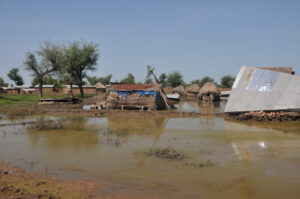
When severe floods destroyed most of these dwellings in 1975, the Musgum people built their new ones out of bricks, as each tolek took about six months to complete! They had to wait for each level to dry before building up, much like coil pottery. In any case, this technique has largely been lost. But the Musgum people keep a few tolek to show visitors. The Polish traveler and journalist Kazimierz Nowak (1897-1937), who crossed the entire continent between 1931 and 1936, from Libya to South Africa and back—40,000 kilometers—had noted them: “The exterior ornaments, although very similar, differ in small details, so that no two are identical.” Gide is more poetic and speaks of “pure curved lines,” of “supple momentum,” of fluting that “gives accent and life to these geometric forms,” “the work not of a mason, but of a potter.” In short, he is captivated by the “beauty so perfect, so accomplished that it seems entirely natural” of these dwellings, which he describes in detail over four pages [Gide pp. 306-307].
Gide is too poetic, to the point that he “would like to see [the Logone] during the flood, which, we are told, transforms it into an immense lake, dotted here and there with small islands of greenery where all the animals come to take refuge” [Gide p. 295]… This is in no way the point of view of the inhabitants who lose their homes, crops, and animals, if not their very lives. Same disconnection when he reads Beaumarchais’s The Barber of Seville, Chekhov’s The Steppe, or when he “advances with rapture into the Second Faust” of Goethe, and rereads Iphigenia “in growing wonder”, while letting himself be lulled by the gentle eddies of the Logone River [Gide pp. 227-8, 338 & 330].

More down to earth, Yahya shows us around the clinic built by the Akwada association, which is hosting us: a consultation room, an examination room, a refrigerator for polio and other vaccines, an office, and registers. Gide had seen one in Logone-Birni, some 200 km downstream from the Logone River, clean, tidy, and very well-run, with 60 patients, but with an absent doctor [Gide p. 295]. Here, Yahya is only a nurse, but given the lack of qualified staff, he is the director, with a midwife as his assistant. The lack of equipment leads to blunders. A young woman gave birth, and then they sent her back to her village, without realizing she was having twins. The second baby died.
Due to a lack of qualified staff, the clinic is run by a nurse
At the time, the local people had “no confidence in our white man’s medicine,” but they had developed their own healthcare with whatever resources they had and relied on acquired immunity. Cow dung compresses, “a warm herb porridge extracted from the stomach of a recently killed goat,” dried food bolus turned to powder, Gide reports. A similar improvisation is happening now. When our group, composed of foreigners, was about to travel for three weeks in the desert, one of our drivers was stung by a venomous scorpion. His companions had no other remedy to apply to the sting than bleach. It worked.
We ourselves were badly stung, but by the cram-cram, or Cenchrus biflorus, one of thousands of spiny herbaceous plants found abundantly in the Sahel. These small thorns cling tightly to clothing, and it is difficult—and painful—to remove them because they injure the fingers and cause abscesses [Gide p. 242].
Acquired immunity or the youth of the population? Nurse Yahya tells us that the 2019-2021 COVID-19 pandemic didn’t cause many deaths in Chad, 10 per million inhabitants. Compared to 2,615 in France, 3,770 in Greece, and 5,669 in Bulgaria.
White god or white devil?
Mouhouna is also where the grave of Jean Bindschedler (1927-2021) lies. A Swiss puppeteer from Geneva, he settled among the Musgums in 1997, seeking more human contact. When he moved to Fribourg, where his wife is from, “I was the outsider. People were very reserved with me. In the bistros, it was difficult to strike up a conversation.” And he would repeat a litany he’d heard countless times: “Genevan, when I see you, I see the devil.” Tribal conflicts aren’t unique to Africa.
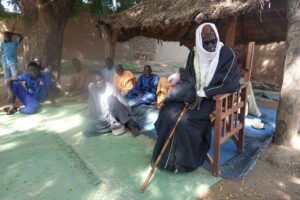
Here, a swarm of children and adults greets us in every village, swirling around us, all smiles and questions. Then comes the courtesy visit to the local sultan. Each time—a true ritual—we are thanked for coming so far to discover their culture.
When the white man arrived, all the villagers crossed the Logone and fled into the bush
The sultan of Katoa praised French culture and thanked France. Our two young companions—French—couldn’t believe their ears. The sultan was 95 years old. A different generation, a different position, a different mentality. Yet another old man, about ten kilometers north of where we are, described it differently to Gide a century earlier: “When the white man arrived, he told us, all the people of the village crossed the Logone and fled into the bush. Only the village chief dared to stay and received the necklaces that the white man gave him. The people returned during the night, but remained terrified by this arrival of a supernatural being who came on a boat that walked all by itself, and who the next morning had already disappeared…” [Gide p. 312].
This white man was Émile Gentil (1866-1914), described by Gide as an explorer, but in fact a French commander returning from the Congo, where he had been implicated in massacres, to subdue—hypocritically, supposedly at the behest of other local sultans—the Sahelian kingdom of Borno, recently conquered by Rabih az-Zubayr, a Sudanese warlord and slave trader. It was this same Gentil who founded N’Djamena in May 1900, then called Fort-Lamy, named after another French commander recently killed in a clash with Rabih, who also perished in this battle and had his head cut off and paraded.
The carnages were not only numerous but also varied in its nature – we have the Malagasy example, as reported by the French historian Philippe Leymarie: “The crushing of the [1947] uprising by the French led to the near annihilation of the ruling class in Madagascar, with consequences that continued to be felt for decades after the country’s independence” (see below)
[“La mémoire troublée de l’insurrection anticoloniale de 1947. Madagascar entre nationalisme et survie”, (The troubled memory of the 1947 anti-colonial insurrection. Madagascar between nationalism and survival), le Monde diplomatique, March 1997, pp. 22 & 23].
Not to mention that Africa is still under the grip of neocolonialism. It is only now that Chad, in turn, after Mali (2021), Burkina Faso (2022), and Niger (2023), is ridding itself of French troops. Abderaman Koulamallah, Minister of Foreign Affairs, announced on November 28, 2024, that it was time for his country “to assert its full sovereignty.”
The big Concessions: the French state’s abdication
It is also on his return from the Congo that Gide lingers and vividly describes the terrible conditions of recruitment, transportation, housing, and supply for the thousands of “volunteer” workers for the construction of the railway that was to connect Brazzaville, in the Republic of Congo, then the capital of French Equatorial Africa, to the Atlantic Ocean, a distance of 512 kilometers. The “herd of natives,” for their part, had to travel on open barges for two weeks from Bangui, now the capital of the Central African Republic, “one of the largest and most densely populated districts of French Equatorial Africa, particularly used for native labor.” On the thousand kilometers of river between Bangui and Brazzaville – half on the Ubangi River (1,000 km long), half on the Congo River (4,700 km), of which it is a tributary – many men, naked, unprotected, and underfed, succumbed to pneumonia contracted during the cold nights on the water following the stifling days. Gide reports temperatures of up to 37 degrees Celsius during the day, 50 “in the summer,” but… only six at night [Gide p. 319]. By the time the railway line was completed in 1934, 17,000 Africans had died on this project! As early as late December 1926, Gide noted: “The mortality rate has exceeded the most pessimistic predictions. How many more deaths will the colony owe its future well-being to?” [Gide p. 224].
By the time the railway line was completed in 1934, 17,000 Africans had died in the project
It wasn’t just humans who were decimated in Africa by European greed, but also nature. Also in 1926, Gide spoke of “the progressive devastation of the forests (often requiring more than eight days’ walk to find even more rubber vines)” [Gide p. 540], nearly a century before COVID-19, which is precisely due to the zoonotic disease created by deforestation.
Rubber and ivory were the main commodities that Europeans coveted, but at the lowest possible cost. “The colonies were not supposed to cost the mother country anything,” but rather be “a source of profit,” says Catherine Coquery-Vidrovitch, a French historian specializing in colonization in Africa and the major concessionary companies, and recipient of numerous honors.
[Les origines du régime concessionnaire en France et au Congo. Le Congo au temps des grandes compagnies concessionnaires 1898-1930. (The Origins of the Concessionary System in France and the Congo. The Congo in the Time of the Major Concessionary Companies 1898-1930), Chapitre I, Tome 1, Coquery-Vidrovitch, Catherine, Éditions de l’École des hautes études en sciences sociales, 2001].
Lured by the profits of the neighboring Congo, private property of the Belgian King Leopold I, and after a long period of stagnation and political procrastination, the French state divided the French Congo among forty concessionary companies during the last decade of the 19th century, 700,000 km2 out of the 900,000 of what are today the Gabonese, Congolese and Central African republics, i.e. the crazy sum of 70 billion hectares.
Under the concession system, “the state entrusts the development and administration of a territory under its sovereignty to private companies. In exchange for their investments, supposedly serving the local interests of the granting power as well as those of the local populations, they profit from the exploitation of the territory’s resources and, in the case of Western empires, from the populations themselves.” The private company manages everything in its own way.
Through the concession system, the state entrusts the development and administration of a territory under its sovereignty to private companies
As Catherine Coquery-Vidrovitch put it: “This was, in fact, a true abdication of the state: by refusing to make the necessary investments itself, the state hoped that private initiative, spurred on by the anticipated profits, would develop the country on its own.”
As André Gide strongly denounced in an exchange of letters with directors of these companies, these private firms did everything they could to reduce their costs, especially regarding the enslaved—excuse me, African workers—and to increase their already considerable profits. They bought a kilo of fresh rubber for an average of 57 centimes, and a kilo of ivory for 2 to 6 francs, and resold them in Europe at prices ten to twenty times higher.
The concessions were obviously accompanied by clauses to “satisfy the public’s sense of justice and lull it to sleep. In practice they were never applied, and the populations inhabiting the immense lands granted were, in fact, reduced to a state which differs from slavery, I would like to know in what way?” wrote Gide in the article “The Distress of our Equatorial Africa” published in the Revue de Paris on October 15, 1927, upon his return from Africa. And he targets the French Upper Congo Company, which, “despite its considerable profits, has never done anything to improve the lot of the natives it exploits: no roads, no schools, no hospitals, not even the slightest healthcare system. It will leave behind, if it ever does, a country bled dry and natives more miserable than before the arrival of the whites” [Gide p. 538]. All things he witnessed firsthand.
Thus, after exploiting this continent for at least a century (especially from 1870 onward, though the Portuguese had already seized Ceuta in 1415) – and while this exploitation facilitated their progress – Europeans now wonder why Africans find it so difficult to develop.
Political Incapacity but Repressive Capacity
At the time Gide was recounting the harsh hardships endured by African laborers, he was preparing to travel from Sahr (then Fort-Archambault), near the Central African border, to N’Djamena (Fort-Lamy) on the Chari River (1,400 km long), whose main tributary is the Logone (1,000 km). He was accompanied by Marcel de Coppet (1881-1968), governor of several French colonies, who had just been appointed to Chad (1926-1928 and 1929-1932). Coppet was close to Gide and Roger Martin du Gard, both Nobel laureates in Literature (1947 and 1937 respectively). Coppet himself held a law degree and a diploma in Malagasy from the School of Oriental Languages, and was a socialist sympathizer, Protestant, and Freemason. Gide introduces him as “loved” by “this black people” [Gide p. 225].
The French army employs various tactics of terror intended to demoralize the population
In any case Coppet had to carry out orders from the colonial power. While he was High Commissioner in Madagascar during the anti-colonial uprising of 1947-48—against, among other things, the colonial power’s practice of forced labor and involuntary conscription into the army in the event of war—the French army “employed various tactics of terror designed to demoralize the population. It carried out mass executions, torture, war rape, the burning of entire villages, collective punishments, and other atrocities such as throwing Malagasy prisoners alive from airplanes (death flights)” [Wikipedia].
At the same time, this same army murdered and raped hundreds of civilians in the villages of My Trach (November 29, 1947) and Quang Nam (June 12, 1948) in Vietnam, then part of French Indochina. A foretaste of occupied Algeria, where this brutality was multiplied a hundredfold. Deemed too moderate, Coppet was replaced in February 1948 by Pierre de Chevigné, a colonel and later a politician, who completed the picture in bloodshed. “The intensity and cruelty of the French response were unprecedented in France’s colonial history.” [«Pour Chirac, la répression de 1947 était ‘inacceptable’» (For Chirac, the 1947 repression was ‘unacceptable), Monique Mas, Radio France Internationale, July 22, 2005]. The total number of Malagasy killed is estimated at between 11,000 and 100,000. Initially, 550 French citizens had been killed. Proportions reminiscent of Gaza, but where the Israelis far surpassed themselves.
(Coppet was also the only governor-general—at the time, in Madagascar—to be dismissed by the Vichy regime in 1940 for attempting to keep the “Great Island” in the war on the side of the English.)
Disturbed by the repression of the Malagasy uprising, Albert Camus compared the French methods to those they had just suffered at the hands of the Germans, and he directly linked the cruelty to racism: “If the Hitlerites applied to Europe the abject laws that were their own, it was because they considered their race superior and that the law could not be the same for Germans and for enslaved peoples […] if, today, some French people learn without revolt the methods that other French people sometimes use against Algerians or Malagasy people, it is because they live, unconsciously, with the certainty that we are superior in some way to these peoples, and that the choice of means to illustrate this superiority matters little” [Combat, May 10, 1947, p. 702]. Still relevant in Gaza, a century later.
The most ironic thing is that the way the colonizers treat those they have subjugated makes them inferior beings themselves, far inferior, like the Nazis. Inwardly and outwardly. Gide observed this well: “What I cannot describe is the beauty in the eyes of these natives, the moving intonation of their voices, the reserve and dignity of their bearing, the noble elegance of their gestures. Compared to these Black people, how many white people look like louts” [Gide p. 260].
Gide: Compared to these black people, how many white people look like louts
And act like it. Gide reports “the stinginess of some white people toward the natives.” The wife of an administrator in Fort-Lamy—nicknamed “Madame Fifty Cents”—couldn’t find fish because she only wanted to pay a quarter of the asking price. “It was she who threw the leftover meat to her dog, rather than letting it end up with her boys [sic]” [Gide p. 244].
The French army was quite capable of organizing massacres—“One high-ranking official refers to a ‘Malagasy Oradour,'” by the name of the French village where the Nazis executed 643 civilians in 1944—but the administration was utterly incapable of organizing its empire. According to Charles Régismanset (1877-1945), no less than director of political affairs at the General Colonial Agency between 1924 and 1926: “It is clear that France has no colonial program, and by persisting in this negative attitude, it remains true to its tradition. It has no program and never has” [Colonial Questions (1912-1923), p. 232].
It had no program, but it did have objectives. The Library of Congress’s book on Chad describes it as follows: “Two fundamental themes dominated the French colonial experience of Chad: the absence of policies aimed at unifying the territory and an exceptionally slow pace of modernization. In the scale of French priorities, the colony of Chad ranked almost at the bottom, and the French came to view Chad primarily as a source of raw cotton and unskilled labor for use in the more productive colonies to the south.”
[“Historical Setting,” Chad: A Country Study, John L. Collier, ed. (1990), Country Studies (2nd ed.), Washington, D.C.: Library of Congress]
In his “Essay on Colonization,” published in 1912, Régismanset, the high French civil servant and Commandeur de la Légion d’honneur, clearly summarizes the colonial plan and priorities of any colonial power: “Poor Black humanity! Let us at least have the honesty to admit that if we take such good care of you, it is because you seem to us to constitute an inexhaustible reserve of labor… We want African races to yield the maximum profit. We want rubber balls and ivory to abound on the docks of Bordeaux or Le Havre, for peanuts to flourish, for palm oil to flow freely. Nothing could be better. But what do science, justice, kindness, and above all, progress have to do with this? I do not wish for Black education to be pushed too far… As long as populations remain the weakest, they will accept the right of the strongest. The day the “strongest” disarms, the day they understand the admirable lie of all these abstractions, they will quickly—the Annamites are already giving us a foretaste—denounce this so-called “contract of association,” and rise up against European control and exploitation. Impossible assimilation or hypocritical association, two systems equally in blatant contradiction with reality.” A fine prediction, half a century in advance.
Perception colors reality
While we listened reverently to the old sultan of Katoa, the mischievous children spied on us all around the thatched platform where we sat on the ubiquitous plastic chairs that characterize our modern era worldwide. The Logone River flowed peacefully nearby. A little further on stood the fortress built in 1764. Little remains of it except the wall. Ruins. Yet inside stands the sultan’s house, very simple. Katoa is the capital of the Musgum region, which comprises 37 villages and more than 50,000 inhabitants. We are about 50 kilometers from Bogo, in Cameroonian territory beyond the Logone River, where, at the end of the 19th century, the great battle took place in which the Musgum were able to defeat the Fulani who were launching “jihads” to convert other tribes to Islam.
On the return journey, sitting in the large dugout canoe, watching a magnificent sunset on the Cameroonian side, I think of André Gide, who sailed these same waters in this very spot, but coming from the north, from the capital, a century ago, before turning west at Katoa. A month later, further south, he would meet, by a surprising coincidence, in the heart of the Cameroonian bush, at the Keigama-Tekel pass, Théodore Monod (1902-2000), the famous French naturalist and humanist, a leading expert on the Sahara, where he had spent some sixty years. Monod was then at the National Museum of Natural History, a preparator “sent to study the fish of Lake Chad” [Gide p. 472], but the writer devotes only a single line of his book to this event, dated April 22, 1927 – Monod, at 25, was not yet famous!
An act is only wrong if it is revealed and if society considers it wrong
Like Gide on the Logone, “I have neither the time nor the desire to write anything down. Completely absorbed by contemplation” [Gide p. 230]. Of nature as much as of the people. There is something captivating that I had already felt during our two weeks on the Amazon (from Belém to Manaus) and on its tributary, the Rio Madeira (from Manaus to Porto Velho, at the gateway to the Pantanal). The landscape doesn’t change drastically, but one is surprised never to be bored, watching this powerful nature unfold before us. The most beautiful and vibrant matter is this thin green border – the details of nature are constantly changing; suddenly, one emerges onto a vast, flat, treeless expanse. We regularly pass fishing boats, or pull up alongside to announce our presence to the local authorities, which always creates a crowd.
Yet, many – Westerners generally – find it boring. This is where perception—entirely subjective—comes into play, coloring the same reality in sometimes diametrically opposed ways. It is the definition we give to an object that defines it and imbues it with emotional baggage. We can return to culture. Speaking of the Igbo people of neighboring Nigeria, Kapuscinski says that they did not know sin before Christian missionaries came to teach it to them. If they had ill thoughts toward someone, there was no wrongdoing unless it resulted in an action that would hurt that person. “The act is only wrong if it is revealed and if society or a third party considers it wrong” [Ebène, p. 336]. As my uncle, the engineer-philosopher, used to say, madness becomes the rule and the norm when the majority of people accept it. As today with Trump in the United States of America. 80 million voted for him, endorsing behavior previously considered criminal.
In Africa, Catholicism internalized this guilt. Before the Christians, the Stoics had explored this crucial relationship between the inner and outer worlds. The Greek philosopher Epictetus defined it in his Enchiridion (Handbook): “Men are not disturbed by things, but by their opinions about them.” And a few centuries later, Shakespeare reformulated it in Hamlet: “There is nothing good or bad, but thinking makes it so.”
Conrad speaks of “the extraordinary effort of imagination it took for us to see enemies in these people”
This is the moment to quote Joseph Conrad (1857-1924) in his famous “Heart of Darkness,” inspired by his brief time working in the Congo, where he witnessed “the forced labor, corporal punishment, and unchecked greed that enabled Belgium to profitably harvest ivory and rubber”. Conrad speaks of “the extraordinary effort of imagination it took for us to see enemies in these people.” Gide, quoting him, adds: “What a policy of hatred and ill will it took to obtain the justification for the brutalities, the exactions, and the abuses!” [Gide p. 245]. This is the work of the official media: to demonize the enemy—then Africans, Vietnamese, Malagasy, Algerians; today China, Russia, Palestinians.
A similar effort of imagination and subjectivization of reality is at play with paintings, about which the French painter Marcel Duchamp said: “I believe that the artist doesn’t know what he does. I attach even more importance to the spectator than to the artist. […] The creative act is not performed by the artist alone; the spectator brings the work in contact with the external world by deciphering and interpreting its inner qualifications and thus adds his contribution to the creative act.”
More generally, the difference between two opposites is often not decisive. In “The Passage of Time” by the Chinese author Yan Lianke, winner of the 2014 Franz Kafka Prize in Prague, based on the half-true story of a mountain village in Henan, the author’s native province, where inhabitants reportedly died before the age of 40 due to the toxicity of the region’s soil and water, he begins with a quote from the Buddha: “Master Dahui! All beings in this world deeply fear the pains of life and death and yearn for nirvana. They scarcely know that the boundary between nirvana, life, and death is merely a metamorphosis of one and the same nature, that all difference is illusory” [p. 7].
When an old man dies, a library burns down.
Three-quarters of a century before Gide, traveling through this region, from Massenya to Timbuktu via the Logone and the Musgum mountains, was the German Heinrich Barth (1821-1865), who covered a total of 19,000 kilometers between 1850 and 1855, including a round trip to Tripoli, Libya, via the Fezzan desert and Lake Chad. He was fluent in Arabic and several African languages (Fulani, Hausa, Kanuri). Sent as part of a British trade mission, he was more interested in history and cultures (his doctoral thesis focused on the trade relations of ancient Corinth). He brought back 3,500 pages of information in five volumes (which he wrote simultaneously in English and German), a work mentioned by Darwin, observing, among other things, that the Sahara had once been a savanna.
Traveling and mapping unknown lands was a first step towards military subjugation
Gustav Nachtigal (1834-1885) was another German, an Arabic speaker and surgeon by training, who crossed the Sahara between 1869 and 1875, passing through the Sahel region of Chad: Tibesti, Bornu, Baguirmi (an independent sultanate until 1897 with its capital Massenya, which we discussed earlier), and Ouaddaï (an independent sultanate until 1904 with its capital Abéché, which we also discussed), before finally reaching Sudan via Darfur. It should be noted that “Travelling and mapping unknown lands was a first step towards military subjugation in the period of emerging colonialism.”
In 1884, Nachtigal was tasked with establishing the German Empire’s first African colonies in Cameroon and Togo-Ghana to protect the commercial interests of their companies which had been competing with the English and French for several years. Like the English and French, the Germans used forced labor to cultivate banana, rubber, palm oil, and cocoa plantations and for their infrastructure projects. Yet Nachtigal did not consider himself superior; he was an abolitionist and harbored the illusion that European domination could stop the slave trade carried out by African rulers. A few pages about him are on display at the National Museum in N’Djamena.
From a pragmatic standpoint, the renowned Chancellor Otto von Bismarck (in office from 1871 to 1890) was skeptical of the economic benefits of acquiring colonies, but he was followed by the colonialist Wilhelm II, the last German Emperor and King of Prussia from 1888 to 1918, who did not hesitate to perpetrate the first genocide of the 20th century in 1904 against the Herero and Nama peoples who had dared to revolt against the German state of South West Africa (present-day Namibia). It was also there that the Germans built their first concentration camps… “Herero and Nama corpses from the concentration camps were reportedly decapitated and their heads boiled and scraped clean of flesh,” in order to be sent to museums and universities in Germany, in support of dubious racial theories that would later shape Nazi ideology. Of course, like other Europeans, the Germans spoke of a civilizing mission by a nation that considered itself superior… until the World War II.
Speaking of explorers of the second half of the 19th century, “at the height of colonial expansion, geography transcended the framework of a neutral scientific discipline and, leaving the scholar’s study, became ‘applied,’ and even ‘militant,’” explains Anne Karakatsouli, a professor at the University of Athens and a researcher, among other things, on the history of colonialism. Geographical societies emerged in Europe and “facilitated the transition from romantic and solitary adventure to imperial projects.”
This professor gave a presentation on Panagiotis Potagos (1839-1903), a Greek physician who undertook two long journeys to Asia and then one to equatorial Africa in 1876. Traveling east of present-day Chad, he reached the Uele and Mbomou rivers, the latter marking the border between the Democratic Republic of Congo and the Central African Republic. Drawing on the ancient glory of Greece, Potagos sought out the works of ancient historians and geographers – Xenophon, Herodotus, Strabo, and Ptolemy – rather than rigorous scientific or commercial observations. This “reflects the arduous construction of modern Greek national identity, using the supreme and unifying reference point of the authority of the Ancients,” says Karakatsouli. These journeys were indeed exceptional for a country which, “on the Balkan periphery” of Europe, was still semi-colonized and in the midst of developing within its own borders since the struggle for independence against the Ottomans (who still occupied half of modern Greece). Also, frustrated by the total lack of interest from the authorities (Greece obviously did not have a geographical society), apart from the University of Athens which helped him write a first volume on his travels, he withdrew, completely forgotten in a village on the island of Corfu.
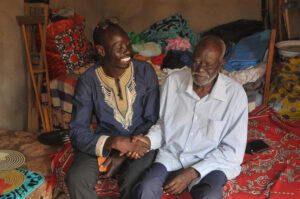
Back in Bongor, we had the opportunity to delve deeper into history by meeting “Papa Malla,” a nurse and historian who told us about various aspects of his country: the birds, the history of the Massa people, of Bongor, etc. He died a few days later. In Chad, more than ever, “when an old man dies, a library burns down,” as Amadou Hampâté-Bâ (1901-1991), of M’bororo Fulani origin, said. Presented as the “African champion of tradition and oral knowledge,” and author of “The Fulani Empire of Macina” and “Fulani Initiation Tales,” this Malian historian and ethnologist was a collaborator of Théodore Monod when the latter was director of the French Institute of Black Africa (IFAN) in Dakar. Hampâté-Bâ had also met Henri Lhote (1903–1991), the renowned expert on the rock paintings of the Algerian Sahara, which had impressed the Malian Fulani, drawing on his people’s traditions.
The rock paintings of the Sahara are a reminder of the traditions of the Fulani people
We visited several of these sites in the Ennedi Desert, some “depicting scenes of livestock farming with cows having lyre-shaped horns and figures wearing hairstyles and clothing very similar to those of modern Fulani” [Alicia Ortego, Kumakonda]. But what we saw is a tiny fraction of more than 650 sites dating back 7,000 years, the majority excavated by Gérard Bailloud, who defined the periods: Archaic (7,000 to 5,000 BCE, featuring elephants, panthers, and ostriches), Bovine (5,000 to 3,000 BCE), and Camel Dwarf (2,000 BCE to the 17th century). The drawings are painted in shades ranging from red to sepia, sometimes with touches of white. Animals are depicted accompanied by men, hunters or warriors, and the few women shown wear long tunics. The camels and horses of the most recent period are shown galloping, their legs extended both front and rear, surmounted by a rider, reminiscent of the Minoan bull-leaping fresco in Crete, which dates back to 1,500 BCE.
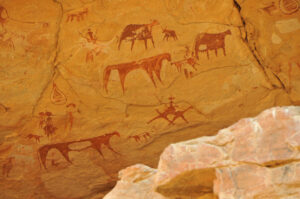
In any case, the depiction of large mammals in the Ennedi and Tibesti mountains clearly shows that in prehistoric times (the Stone Age, from 3.3 million years ago to 3000 BC) – even before the formation of Lake Chad – Chad was infinitely greener than it is today.
How many mysteries lie within the vast desert of the Sahara! Maybe it was the route followed by the Fulani migrating from Ethiopia – as the Romans indiscriminately called all of sub-Saharan and East Africa – or one of the routes taken by the Romans who may have reached the Niger River via the Tibesti Mountains, skirting the Ennedi. In the first century AD, the expeditions of Septimius Flaccus (in 50 AD (departing from the magnificent Leptis Magna on the Mediterranean Sea via the Fezzan) and Julius Matiernus (40 years later, departing from the Gulf of Sirte, crossing the Tibesti Mountains) are believed to have reached Lake Chad, which Ptolemy called “the lake of hippopotamuses.” These expeditions were initially military in nature, aimed at securing trade, particularly in gold.
Lhote cataloged over a hundred war chariots in southern Algeria, which he studied for 15 years. Experts say these chariots also resemble Minoan art in Crete, this “people of the sea” having landed in Cyrenaica to conquer new territories. We saw no chariots in the Ennedi cave paintings.
However, we did see an interesting array of birds (out of a total of 525 species) and some beautiful butterflies, such as the very colorful African Monarch and about twenty Belenois aurota (Pieridae), which were drinking in a small pool. In this same Ennedi guelta, a group of baboons (Papio) frolicked, having taken refuge atop the rocks framing the canyon. And there’s no doubt that a Crocodylus suchus, crouching at the bottom of the Archei pool, was watching us from its safe haven. The landscape is so impressive that in 2018 the Ennedi Nature and Cultural Reserve was created. “The hidden paradise of the Sahara” had already been a UNESCO site for two years, boasting numerous gueltas – natural waterholes – where caravans quench their thirst. Ennedi, this small part of the Great Desert, 50,000 km² out of the Sahara’s 9.2 million km², is the easternmost part, some 200 km from Sudan, and barely larger than Switzerland.
A victim of extensive poaching, the addax (Addax nasomaculatus), a spotted-nosed antelope, and the red-necked ostrich or North African ostrich (Struthio camelus camelus) have recently been reintroduced to the area. These species appear in rock paintings, proving their long-standing presence in the region.
In fact, the desert can be just as fascinating in terms of flora and fauna as the rainforest. First, one must not confuse regs, “flat, rocky outcrops covered with a thin layer of pebbles mixed with sand”, with ergs, vast expanses covered with sand – the product of wind erosion. Then there are the wadis,(from an Arabic word, meaning riverbed in the Maghreb), dry riverbeds that only fills during the rainy season. Often, these wadis become oases, inhabited or uninhabited depending on the amount of groundwater available to supply herders or travelers. They are many wadis throughout the Sahara and they can reach hundreds of kilometers in length, canyons between rock formations. And there are gueltas (also from Arabic), also formed by natural of water, but more of a pocket that forms within rock formations, and more permanent than wadis.
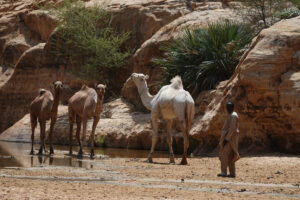
This water is equally beneficial to animals and plants. The rock formations of the Ennedi help to break the winds, particularly the harmattan – a particularly hot and dry wind blowing from the northeast from December to March – which promotes vegetation growth. Rainfall alone is not enough; moisture is also necessary for growth, but the winds carry away the moisture and dry out the air. Thus, the Ennedi’s microclimate is tropical, unlike the Mediterranean climate of the Tibesti Mountains further north, on the Libyan border. It contains 75% of the plant species recorded by the French botanist Hubert Gillet (1924-2009) (not to be confused with the other botanist Claude Casimir Gillet (1806-1896) who conducted a detailed study during his stay in Algeria).
Excerpt from the presentation that led to Ennedi being designated a Mixed Natural and Cultural Site of World Heritage in 2016: “The wetter conditions prevailing in the Ennedi massif, due to its exceptional orographic position, also allowed plant and animal species that inhabited a wider area when climatic conditions were more favorable to survive in the mountains to this day. Furthermore, there is an exceptional proportion of relict species, primarily trees that are survivors from ancient times. In the gueltas and canyons of Ennedi, plants and animals live that are far removed from their usual ranges in the tropical and subtropical zones. This is what has earned Ennedi the title of Garden of Eden in the Sahara.”
Two years later, the environmental organization African Parks signed an agreement with the Chadian government for the development and protection of the Ennedi. We visited them in Fada, capital of the Ennedi-Ouest Region, and a small, dusty town, 250 km west of Sudan. But African Parks had nice offices on the outskirts, and a small hotel under construction, brochures on botany and ornithology, staffed by Europeans, an Englishwoman, a Belgian woman – the typical NGO.
End