

(Français)
For nearly eight years, the official story of what happened in the La Saline neighborhood of Port-au-Prince on Nov. 13, 2018 has functioned as settled history.
Two human rights reports — one from Fondasyon Je Klere (FJKL), published just three days after the violence, and one from the Réseau National de Défense des Droits Humains (RNDDH), published on Dec. 1, 2018 — established the narrative that international mainstream media, foreign governments, and eventually the United Nations Security Council would build on for years to come: that a “state-sponsored massacre” was orchestrated in large part by a police officer named Jimmy “Barbecue” Chérizier, who would go on to become the country’s most well-known armed-group leader.
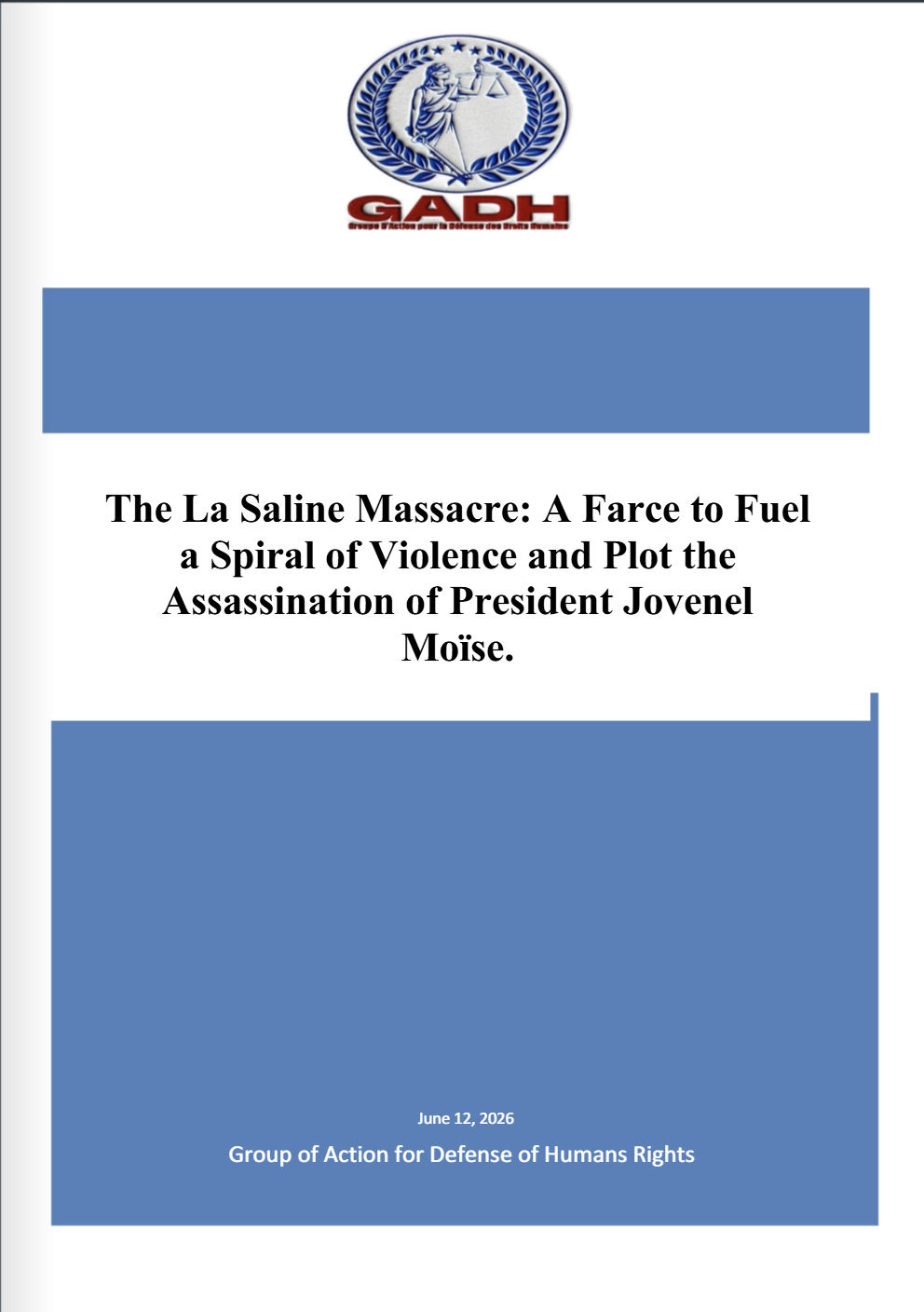
A new 23-page report from the Groupe d’Action pour la Défense des Droits Humains (GADH), titled “The La Saline Massacre: A Farce to Fuel a Spiral of Violence and Plot the Assassination of President Jovenel Moïse,” argues that this founding narrative was built too fast, on lies and too little verification, and with a political agenda on the part of the people constructing it. Released in June 2026, the report doesn’t dispute that people died in La Saline in November 2018. What it challenges is how those deaths were investigated, labeled, and attached to specific names — Chérizier’s above all — within days of the violence, by organizations GADH says never contacted many of the people they were naming.
A Factional War Before It Was a “Massacre”
GADH’s reconstruction begins by zooming out on the story. Rather than a single atrocity on Nov. 13, the report describes a two-week armed conflict between rival factions fighting for control of La Saline and, more specifically, of the Croix-des-Bossales market — one of the country’s most important commercial hubs, sitting beside the port.

The rivalry, GADH says, pitted a faction loyal to Serge “Ti Junior” Alectis, ousted from the neighborhood in an earlier internal split, against the faction that had displaced him, led by Hervé “Bout Janjan” Barthélémy and Juliot “Kiki” Pyram. According to the report, Ti Junior rebuilt his alliances after a failed negotiation over market revenue conducted, of all places, in Miami, and launched an offensive on Nov. 1 that escalated through nearly daily clashes until the culminating assault on Nov. 13.
That framing matters to GADH’s larger argument: if the events were the “culmination of a territorial war that had erupted nearly two weeks earlier,” rather than a single planned crime, then use of the term “massacre” — with its implication of premeditated, one-sided slaughter of civilians — is political. As the report puts it, the label shifted only after images “circulated widely on social media and sparked strong public outrage,” at which point “what was initially presented as a territorial war between rival groups gradually began to be reclassified as a ‘massacre.'”
GADH also stresses something the RNDDH report itself even conceded at the time: the actual death toll was never firmly established. Contradictory figures circulated, some self-proclaimed relatives with no supporting documentation came forward through informal advocacy networks the report calls “Paran Mò,” (family of the dead) and officials on the ground reportedly withheld numbers because the count had “transcended purely security concerns.”
The FJKL Report: Naming Without Interviewing
GADH’s most pointed methodological critique is reserved for the Nov. 16, 2018 FJKL report — published, the report notes, just three days after the violence and before police or forensic units had even been able to fully access the neighborhood. The FJKL report was the first public document to attach Chérizier’s name to La Saline, describing him as reinforcing one side of the clash.
GADH’s objection isn’t just to the speed, though it does ask pointedly how, in under three days, an organization could “gather testimonies, establish responsibility, verify armed affiliations, reconstruct the chain of events, [and] identify certain individuals by name.” Its sharper point is that Chérizier — at the time a serving police officer, assigned to the security detail of a sitting member of parliament, and reachable through ordinary institutional channels — was never contacted for his version of events before FJKL published his name.
“Several channels existed to obtain his version of events,” the report states. “None appear to have been used.” GADH frames this omission, alongside the report’s silence on other figures who were active in the same political and territorial disputes, as evidence that the document was assembled to “contribute to the production of a political narrative,” not simply to document violence.
The RNDDH Report: Contested Geography and a Meeting That Evidently Never Happened
GADH treats the RNDDH report as the document that “institutionalized” the accusations — the one picked up by foreign embassies and international media, and the one that permanently linked Chérizier’s name, alongside Interior Ministry official Fednel Monchéry and others, to allegations of a coordinated, state-backed attack.
The report challenges RNDDH’s account on several specific, verifiable points. It disputes RNDDH’s map of La Saline’s “armed bases,” arguing that one base RNDDH placed inside La Saline — “Belekou,” whose leader was the late Iscard Andrice — actually sits in a different neighborhood, Cité Soleil, and that its inclusion “artificially expands the territorial scope” of the case. It similarly disputes the existence of a “Delmas 6 Base” that RNDDH attributed to Chérizier, arguing that no armed structure by that name was known locally before the report named it, and that Delmas 6 is a geographic area, not an organized group.

The report’s most consequential challenge concerns a meeting RNDDH says took place on Nov. 6, 2018 in Delmas 6, allegedly bringing together Chérizier, Monchéry, and departmental delegate Joseph Pierre Richard Duplan to plan the attack and distribute weapons. GADH says it could find no photographs, recordings, minutes, or named witnesses supporting the meeting — and that RNDDH’s claim that then-deputy Roger Milien had been informed of it does not hold up. GADH says it contacted Milien directly, and that he denied any knowledge of such a meeting, telling the group: “I was surprised to hear Pierre Espérance [RNDDH’s chief] state that I was aware of this meeting of Nov. 6. I don’t know what such a claim was based on. I never made such a statement.” If accurate, that’s a real, checkable falsehood in the RNDDH account’s sourcing — one that GADH says was used to lend outside credibility to a claim that was never independently confirmed.
Chérizier’s Own Account, Which Should Have Been in Previous Reports
A large portion of the GADH report is built on Chérizier’s own testimony — his description of a “True Brothers” anti-gang policing group he says he helped form in 2005, his account of refusing an alleged bribery offer to attack President Moïse’s motorcade on Oct. 17, 2018, his description of a two-hour phone call with FJKL’s Samuel Madistin protesting his inclusion in the report, and his account of being effectively forced out of the police force through informal, undocumented pressure rather than a formal legal process.
This is the first human rights report where Chérizier is allowed to respond to his accusers on key points: that he refused the assassination plot, that he was never involved in planning La Saline, that his firing was orchestrated rather than earned. These rebuttals complement GADH’s documented findings like the geographic errors and Milien’s denial.
GADH’s conclusion is unambiguous: that the accusations “contributed to his radicalization” and were “one of the factors that led to the formation of the G9,” and eventually the Viv Ansanm (Live Together) coalition that now governs much of Port-au-Prince. It also draws a direct institutional line from the RNDDH report to the February 2019 arrest warrant sought against President Moïse, and from there to the failed February 2021 coup attempt and Moïse’s assassination that July — casting La Saline as the opening move in a chain of events that reshaped Haitian politics.
“So-Called Human Rights Organizations”: Chérizier in His Own Words
Although GADH is the first human rights report to include Chérizier’s own account, he’s told the story before. In a February 2024 interview with photojournalist Giles Clarke, conducted days before Chérizier’s forces prevented de facto Prime Minister Ariel Henry from returning to Haiti, he opened by describing his own police career, spending 14 years on the force “until so-called ‘human rights organizations’ lied and implicated me in the La Saline massacre, which led to my firing.”
He made a similar argument, at greater length, in Another Vision: Inside Haiti’s Uprising, the three-part documentary series co-produced by Haïti Liberté and Uncaptured Media and released in November 2022. In the film, Chérizier says that Haiti’s human rights groups had “transformed themselves into political parties” — aligned with the “loyal opposition” backed by the country’s ruling bourgeoisie. In the film, he also presents his movement in explicitly redistributive terms: “We want a revolution to redistribute the country’s wealth, for all Haitians to have something,” he says, invoking Haiti’s independence leader, “just like our nation’s father, Jean-Jacques Dessalines wanted all of Haiti’s children to have something, and that’s why they assassinated him.”
Repeated Efforts to Challenge the State Department Narrative
GADH’s report arrives eight years after the fact, but it isn’t the first attempt to take the La Saline reports apart piece by piece. In October 2022, Haïti Liberté published an investigative piece by Dan Cohen, “U.S. Disinformation Campaign Provides Pretext as UN Military Intervention Looms,” subtitled “Haiti’s La Saline ‘Massacre’ Revisited” — the print version, essentially, of the argument Another Vision was making on screen. Its framing was straightforward from the first paragraphs: the events of November 2018 “have been mischaracterized as part of a disinformation campaign emanating from the State Department and National Endowment for Democracy (NED) that has paved the way for the current push for military intervention in Haiti,” providing “a patina of human rights concern for aggression against the burgeoning revolutionaries of the G9, and maintenance of Haiti as a neo-colony of the U.S. empire.”

The Haïti Liberté piece surveyed all seven reports written on La Saline and found many of the same evidentiary gaps that GADH later documented in more granular form — no verified death toll, no corroborated meeting, sourcing discrepancies — concluding starkly that “none of the contradictory reports provide concrete evidence of Jimmy Cherizier’s involvement, or that a massacre even took place.”
It also supplied Cherizier’s own account of the alleyway blockade that GADH’s report referenced: “We, the area’s police officers, along with the local population, took measures so that these guys [the 117 Gang] couldn’t return into lower Delmas,” Chérizier said. “It was the first time that I spoke to Ti Junior, on the telephone no less. But I had never met Ti Junior face-to-face, much less would I go fight for him, much less carry out a massacre.”
GADH’s report is, for a change, much more objective and fact-driven than what often comes out of rights groups. “The human rights organizations in Haiti, particularly the two most influential ones, have transformed themselves into political parties,” Cherizier told Cohen, naming RNDDH and FJKL directly. “They do not do their job with fairness. They have a lot of bias. They destroy one side and protect the other. They destroy me and they protect those that I’m up against.”
That framing — RNDDH and FJKL not as well-intentioned monitors, but as political instruments in service of Washington — is the interpretive scaffolding GADH’s report inherits and tries to substantiate with documentary specifics of its own: implausible timelines, contested maps, an unconfirmed meeting, a source who denies saying what he was quoted as saying.
What unites both the Haïti Liberté reporting and the GADH report is a willingness to question a narrative that had, by sheer force of repetition, hardened into unexamined consensus. Once RNDDH’s account was picked up by the Associated Press in January 2019, it was treated by most subsequent coverage — and by the diplomatic and UN statements that followed — less as one organization’s contested findings than as settled fact, cited without the qualifying language (“alleged,” “suggests”) that the original UN and OAS reports on the same events had been careful to use.
GADH’s report pushes back against that conflation: it goes back to the primary sources, tracks down the people cited in them, and asks whether the specifics hold up, pointing to Milien’s denial and La Saline’s boundaries. That kind of detailed fact-checking is essential, and it’s a useful corrective to how an early, imperfectly verified, and politically skewed account can calcify into official truth simply because no one goes back to check it. It gives a more plausible version of what happened in La Saline and hence is a meaningful challenge to the earlier reports.
GADH’s own conclusion is notably more careful than its title. It doesn’t pretend to be the final word; it says explicitly that “this report does not claim to close the debate on La Saline,” and calls instead for independent forensic reinvestigation, witness protection, and for the original reporting organizations to publicly revisit their findings “should any information prove to be inaccurate, incomplete, or insufficiently verified.”
What GADH’s report demonstrates, regardless of what happened on Nov. 13, 2018, is how much weight a human rights report carries in Haiti — and how rarely that weight gets checked. A human rights report is no substitute for a judicial trial; it’s just a version of what some investigators say happened. It may contain fabrications and become a political instrument, deployed into an active power struggle, capable of ending careers, reshaping alliances, and, GADH argues, pushing a man from policing into insurgency.
By going back to the maps, the dates, and the people RNDDH and FJKL named or failed to name, GADH’s report raises questions those organizations have never had to answer publicly: whether the label “massacre” was applied to a two-sided armed conflict without the evidence a term with that much political force ought to require, and whether the human rights apparatus that Washington, Paris, and Ottawa leaned on to justify years of sanctions and intervention rhetoric against Chérizier was doing independent fact-finding or repeating claims that had never been verified in the first place.
With its new report, GADH is the first human rights group to start asking the right questions and providing the full context about what happened in La Saline eight years ago, and it’s about time.