
(Français)
As we go to press, the combined forces of the Salvadoran troops, the Vectus Global Task Force mercenaries, the GSF, the PNH, and the FAdH are attacking, with helicopters, drones, and armored cars, the demonstrators who were gathering to hold anti-intervention marches for Vertières on Nov. 18 in towns on the Cul-de-Sac plain, specifically Kanaran, Croix-des-Missions, and Croix-des-Bouquets.
On Nov. 17, the eve of one of Haiti’s most patriotic dates, thousands marched through the streets of Port-au-Prince chanting “Bukele, Bukele” to signal their support for the Salvadoran president’s deployment of some 2,500 soldiers to Haiti beginning on Oct. 22.
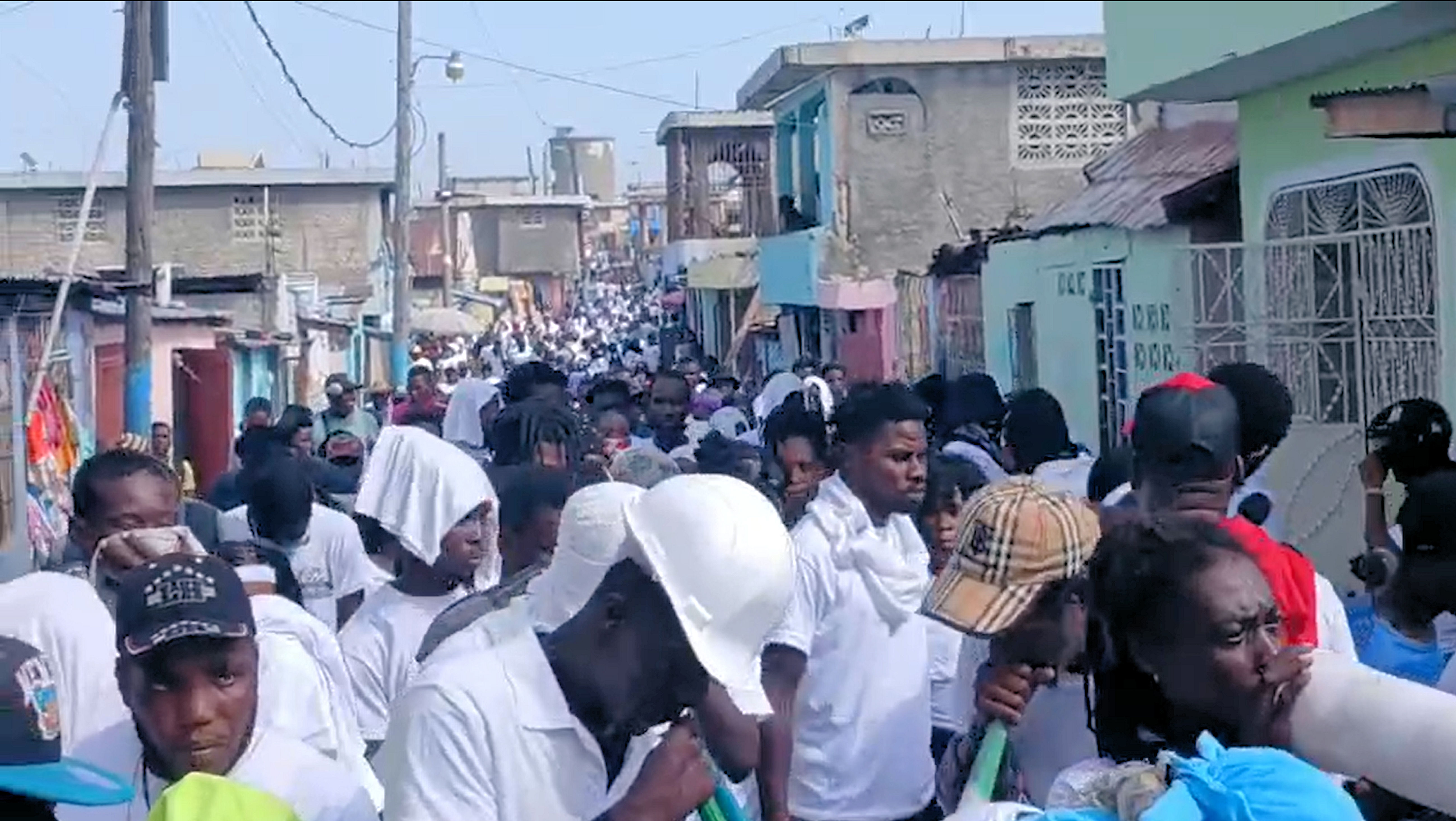
Meanwhile, on Nov. 18, the 223rd anniversary of the epic battle in which the former slaves of Saint Domingue won their independence from France, another large demonstration opposed to foreign intervention is scheduled to take place in Kanaran (Canaan), a sprawling community on the capital’s northern fringe. The two sponsoring regional coalitions – Kanaran Debou (Canaan Stand Up or KAD) and REDORSOP (Grouping of Civil Society Organizations and Sectors) – organized a similar march of over 1,000 on Nov. 2.
Several anti-intervention, pro-dialogue, and even pro-revolution declarations and actions have taken place in recent weeks in Kanaran, Cité Soleil, and Croix-des-Bouquets. These three communities are all homes to neighborhood armed groups – labeled “gangs” by the bourgeois media – against which Nayib Bukele, with Washington’s support and approval, has sent his troops to do battle.
Croix-des-Bouquets: “Because He Is Haitian”
For example, on Nov. 11, Robentz Dorvil, a former parliamentary candidate, leader of the Haïti 2050 political party, and owner of a borlette (lottery) chain in Croix-des-Bouquets, held a press tour in that town to push back on the disinformation campaign being waged against it.

Advocating for “economic revolution” and “a message of peace,” Dorvil began by saying that Haiti is “caught in an international plot” and “paying the price of its independence as the first Black republic.”
The U.S. and its allies have “demonized almost all the youth we have in the country, just as they did in 2004,” he said, taking as an example Jean Anthony “Grenn Sonnen” René, a pro-Lavalas, anti-occupation “gang” leader whom UN MINUSTAH troops killed in April 2005.
Today, Dorvil continued, the foreign occupation troops’ target is Jimmy “Barbecue” Cherizier, the leader of the Viv Ansanm (Live Together), a coalition of greater Port-au-Prince’s neighborhood armed groups.
“I’m sending this message to the Salvadoran people: Bukele is an assassin who is killing people in Croix-des-Bouquets,” he said, citing the case of an 8-year-old girl, whom Salvadoran troops shot in the head near Croix-des-Bouquets on Oct. 25.
“I myself, as a political figure, decided to stand with Wilson Joseph, alias Lanmò San Jou,” Dorvil continued. “We don’t stand with Wilson Joseph because we are a gang. We stand with him because he is Haitian, because he has that right.”
He said that many Haitians “are hypocrites” regarding “Mr. Wilson Joseph, alias Sonson, who grew up in Croix-des-Bouquets, whom everyone knows. We always see society do things to him and we laugh, but when he reacts, we say he’s a bandit. Today I tell you that Haiti needs a revolution, but not a revolution where Haitians kill Haitians. Not a revolution where we have to kill each other, but a revolution where we have to become conscious and hold a national dialogue.”
Dorvil traced back Haiti’s problems to the degradation of its educational system “because the best way to kill a people is to kill its education.” And due to this abandonment of schooling, he admonished, “it’s we ourselves who created these young rebels, who violated the rights they have as people, so that today, if they have chosen to take up arms, if they carry arms in the ghetto, then we have to all sit down so that we can achieve national reconciliation.”
He praised “Russia, Pakistan, China, which did not agree to having international forces come here to kill Haitians” and predicted that “the boat is going to capsize” with de facto Prime Minister Alix Didier Fils-Aimé and his “political gang.”
Defending Lanmò Sanjou
On Nov. 16, Dorvil gave a full press conference, where he defended Wilson as “someone who preaches peace.” He said Croix-des-Bouquets has three rules: no thieves, no rapists, and no informers working for the police against Wilson’s armed group 400 Mawozo.
Lanmò Sanjou is most well-known for the 2021 kidnapping of 17 Christian missionaries. Dorvil explained that event as follows: “I remind you that Haiti is going through different stages. Like a child growing up, it has to go through several stages of maturity, as many countries in this world have done… Injustice is the social base that exists throughout the country. That’s why I tell you that Mr. Wilson Joseph is a defender of justice. And like the story of Jean-Jacques Dessalines, Wilson Joseph became a target of the international community. He became a target because he was defending the Haitian community against CAM, Christian Aid Ministries… an international organization that came on a religious basis and sexually abused children 8 to 10 years old. The American people are trying Jeriah Mast, who represented Christian Aid Ministries in Haiti, because he was [abusing] children aged 8 to 10. So who is the criminal? Mr. Wilson Joseph, who was defending our community of poor people, where the state was compromised together with Christian Aid Ministries? Or is it us? That’s what makes it clear and plain.” He asked for the FBI to withdraw the wanted notice it placed on Wilson.
Dorvil said that he has “decided to stand behind Wilson Joseph, not only as a young man but as an entrepreneur, because I have businesses in the commune of Croix-des-Bouquets” where he has security, stability, and feels at ease. He added that “like everyone who struggles, I am a political victim. That’s exactly why I decided to stand with Mr. Wilson Joseph, because I understand that he is a victim of the system: someone you demonize simply because many of you are either hypocrites or bitter about his success.”
Dorvil also told Haïti Liberté late on Nov. 17 that a demonstration is also planned to be held in the Place of Croix-des-Bouquets, the town’s central square, on Nov. 18.
Cité Soleil: “We Demand Dialogue”
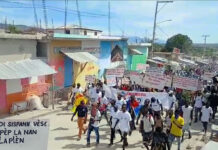
Another anti-intervention demonstration took place in the Boston neighborhood of Cité Soleil, the capital’s largest slum. Many hundreds of demonstrators took to its narrow streets with hand-painted signs in Kreyòl and Spanish saying “We say no to violence,” “We demand dialogue,” and “GSF and Task Force, We Demand Peace.” (GSF refers to the U.S.-assembled, UN-authorized Gang Suppression Force and the “Task Force” are the 200 or so mercenaries of Erik Prince’s Vectus Global who work with the Haitian National Police or PNH.)
The Boston neighborhood, one of Cité Soleil’s largest, was the home of former physics professor Andris Iscard, a founder with Cherizier of the G-9 Family and Allies, the original anti-crime armed group coalition, launched in May 2020. Iscard fatally shot himself in a firearm accident on Nov. 13, 2023, so the march also marked that three year anniversary.
Kanaran Answers Its Critics
Finally, the demonstration planned for Kanaran comes after the KAD and REDORSOP faced a backlash from Haiti’s political class after their highly spirited and successful Nov. 2 march. Attackers on radio and social media said that the organizers had been forced to organize the rally by the armed group of Jeff “Gwo Lwa” Larose.

“We appear before the press again to issue a formal denial of all the diversions some media have made to attribute the work of civil society in the Plaine du Cul-de-Sac to other groups,” said Pastor Timothée, KAD’s spokesman. “We are together public and private school directors, teachers, notables, social organizations, nurses, Vodouists, Catholic priests, and pastors… We have come to formally deny everything that has been said attributing [our demonstration] to groups that supposedly forced us to hold it. We are hundreds of leaders who have been working in this community since 2010. It is with our own hands that we work and built our homes.”
The KAD leaders also gave tours of Kanaran, showing crowded, bustling markets and children in uniforms going to school.
“I want to show you the people here in Kanaran,” said Madame Margareth, a nurse, teacher, and KAD leader. “Even though Lochard, the former magistrate of Cité Soleil, said that the Plaine is empty, that there’s no one here, that’s just a lie people are spreading.”
“Some media want to link us to other armed groups,” said Sadrack, another KAD leader, at the press conference. “That doesn’t bother us, because we are clear in our strong demands for our children, for the people of the Plaine, for our country…. I say to the traditional journalists, journalists paid by politicians, journalists in cahoots with the international community, no one forced us to take to the streets. We took to the streets because we feel our lives are in danger. Our children have trouble going to school; our wives are in danger. All the people of Croix-des-Bouquets are in difficulty… We are committed people. We have brought out thousands of people who believe in us.”
The Pro-Bukele Camp
One of the key organizers of the pro-intervention, pro-Bukele march in Port-au-Prince on Nov. 17 was Pastor Marcorel Zidor, known as Pastor Marco, a controversial Haitian evangelical leader who led a deadly confrontation in August 2023 with Larose’s armed group in Kanaran.
The demonstrators marched from Lalue to Bourdon to Musseau.
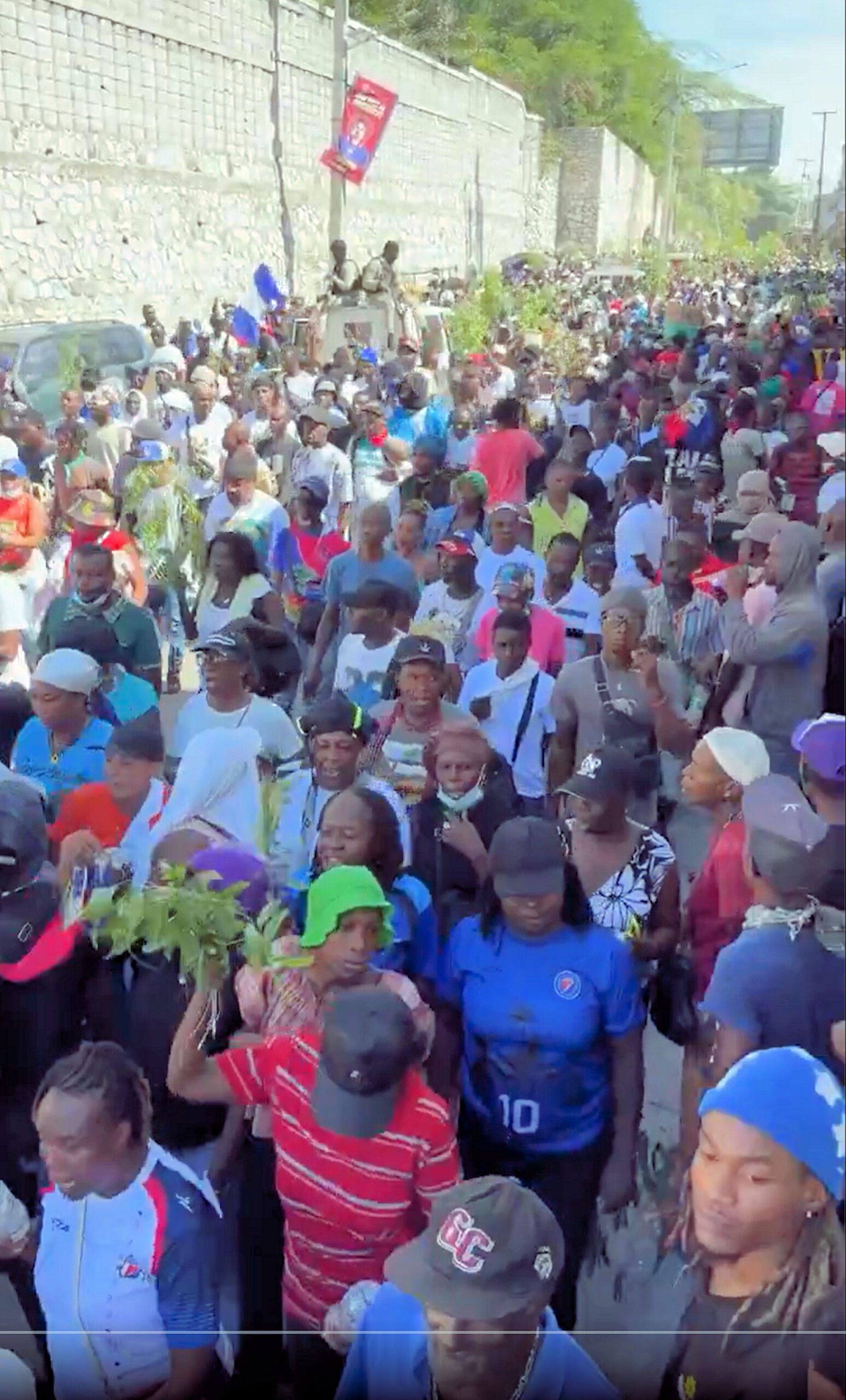
Meanwhile, on Nov. 16, there were over 10 drones exploded in the area of Village de Dieu and Grande Rue, according to the Verite Presizyon online outlet, near the national stadium where Salvadoran troops and soldiers of the Gang Suppression Force (GSF) have set up a base.
The Honeymoon Always Ends
The crowds chanting Bukele’s name in Port-au-Prince are nothing new. Foreign troops landing in Haiti have often been greeted by cheering Haitians, at least at first. But the honeymoon has always faded once the soldiers started killing people, whom they invariably labeled “gangs.”
When some 20,000 U.S. troops landed on Sep. 19, 1994 to return President Jean-Bertrand Aristide from exile, a large, enthusiastic crowd welcomed them at the Port-au-Prince wharf. After three years of a murderous military dictatorship, many Haitians saw the soldiers as liberators. Within a week, however, U.S. Marines had killed 10 Haitians in a firefight in Cap-Haïtien. The occupation went on to oversee Aristide’s return under Washington’s tutelage and the dismantling of the Haitian army, but it did little for Haiti’s poor majority. When the last U.S. troops left in early 2000, they slipped away without fanfare, leaving widespread disgust behind.
The same cycle played out a decade later. After Aristide was kidnapped by a U.S. Seal team out of Haiti on Feb. 29, 2004, U.S. Marines, French soldiers and the “rebels” of the former army moved into the capital, and thousands danced in the streets and cheered. Less than two weeks later, according to witnesses cited by the National Lawyers Guild, Marines fired upon and killed up to 10 Haitians in Bel Air, a pro-Aristide stronghold.
The UN Stabilization Mission in Haiti (MINUSTAH) took over in June 2004 and carried the war into the capital’s poorest neighborhoods. Its targets were “gang leaders” like Grenn Sonnen and Emmanuel “Dread” Wilme, whom residents saw as defenders of their communities. On Jul. 6, 2005, 1,440 Brazilian and Jordanian soldiers sealed off Cité Soleil with 41 armored personnel carriers and attacked and killed Wilme and many other people. Residents and human rights groups called it a massacre; MINUSTAH said it was fighting “gangs.” A second raid on Dec. 22, 2006 left more than 25 dead and more than 60 wounded, according to one Haitian health worker, among them infants and children.
By the time MINUSTAH left in 2017, after 13 years, its troops had also introduced cholera, which killed about 10,000 Haitians, and been implicated in widespread sexual abuse. As Haïti Liberté noted, many of Haiti’s poor majority viewed the mission as an occupying force and had called for its departure since it arrived.
Bukele’s troops are now at the start of the same cycle. The Salvadoran president has posted videos of his soldiers patrolling the streets and being greeted by locals. But his deployment was launched unilaterally and in violation of international law, with the blessing of President Donald Trump, and before any agreement defining its terms had been made public. Already, an operation backed by Salvadoran troops has left 20 dead, all described as gang members. In Croix-des-Bouquets, residents say an 8-year-old girl was among the first victims. If history is any guide, the chants of “Bukele, Bukele” will not last long.
The Lesson of Vertières
That is a lesson worth remembering on this 223rd anniversary of Vertières. On Nov. 18, 1803, Jean-Jacques Dessalines ordered his army to take the fort of Vertières outside Cap-Français, forcing Napoleon’s commander Rochambeau to capitulate and evacuate what remained of his expeditionary army. Six weeks later, on Jan. 1, 1804, Dessalines and his generals proclaimed Haiti’s independence and swore to live free or die.
The essence of Dessalines’ message in founding Haiti was that it must be a sovereign, independent, and free nation, never again dictated to or ruled over by colonialist powers. Today’s neo-colonialist powers seldom send their own soldiers. They work through proxies. Nayib Bukele and his 2,500 troops, deployed with Washington’s approval and in the service of Haiti’s de facto government, are clearly such a proxy.
Haitians may disagree about how to deal with the armed groups in Cité Soleil, Croix-des-Bouquets, and Kanaran. But the marchers in Kanaran on Nov. 18 are reminding the nation of something the cheering crowds of Nov. 17 seem to have forgotten: Haiti’s problems will be solved by Haitians, through dialogue, and not by foreign soldiers who arrive as liberators and leave as occupiers.