

(Français)
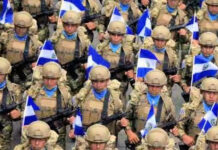
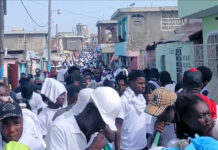
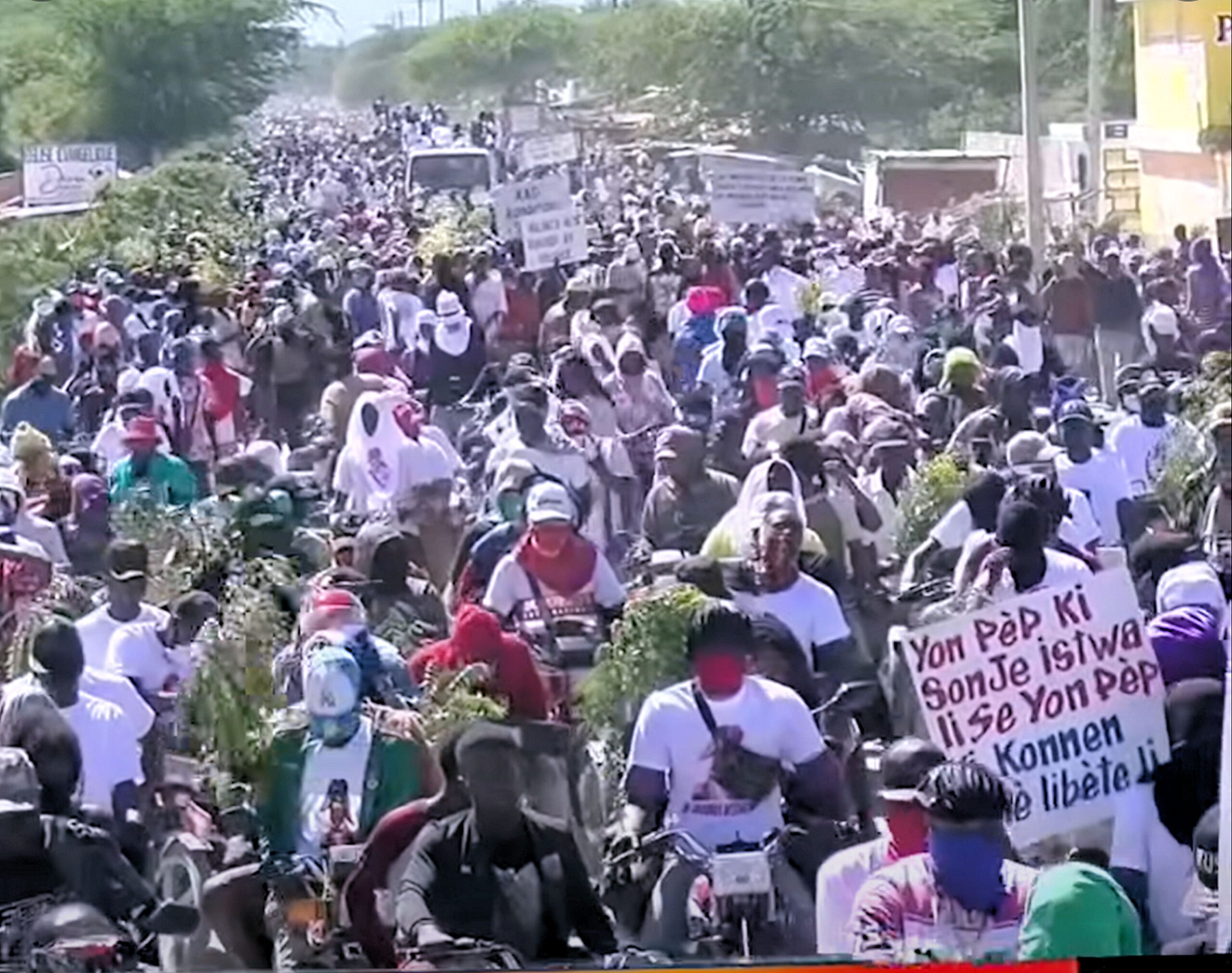
On Wed., Nov. 18, 2026, the 223rd anniversary of the Battle of Vertières, where Jean-Jacques Dessalines’s army of former slaves routed Napoleon’s expeditionary force and sealed Haiti’s independence, thousands of Haitians marched through the towns of the Cul-de-Sac Plain northeast of Port-au-Prince to remind the world, and El Salvador’s President Nayib Bukele, what that victory still means.
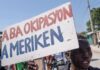
In Canaan (Kanaran in Kreyòl), Croix-des-Bouquets, Croix-des-Missions, and other communities of the plain, demonstrators waved Haitian flags, invoked Dessalines, and declared that Haiti is a sovereign nation, not a testing ground for a foreign army. They cursed Bukele and demanded that his troops leave, calling for dialogue and peace among Haitians instead of the helicopter gunships, explosive drones, and mercenary contractors that have turned the capital’s popular neighborhoods into free-fire zones.
You would not know any of this from reading the mainstream press.
The day before, on Nov. 17, a march through Port-au-Prince by Haitians cheering Bukele and his soldiers received wall-to-wall coverage, and intense promotion beforehand. The Associated Press reported that thousands of people poured into the streets of Haiti’s capital “and beyond” to praise the Salvadoran president, with some shouting for more drones and Israeli rifle-mounted robot dogs that now patrol the capital. Fox News announced that Bukele had received a “hero’s welcome from afar,” and Bukele himself tweeted back to the marchers that “God will give us victory.” That same day, Haiti’s de facto government announced it had formalized a “cooperation agreement” with El Salvador, giving a veneer of legality to a deployment that began unilaterally in October.
The Vertières marches against the occupation, by contrast, were not covered by AP, Reuters, AFP, or any other major outlet. On social media, the photos and videos that the anti-intervention marchers posted were buried under an avalanche of pro-Bukele, pro-invasion posts from bots and trolls, which cheered each new airstrike and branded anyone opposing the foreign troops as a “gang” sympathizer.
Bukele’s “Gift” for Vertières
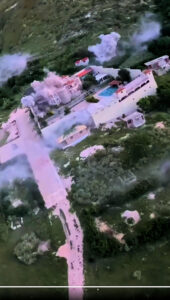
Bukele marked Vertières in his own way. That morning, he posted on X a video of Salvadoran helicopters firing rockets and heavy machine guns into the house of Jeff “Gwo Lwa” Larose, leader of the Viv Ansanm–affiliated armed group in Kanaran. In Kreyòl, he called the strike “my gift to the Haitian people on the anniversary of the Battle of Vertières.”
Larose was not inside his house during the attack, and no casualty figures have been published. In a private voice message which he sent to a friend (who asked that it not be published), Larose greeted the damage to his house with a sort of philosophic shrug, saying he was “never obsessed with material things.”
“People forget that it was only stinking mud that they left us in the ghetto,” he continued, “along with slapping the back of camionettes [Haiti’s once ubiquitous painted public transport pickups], and sleeping under pieces of tin, on corners, or in the street.”
The assault on Larose’s home came 10 days after the Nov. 8 attack that badly damaged (but did not destroy, as rumored) the house of Wilson “Lanmò Sanjou” Joseph, leader of the 400 Mawozo armed group in Croix-des-Bouquets. Since then, the combined forces of Salvadoran troops, mercenaries working for Erik Prince’s Vectus Global, the UN-authorized Gang Suppression Force (GSF), the Haitian National Police (PNH), and the Armed Forces of Haiti (FAdH) have widened their campaign to the homes and strongholds of other Viv Ansanm leaders. Their targets now include Christ-Roi “Krisla” Chéry, whose Ti Bwa group governs Fontamara and much of Martissant; Johnson “Izo” André, leader of 5 Segonn in Village de Dieu; and Renel “Ti Lapli” Destina, whose base is Grand Ravine.
Bukele has turned the destruction of these houses into a recurring show, with each strike released first as a slickly edited video on his X account, long before any independent reporter can reach the scene.
Martissant Under the Drones
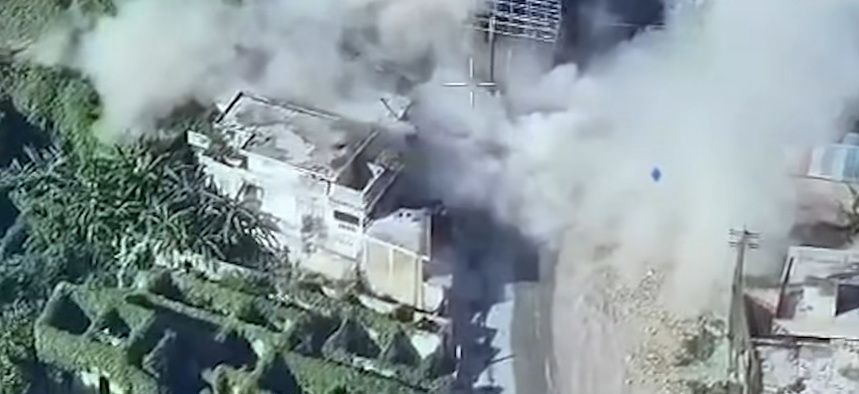
On Thu., Nov. 19, the war came to Martissant, the capital’s southern gateway, which had been a relatively calmer flank than the battle lines to the north and east. The online news agency Vérité Presizyon reported that 14 drones exploded across the area that day.
The PNH announced that, with support from the “Task Force,” the Vectus Global drone unit run out of the prime minister’s office, it had launched a vast operation in Martissant 2, 4, and 23 early that morning, killing 34 “presumed bandits”. The police said the target was a base belonging to Ti Lapli. No one has independently verified who those 34 dead were. The bombardment continued the next day in Martissant and Village de Dieu, and on Sun., Nov. 22, police and Salvadorans moved on Grande Ravine and Ti Bwa, the zones of Ti Lapli and Krisla.
Human Rights Watch has documented how such quadcopter drones are used in exactly these neighborhoods, striking people in the street, buildings, and vehicles and leaving residents afraid to leave their homes. A barrage of 14 explosions in a single day across a densely populated district is hard to reconcile with the image, broadcast daily from San Salvador and Washington, of a precise, surgical campaign against “terrorists.”
“Manufacturing the Boogie Man”
That image is no accident. Chris Martin, a former U.S. contingent commander in Haiti under the UN’s MINUSTAH mission, explains its mechanics in a Nov. 16 article on LinkedIn entitled “Perception Inversion: Weaponizing Information Operations, ‘Cut-Outs,’ and Proxy Forces to Criminalize Grassroots.”
The piece is a continuation of an analysis he published on Jul. 31, “Manufacturing the Boogie Man: The Weaponization of Information Operations, NGO Mandates, and State Cut-Outs.” In that earlier article, Martin draws on his time as a U.S. advisor with Special Operations Task Force-South in Afghanistan. He states the doctrine bluntly: “what is broadcast first is what the people are going to believe.” He recounts how, after the Taliban had beaten the Afghan police in firefights, U.S.-backed radio stations would announce the opposite, that the police had routed the Taliban, and the population accepted it.
In Haiti, Martin argues, a failing state and its foreign backers must turn the neighborhood armed groups into a “boogie man,” the single source of all the country’s misery. Doing so erases the political and social grievances (no water, no sanitation, no electricity, no schools, no medical clinics, no maintenance, no elections) that drove many of these groups to take up arms, and it justifies a military solution while foreclosing dialogue. He notes that Washington slapped a Foreign Terrorist Organization designation on Viv Ansanm just as the coalition was announcing it would become a political party in May 2025.
In his latest piece, Martin adds the other half of the equation: the foreign “savior.” Bukele and his troops, he writes, have been packaged in Western media as battle-hardened liberators, with Bukele’s domestic crackdown sold as a blueprint that can clean up Port-au-Prince in a few weeks. But viewed through a realpolitik lens, Martin concludes, “El Salvadoran forces are functioning as a direct proxy of the United States government.” Using Latin American soldiers instead of U.S. Marines lets Washington present the operation as regional solidarity while avoiding the political cost of American casualties. He predicts that, without the population’s trust, the foreign troops will be blind on the ground and stuck in an attritional stalemate that no amount of narrative spin can resolve.
The Spin Around Salvadoran Casualties
Last week offered a textbook case of the information warfare Martin describes.
On Nov. 17 or 18, three Salvadoran soldiers were wounded, according to sources in Haiti. Two of them were so gravely injured that they were medevaced to the Dominican Republic, where Dominican outlets confirmed Salvadoran soldiers were being treated at the Cedimat hospital in Santo Domingo. One of them died on Fri., Nov. 20.
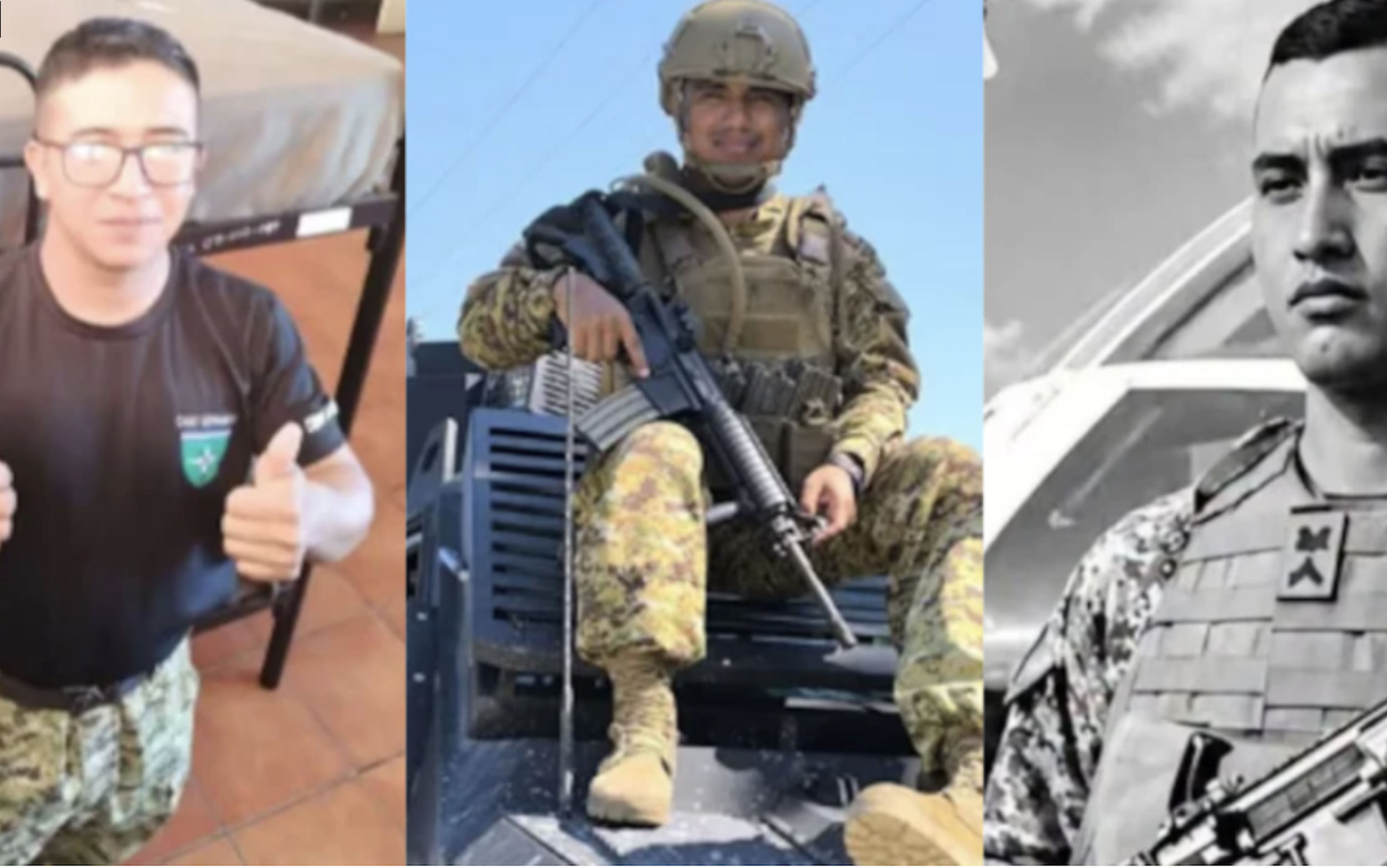
Then, the same day, two Salvadoran soldiers were killed, and at least one more wounded, during fighting near Cité Doudoune in Croix-des-Bouquets. According to Viv Ansanm sources, the Salvadorans were killed fighting soldiers of Wilson Joseph’s 400 Mawozo.
The Salvadoran authorities told a very different story. The Armed Forces of El Salvador announced on X that four soldiers had been “affected by an explosion while working with explosive material at one of the camps.” Hours later, they announced that one of the wounded had died in a Dominican hospital after the same “accidental detonation.” On Sun., Nov. 22, Bukele named the three dead, Lieutenant Cristian Daniel Palacios Santos and Corporals Emerson Alexander Zepeda Zelada and Wilber Manuel Serrano Medina. He explained that the corporals had been trying to dislodge a grenade from a drone whose battery was running out when it exploded.
Thus, separate casualty incidents became a single mishap in a camp, and combat deaths became an accident. The international press dutifully reported the “accidental explosion” as fact. One outlet went so far as to headline what the military base blast “means” for Bukele’s operation, without questioning whether there had been a blast at a base at all. Even the location was vague. The Spokesman-Review noted it was unclear whether the explosion occurred at the Sylvio Cator stadium or near the airport.
This is exactly the “first broadcast” doctrine at work. A narrative of soldiers killed in battle by the “boogie man” would puncture the image of an invincible army that, according to Bukele, is notching up victory after victory. The story of an unlucky accident preserves it.
Bukele quickly announced a $1 million fund for the families and told his troops that any who wished to go home could do so without reprisal, an unusual offer for a commander supposedly on the brink of victory. No such opt-out was offered, or even allowed, at the beginning of the operation.
Tribute to Trump
Why is El Salvador, a small, heavily indebted country, spending its own money and its soldiers’ lives in Haiti? By Bukele’s own account, El Salvador is covering 90% of the cost.
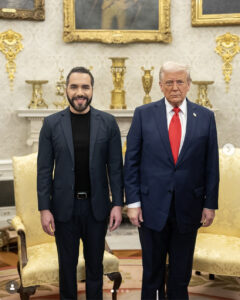
Photo: White House
The YouTube channel The Marrow offers a compelling answer in its analysis “Bukele’s Invasion of Haiti Has Nothing to Do With Gangs.” The deployment, it argues, is a form of tribute to President Donald Trump, paid so that Washington will keep extending Temporary Protected Status (TPS) for Salvadorans in the United States.
The stakes for Bukele are enormous. Some 2.5 million Salvadorans live in the U.S., and El Salvador received a record $9.99 billion in family remittances in 2025, almost all of it from the United States. That is equal to more than a quarter of the country’s GDP, making remittances El Salvador’s most important source of revenue. The government, meanwhile, is living on a $1.4 billion International Monetary Fund program that the IMF itself says was needed because of “high debt and weak external and financial buffers.”
The Salvadoran TPS designation, which shields roughly 190,000 people who have lived in the U.S. since at least 2001, was due to expire on Sep. 9, 2026, but the Trump administration has still announced no decision. Every month it stays in limbo is a month Bukele must keep Washington happy. Other countries were not so lucky. The administration terminated TPS for Haiti, covering more than 350,000 people, and for El Salvador’s immediate neighbor, Honduras.
The Ad Man’s War
None of this should be surprising given who Bukele is. Before entering politics, he spent more than a decade in advertising. He ran Obermet, his family’s marketing firm, which handled the FMLN’s presidential campaign advertising in 2004 and 2009. He has built his presidency on viral videos, slick branding, and total control of the narrative, and the war in Haiti is being run the same way: every strike is a reel, every destroyed house a “gift,” every dead Salvadoran soldier an accident.
The campaign is aimed as much at Salvadoran voters as at Haitians or Washington. On Nov. 19, the day after his Vertières “gift,” Bukele registered his candidacy for a third consecutive term in the Feb. 28, 2027 election, which constitutional changes rushed through in 2025 made possible. A foreign war of daily victories, with no combat losses admitted, makes an ideal campaign ad.
But as Chris Martin warns, the people on the ground eventually have the final say. The thousands who marched on the Cul-de-Sac Plain on Vertières Day, ignored by the press and drowned out by bots, delivered a message that Dessalines’s soldiers would have recognized: Haiti is not for sale, not for experimentation, and its problems will be solved by Haitians, through dialogue and not drones.