
Social media has long been a spring for misinformation, disinformation, and rumors, often spread by the Pentagon’s largest-in-history “secret undercover army” of 60,000 internet “trolls” increasingly augmented by AI-deployed “bots.” But the recent fountain of inaccuracies and falsehoods coming out of Haiti, even in the mainstream media, is without recent parallel.
Take for example, the Nov. 5 killing of Mathias Saintil, the leader of the armed group in the Boston neighborhood of the capital’s sprawling Cité Soleil slum. The Miami Herald said he was killed “in a drone strike,” basing its report largely on the accounts of the Haitian National Police (PNH) and the National Endowment for Democracy (NED)-funded National Human Rights Defense Network (RNDDH).
But a local eye-witness gave Haïti Liberté a very different account. Our source said that a PNH spy told the police that Mathias was in Drouillard, an area on the shanty town’s eastern edge, far from Mathias’ base. The cops had been tracking him since Nov. 1 or 2, and they’d set up an ambush for when he left Drouillard. “In front of the Aciérie [the late Gilbert Bigio’s steel works], they riddled his car with bullets,” the source continued. “He was wounded by several bullets in his gut. He was also badly wounded by bullets in both legs. Another of his security in the back [of the car] was also hit by bullets. He got out of the car and crossed the canal” into the slum.
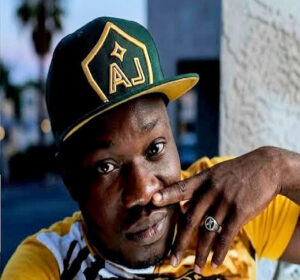
Mathias was weakening and unable to stand up, so his security took him to an “isolated place,” where they put him on a door to transport him, as his intestines were beginning to spill out. Mathias’ “soldiers were so nervous, that they started to shoot in the air. The cops in the [PNH] armored car thought that the guys were firing back at them… So they sent a drone to strike the car… [which] burst into flames.” The PNH exploded at least two other drones in other quadrants of Cité Soleil, including an area named Jacques Roumain, after the novelist who founded Haiti’s Communist Party. “His soldiers transported Mathias on the door through back alleys until they found a way to take him to a hospital,” the source concluded. “They tried to operate on him there, but he died on the operating table.”
(Asked about Mathias’ killing, Jimmy “Barbecue” Cherizier, the leader of the Viv Ansanm armed neighborhood group alliance, said that it was the result of “negligence” by Mathias, who “should not have been freely circulating” when he knew that “he was being tracked.”)
False information fuels the foreign invasion
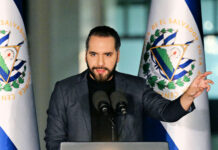
The same Herald article reports that four Salvadoran soldiers attached to the UN-authorized Gang Suppression Force (GSF) “went missing” on Oct. 18. Their “rescue” has been the excuse for El Salvador’s President Nayib Bukele to send some 2,500 Salvadoran soldiers to Haiti indefinitely. But as Haïti Liberté has reported, based on unimpeachable sources, the four Salvadorans and at least one other man were incinerated in their armored car. Bukele claims that the charred remains which the Chen Mechan (Mean Dog) armed group from Croix-des-Missions returned to the GSF were not those of his men. The GSF says it is unsure.
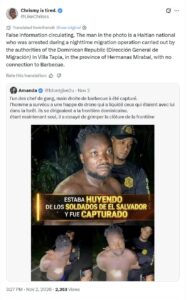
Much of the false information on social media is peddled using AI-generated or misleadingly identified photographs, such as in a tweet by Amanda (@Idontgive2u) of a shirtless Black man whom she identifies as Cherizier’s “right-hand man.” She asserts that the “man survived a drone strike that took out those who were with him in the forest. They were heading to the Dominican border. Now alone, he tried to climb the border fence with the Dominican Republic. He was spotted by the Dominican border police, who seized the offender who had removed his clothes to avoid being noticed. He was handed over to the Salvadoran commandos. He offered 3 million dollars to be released, but the commandos stated that the money there must serve to compensate the many Haitian families he had killed.”
When questioned by Haïti Liberté about the tweet, Cherizier simply replied: “I don’t know that guy. I’ve never seen him before.” But it wasn’t until over six hours later that another X account, @LikeChrisss, traced the falsely identified photograph’s origin and tweeted out the truth. However, Amanda’s original tweet had already been viewed, and possibly believed, almost 400,000 times.
In the same vein, there are many videos of celebrating Haitians being falsely presented as crowds cheering for Bukele, which prompted @JanJak_AMC to comment: “Bukele’s and Dominicans’ bots have been busy finding clips of past streets celebrations in Haiti to claim that Haitians are supporting Bukele’s mercenaries in Haiti. If there was such support, they wouldn’t need to be creating fake contents that misrepresent the context.”
AI to the rescue
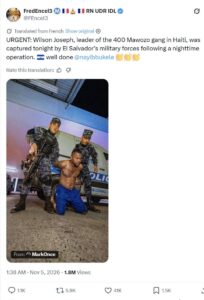
Meanwhile, photos of two Salvadoran soldiers holding a captured Joseph “Lanmò San Jou” Wilson, leader of Croix-des-Bouquets’ 400 Mawozo armed group, kneeling on the ground, the faces of the four supposedly missing Salvadoran soldiers, as well as Wilson’s completely destroyed home were all proven, or are extremely likely, to be AI-generated. (Wilson’s home had been damaged by drones and subsequently, on Nov. 9, a rocket.)
Some Haitian outlets have made up stories as well, such as Amerique.info7, which reported on Nov. 10 that a certain 400 Mawozo member “Lisifè” (Lucifer) had been lynched in Arcahaie. A short time later, Infos Partagé reported that the man has been held in Belladère since July 2025.
Most shamelessly, Bukele himself has resorted to tweeting out fake news (which he justifies as irony) when he sent out a doctored post of a fake Economist article with fabricated quotations attributed to “General Barbecue.” Viewed at press time almost 2.2 million times, many believe the tweet’s content to be true, having contacted Haïti Liberté for verification.
Five armies, one air war
Behind the smokescreen of fake news lies a very real escalation. There are now five armed forces waging war in Haiti’s poor neighborhoods. Three are foreign: the UN-authorized GSF, the drone “Task Force” run out of the Prime Minister’s office with Erik Prince’s Vectus Global mercenaries, and Bukele’s Salvadoran troops, most of whom operate outside the GSF’s command. Two are Haitian: the PNH and the resurrected Armed Forces of Haiti (FAdH). Even the Miami Herald’s Jacqueline Charles now lists all five in describing Haiti’s “crowded security landscape.”
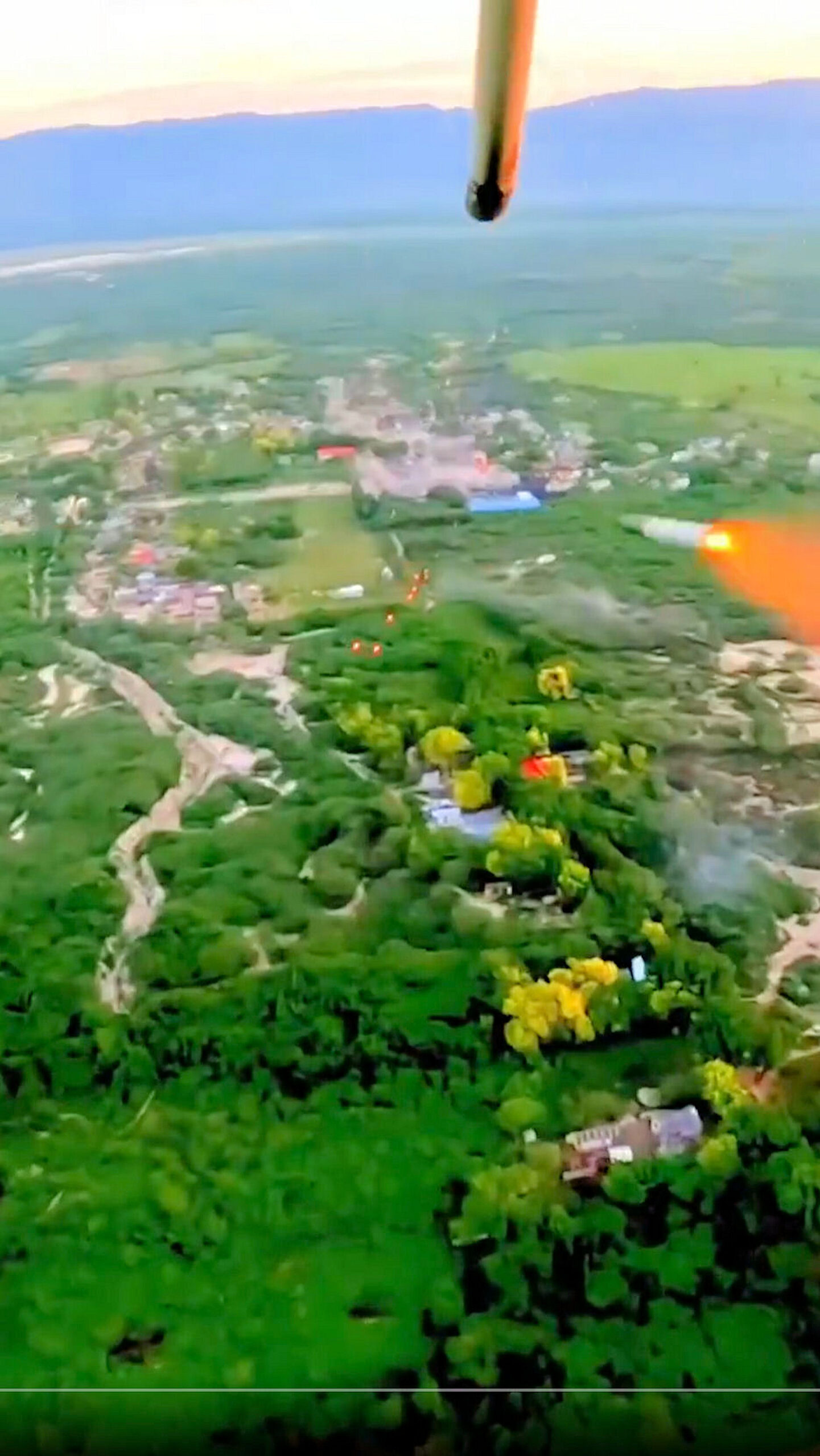
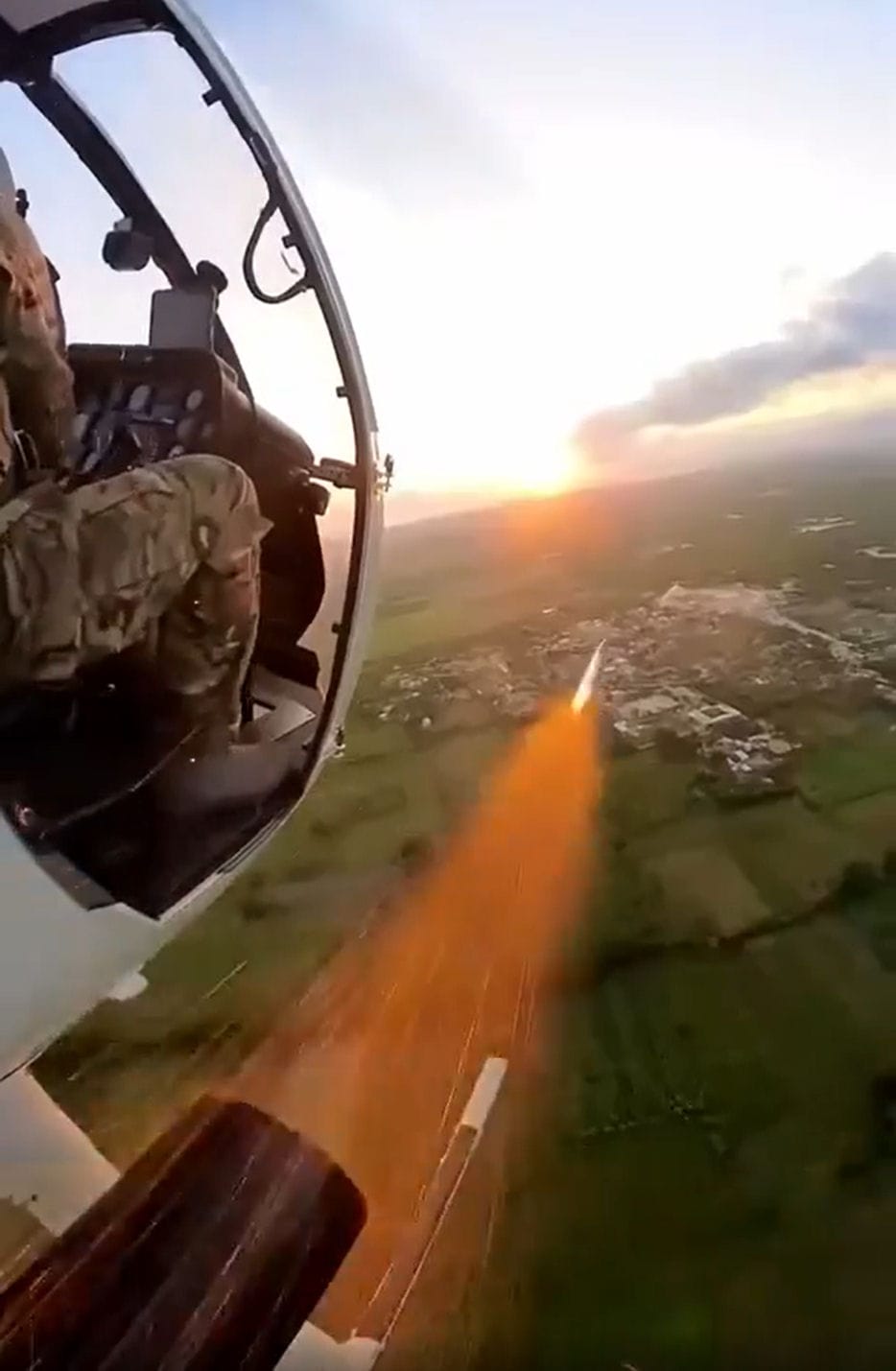
Since Bukele’s soldiers began landing on Oct. 22, all five have dramatically stepped up their assaults, primarily from the air. On Oct. 20, the GSF launched a helicopter-backed offensive in the Plaine du Cul-de-Sac. El Salvador has brought at least five MD 500E attack helicopters and two Black Hawks, according to the Dominican press. On Oct. 28, the Haitian human rights group UNA-Haiti wrote to UN Secretary General António Guterres denouncing bombardments and helicopter attacks on Croix-des-Bouquets, which both the GSF and Bukele denied. Doctors Without Borders counted 30 wounded people in its facilities between Oct. 18 and 26 alone.
On Nov. 5 and 6, at least seven kamikaze drones struck neighborhoods across the capital, including the operation in which Mathias Saintil died and civilians were also killed. Prime Minister Alix Didier Fils-Aimé celebrated on X: “One less gang leader.” Then, on Nov. 6, Bukele tweeted a dare about Lanmò San Jou’s house: “Give us the exact address, and we’ll destroy it.” Two days later, at about 2:30 a.m. on Nov. 8, explosive drones flown by the PNH Task Force and its contractors slammed into the house, while four helicopters, two of them piloted by Salvadorans, provided air cover, according to the Herald. Wilson was not home, but up to 20 people were reported killed. But the account was put in question when Bukele posted a video of helicopters circling and firing missiles during daylight hours, not the middle of the night, boasting “We destroyed the house of Lanmo San Jou and the 400 Mawozo gang’s headquarters.” The unclarity about the timing and number of strikes on Wilson’s home is just one more example of the information fog covering Haiti.
As we go to press on Nov. 10, the Whatsapp channel Verite Presizyon reports that there were three drone explosions in Martissant and five explosions in Village de Dieu.
None of this is new, just bigger. Human Rights Watch counted 141 Task Force drone operations between Mar. 1, 2025 and Jan. 21, 2026, which killed at least 1,243 people, including 17 children, and wounded 738. By October, CNN tallied more than 2,000 drone strikes since the Task Force’s creation. Vectus Global operates under a State Department export license.
“A temporary tactical band-aid”
Will bombing from the sky work where years of police raids have failed? History says no, and Chris Martin should know. A former U.S. Special Forces adviser with three combat rotations in Afghanistan, Martin was also the U.S. Contingent Commander in Haiti under the UN’s MINUSTAH mission, where he trained the PNH’s SWAT team. In a Nov. 7 LinkedIn essay, “The Aerial Counter-Asymmetric Fallacy: From the Hindu Kush to the Labyrinth of Port-au-Prince,” he calls air power against irregular forces “a temporary tactical band-aid, not a strategic solution.”
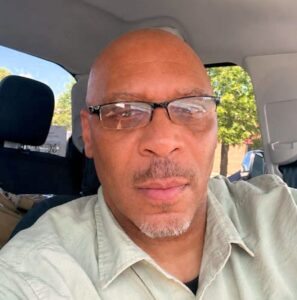
Martin begins in Afghanistan, where the “Soviet air mobilization doctrine collapsed” once the CIA handed the mujahideen “a man-portable asymmetric equalizer: the FIM-92 Stinger missile.” But high technology was never the decisive factor. “Insurgent teams did not need advanced surface-to-air missile systems to down conventional helicopters,” he writes. In dense terrain, rocket-propelled grenades do the job, and “a single hidden sniper could pin down an entire conventional platoon for hours.”
The deeper failure was political. Forces that substituted firepower for presence “fell straight into the CIVCAS Trap,” Martin explains, using the military shorthand for civilian casualties. Every dead child or flattened home ended up “turning the entire population into an active resistance pipeline.” He traces the same pattern from Afghanistan through Iraq, Mali, and Nigeria’s Lake Chad Basin.
Haiti’s armed groups, he argues, are not an invading army that can be bombed out of a fixed position. “They survived because they were organically born straight out of the neighborhoods where they were based,” Martin writes. Helicopters may own the sky, but the groups “command the physical reality of the dirt.” Meanwhile, “the local community monitors the footprint of every foreign soldier and private contractor.” His verdict on the counter-insurgency manual now being dusted off in Port-au-Prince: “The playbook is officially dead.”
Kill the man who asks, get the man who won’t
In another essay, on how resource deprivation and denied dialogue make an insurgency, Martin looks at Nigeria. In the 2000s, Mohammed Yusuf built his movement in Borno State, one of the country’s poorest, by denouncing a corrupt elite that left the population without services. His mosque in Maiduguri offered what the state did not: food, welfare, small loans, and a community.
“Mohammed Yusuf emerged from a specific, localized demand for structural justice, dignity, and basic socio-economic respect for the historically neglected Kanuri-majority population of Borno State,” Martin writes.
Nigeria’s government answered with guns. In July 2009, a clash at a police checkpoint over a motorcycle helmet law set off an uprising that left more than 1,000 dead. Troops captured Yusuf on Jul. 30 and handed him to the police, who executed him in public outside their Maiduguri headquarters. The killing was filmed.
“The conventional state apparatus celebrated the execution as a total systemic victory, operating under the bureaucratically insulated delusion that by killing Yusuf, they had permanently killed the movement,” Martin concludes.
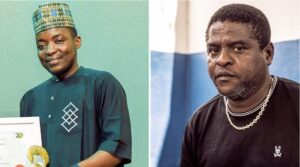
The man who replaced him, Abubakar Shekau, had no interest in services or negotiation. Under his leadership, the movement became Boko Haram as the world knows it: prison breaks, the bombing of UN headquarters in Abuja in 2011, the kidnapping of 276 schoolgirls from Chibok in 2014, and a war that has killed tens of thousands and displaced millions across the Lake Chad Basin. Killing Yusuf did not end the movement. It removed the one leader still asking for something the state could give.
Haiti’s armed groups have been asking too. Cherizier has called for years for dialogue and for an end to the misery of the slums. Last week, Wilson Joseph wrote to the UN Secretary General seeking mediation, while 400 Mawozo asked for peace talks and for his home to be protected as civilian property. Haiti’s disarmament commission replied that any dialogue must follow the government’s “roadmap.” Bukele replied with drones and helicopters.
Toussaint’s offer, Dessalines’ answer
Haitians don’t need to look to Nigeria for this lesson. They lived it first, over two centuries ago.
Toussaint Louverture, a Black freedman from Saint-Domingue, did not set out to break with France. In 1797, he sent home Léger-Félicité Sonthonax, the French commissaire civil who had proclaimed the abolition of slavery in 1793. Toussaint’s 1801 Constitution then named him governor-general for life while keeping Saint-Domingue a French colony. It was, in effect, history’s first neo-colonial proposal: a Black man from the colony would run it for France, guaranteeing its exports and its loyalty, in place of a white commissioner sent from Paris.
Napoleon Bonaparte would have none of it. In 1802, he sent his brother-in-law, General Charles Leclerc, with some 20,000 troops to retake the colony and restore slavery. On Jun. 7, 1802, Toussaint was lured to a meeting under a promise of safe conduct, arrested, and shipped to France. He died in a freezing cell at Fort de Joux in the Jura Mountains on Apr. 7, 1803.
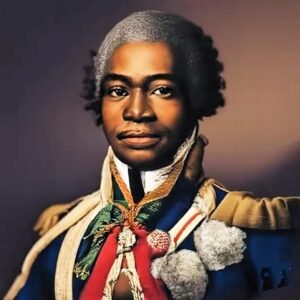
Kidnapping the moderate unleashed the revolutionary. Jean-Jacques Dessalines, Toussaint’s general, had served as an officer in the French army. Now he renounced that commission and organized a war not for autonomy within the empire but for independence. On May 18, 1803 in Arcahaie, he tore the white out of the French tricolor to create the Haitian flag. On Nov. 18, 1803, his army crushed the French at Vertières, and on Jan. 1, 1804, he declared Haiti Latin America’s first independent nation.
Napoleon got the opposite of what he wanted, just as Nigeria’s generals did. Washington, San Salvador, and their partners in Port-au-Prince should consider who might come after the leaders they are now trying to incinerate.
A fractured command, and “friendly fire”
Martin also saw the next problem coming. As Haïti Liberté reported on Oct. 28, he warned that Bukele had “bypassed the slow-moving GSF oversight frameworks to launch a parallel, unilateral rescue operation,” which “entirely fractures the unified command structure” of the UN-authorized mission. “To the population on the ground, these external units are viewed strictly as invaders,” he wrote, adding that “conventional forces only control what they can physically sit on, while local networks govern the terrain.”
Two weeks later, the fracture is now out in the open, and it runs not only between the forces in Haiti but through the U.S. government itself. On Nov. 10, Axios’ Marc Caputo argued that State Department officials have quietly fought Bukele’s operation even as President Donald Trump publicly blesses it.
According to the apparent scoop, tensions spiked after an Oct. 31 clash in which a Salvadoran convoy came under fire and the U.S. Embassy in Tabarre was struck by gunfire. On Nov. 4, U.S. Chargé d’Affaires David Howell texted Fils-Aimé that the Salvadorans were not coordinating with the GSF and had nearly killed GSF troops, asking that their operations stop “as soon as possible … until they coordinate.”
A Nov. 5 diplomatic note from the U.S. Embassy in San Salvador went further, charging that Salvadoran small-arms fire had hit the U.S. Embassy in Port-au-Prince. In other words, a “friendly fire” incident against Washington’s own diplomats.
Bukele’s government fired back with a formal note on Nov. 9, rejecting each claim and questioning Howell’s “credibility.” A source who spoke with Bukele summed up his attitude: “I checked with Trump. He said do what we have to do.” An unnamed U.S. official blamed career diplomats for resisting the President’s regional agenda.
“El Salvador’s military deployment in Haiti is exposing the divisions in Washington,” tweeted the Center for Economic and Policy Research’s Jake Johnston on Nov. 10. “Trump gave the okay to Bukele, but Rubio and the State Department are pissed.”
The friction is visible in Haiti too. Secretary of State Marco Rubio insisted to the Herald that the GSF “has to work,” because “there’s no plan B here anymore,” even as Bukele’s 2,500 troops, outnumbering the GSF’s roughly 2,000, operate under a separate bilateral deal whose terms nobody has published. Fils-Aimé has set up a “coordination cell” to synchronize the five forces, and he is due in San Salvador next week to discuss the troops’ future. Meanwhile, Amnesty International is demanding that both governments make public “the agreement governing the deployment,” and the Salvadorans are building a base next to the U.S. Embassy, suggesting they have no plans to leave.
Splintering, or smokescreen?
How should we read the Axios revelations? One possibility is that they reflect real and growing tensions, factions, dismay, and splintering inside the Trump administration as it faces intractable problems on several fronts. In Ukraine, peace talks in Abu Dhabi grind on over the Donbas. In Iran, Rubio now tells G7 ministers that Washington does not “need to conduct military strikes,” while the naval blockade and skirmishes in the Strait of Hormuz drag on. Yemen’s war is unresolved. And now Haiti, where Washington built a UN force it won’t fully fund, only to watch an ally barge in with an army of his own. Reports that Rubio himself may leave the administration to prepare a 2028 presidential run only add to the impression of a team pulling apart.
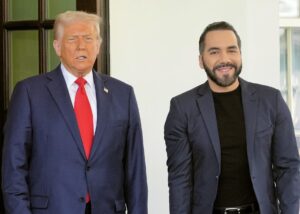
Photo: Manuel Balce Cenata/AP
But given the disinformation epidemic noted above, there is another possibility. Axios is seen by many as a pro-Trump and Zionist outlet with privileged access to the White House. A story pitting “bureaucrats” at State against a President who “blesses” Bukele could be one more way to inject disinformation and confusion into an already murky situation in Haiti. It allows Washington to distance itself from the bloodshed in Croix-des-Bouquets and Cité Soleil while dissimulating its close collaboration with Bukele: the U.S. Southern Command C-130s that ferried his troops to Haiti at the request of the State Department, which also licenses Vectus Global to fly its drones, and the President’s own green light.
Either way, the people of Haiti’s poor neighborhoods are paying the price, under drones and helicopter gunships raining down death and terror, for a war that even a U.S. Special Forces veteran says cannot be won from the air.